10 Best Practices to Maintain Quality Control in Offshore Staffing
Maintaining quality control in offshore staffing and remote staffing is essential for sustainable business growth and operational excellence. While offshore staffing offers cost efficiency, scalability, and access to global talent, quality does not happen automatically. Without structure, even highly skilled remote teams can struggle with alignment, communication gaps, and inconsistent performance.
High-performing offshore teams are built on clear standards, strong processes, and transparent communication systems. Organizations that proactively manage quality see higher productivity, stronger collaboration, and improved client satisfaction.
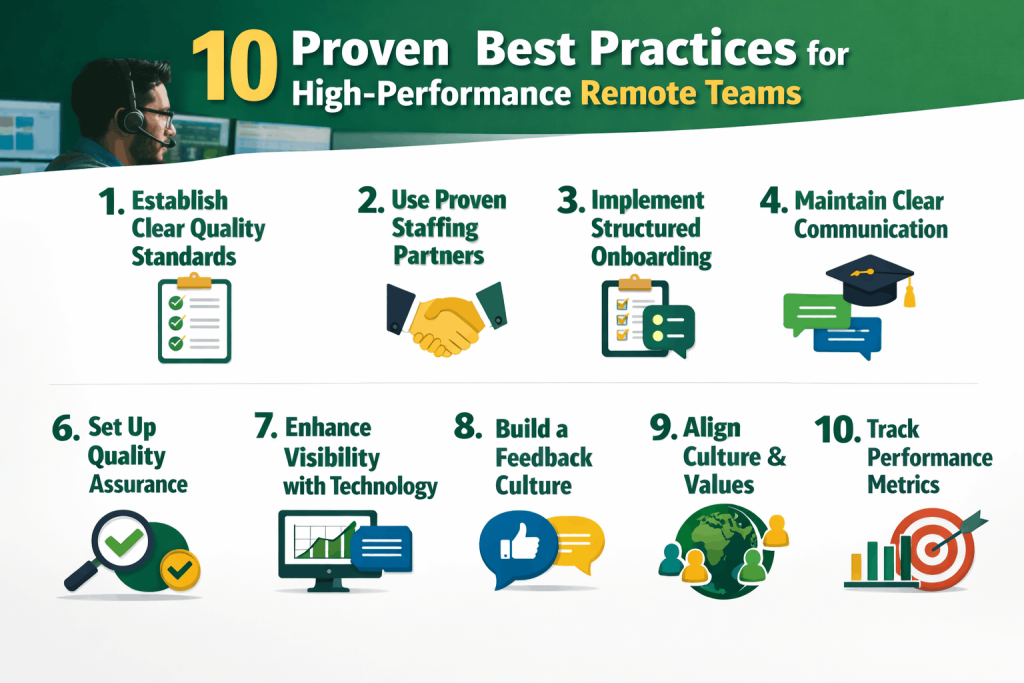
This guide outlines 10 proven best practices to help organizations maintain consistent, high-quality outcomes when working with offshore teams.
Quick Facts
- 90% of staffing clients were satisfied with the quality of candidates provided by staffing agencies in 2023.
- 70% of staffing agencies report increased demand for remote staffing solutions since 2020.
- 18% of companies offshore specifically to improve service quality.
- 62% of companies report that offshore providers met or exceeded service level agreements (SLAs).
These statistics reinforce one important reality: offshore staffing works when quality control systems are in place.
1. Establish Clear Quality Standards
What This Means
Quality standards define what “good” looks like. Without measurable expectations, offshore teams are left interpreting success on their own, which can lead to inconsistencies.
Best Practice
- Develop detailed Service Level Agreements (SLAs) and Key Performance Indicators (KPIs) for every role.
- Define expectations around deliverables, timelines, accuracy rates, responsiveness, and reporting.
- Document workflows and quality benchmarks in writing.
- Review standards during onboarding and reinforce them regularly.
Why It Matters
Clear quality standards reduce ambiguity and make performance measurable. They create accountability and provide offshore team members with a clear roadmap for success. When expectations are documented, teams can self-correct before small issues become major problems.
2. Use Proven Staffing Partners
Not all offshore staffing providers operate with the same rigor. Partner selection directly impacts quality outcomes.
Why Partner Selection Matters
Reputable offshore staffing partners implement structured candidate screening, cultural assessments, compliance management, and onboarding support. They act as quality gatekeepers before talent ever joins your team.
How to Choose the Right Partner
- Request verified case studies and references.
- Evaluate their screening process for technical and soft skills.
- Assess language proficiency and cultural alignment processes.
- Review how they manage performance tracking and replacements.
Strong staffing partners reduce hiring risk, shorten time-to-productivity, and ensure better alignment between offshore staff and your organizational goals.
3. Implement Structured Onboarding
Onboarding is one of the most overlooked factors in offshore quality control. Many organizations assume skilled professionals can “figure things out.” That assumption often leads to delays and errors.
What Structured Onboarding Should Include
- Role-specific training
- Clear explanation of KPIs and quality metrics
- Documentation access and workflow walkthroughs
- Tool setup (project management platforms, communication tools, reporting dashboards)
- Introductions to team members and leadership
Why It Works
Structured onboarding accelerates ramp-up time and reduces miscommunication. When offshore employees understand your company’s standards, processes, and expectations from day one, quality becomes embedded in their daily work habits.
4. Maintain Clear and Frequent Communication
Communication is the foundation of offshore quality. Remote teams require intentional, structured communication systems.
Best Practices for Communication
- Schedule consistent daily or weekly sync meetings.
- Use project management tools for real-time task tracking.
- Maintain centralized documentation for processes and updates.
- Set expectations for response times and availability windows.
Tools such as Slack, Microsoft Teams, Zoom, Asana, and Trello enable seamless collaboration across time zones.
Why It Matters
Frequent communication prevents small misunderstandings from escalating into costly mistakes. It also strengthens alignment between onshore leadership and offshore execution teams.
5. Build Strong Training and Development Programs
Quality control is not a one-time setup; it is a continuous process. Skills evolve, tools change, and industries advance.
Ways to Support Ongoing Development
- Technical certifications and skill refreshers
- Soft skills workshops (communication, leadership, collaboration)
- Cross-functional training
- Mentorship or buddy systems
Impact on Quality
Continuous training ensures offshore staff remain competitive and aligned with your evolving business needs. It reduces errors caused by outdated processes and builds long-term team loyalty.
Organizations that invest in professional development experience higher engagement, lower turnover, and stronger quality consistency.
6. Set Up Robust Quality Assurance and Review Cycles
Quality control requires systematic oversight. Even top-performing teams benefit from structured review processes.
Examples of QA Systems
- Weekly work audits
- Peer review mechanisms
- Quality scorecards tied to KPIs
- Monthly performance evaluations
- Client satisfaction surveys
Why Review Cycles Matter
Regular reviews catch issues early, provide opportunities for coaching, and reinforce accountability. They also create data points that leadership can use to refine processes and optimize performance.
Proactive quality assurance reduces costly rework and builds confidence among stakeholders.
7. Use Technology to Enhance Visibility
Visibility is one of the biggest challenges in offshore staffing. Leaders must be able to see progress, performance metrics, and bottlenecks in real time.
Recommended Tools
- Project Management: Asana, Trello, Monday.com
- Communication: Slack, Microsoft Teams, Zoom
- Performance Tracking: Automated dashboards, KPI reporting tools
- Time and productivity tracking systems
Why Technology Matters
Technology eliminates guesswork. Real-time dashboards provide transparency into project status, workload distribution, and quality metrics. Leaders can identify performance trends early and intervene before issues escalate.
Data-driven visibility increases accountability and ensures projects stay on track.
8. Build a Feedback Culture
Quality thrives in environments where feedback flows both ways.
Effective Feedback Strategies
- Regular one-on-one meetings
- 360-degree feedback systems
- Peer review discussions
- Recognition programs for high performance
Benefits of a Feedback Culture
Constructive feedback accelerates improvement, strengthens morale, and increases engagement. Offshore team members who feel heard and supported are more likely to take ownership of their work and strive for excellence.
Recognition is equally important. Celebrating wins reinforces positive behavior and sets benchmarks for others.
9. Align Teams with Shared Culture and Values
Cultural alignment plays a major role in maintaining quality. When offshore teams understand your company’s mission and values, they work with greater purpose and accountability.
Actionable Ways to Build Culture Alignment
- Virtual team-building activities
- Shared goal-setting sessions
- Cross-location collaboration projects
- Company-wide recognition events
- Occasional in-person meetups when feasible
Why Culture Impacts Quality
Cultural alignment reduces misunderstandings, improves communication styles, and builds trust across distributed teams. When offshore staff feel integrated rather than isolated, performance improves naturally.
10. Track Performance Metrics and Continuously Adjust
You cannot improve what you do not measure. Data-driven performance tracking is essential for long-term offshore quality control.
Key Metrics to Monitor
- Accuracy rate of deliverables
- On-time task completion percentage
- Client satisfaction scores
- Rework frequency
- Communication responsiveness
- Error resolution time
Continuous Improvement
Review metrics regularly and identify trends. If accuracy drops or turnaround times increase, investigate root causes and implement corrective measures.
Data should guide decision-making, not assumptions.
Case Study: Improving Offshore Quality Through Structure
Background
A mid-size technology company faced inconsistent offshore development outcomes. The issues stemmed from unclear KPIs, inconsistent communication, and lack of structured QA processes.
Solution
The company implemented:
- Clearly defined KPIs tied to project milestones
- Daily stand-up meetings
- Weekly quality audits
- Transparent performance dashboards
Results Within Six Months
- Delivery accuracy improved by over 30%
- Communication efficiency increased significantly
- Error resolution time decreased by 25%
- Stakeholder satisfaction scores improved
This case illustrates a powerful truth: clarity and structure directly improve offshore staffing quality.
Why Quality Control Matters in Offshore and Remote Staffing
Offshore staffing has evolved from a cost-saving tactic into a strategic growth model. With 70% of staffing firms now offering remote onboarding processes and reporting productivity gains, businesses must prioritize structured quality systems.
Strong quality control ensures organizations:
- Consistently meet deliverables
- Reduce errors and rework
- Improve client satisfaction
- Enhance global collaboration
- Strengthen performance reliability
- Protect brand reputation
Companies that invest in structured offshore quality control gain a competitive advantage in fast-changing markets.
Conclusion
Quality control in offshore staffing and remote staffing is built on three core pillars: people, process, and platforms. By establishing clear performance standards, partnering with reputable staffing providers, implementing structured onboarding programs, maintaining strong communication channels, investing in continuous training, conducting regular quality assurance reviews, leveraging technology for visibility, encouraging consistent feedback, aligning teams around shared culture and values, and tracking meaningful performance metrics, organizations can develop offshore teams that consistently deliver exceptional results.
Offshore staffing is no longer just about reducing costs; it has evolved into a strategic approach that enables scalability, strengthens global collaboration, and drives high-performance execution.
If you are looking to scale high-quality offshore teams or build customized remote staffing solutions, contact Neuhire today to receive expert support or download our free guide on effective offshore staffing strategies.

Marketing professional with a passion for people, creativity, and growth. I love turning ideas into campaigns that connect and inspire. Currently part of the Neuhire team, helping businesses find the right talent fast.

Marketing professional with a passion for people, creativity, and growth. I love turning ideas into campaigns that connect and inspire. Currently part of the Neuhire team, helping businesses find the right talent fast.