
Offshore IT Staffing for Digital Transformation: A Strategic Guide for 2026
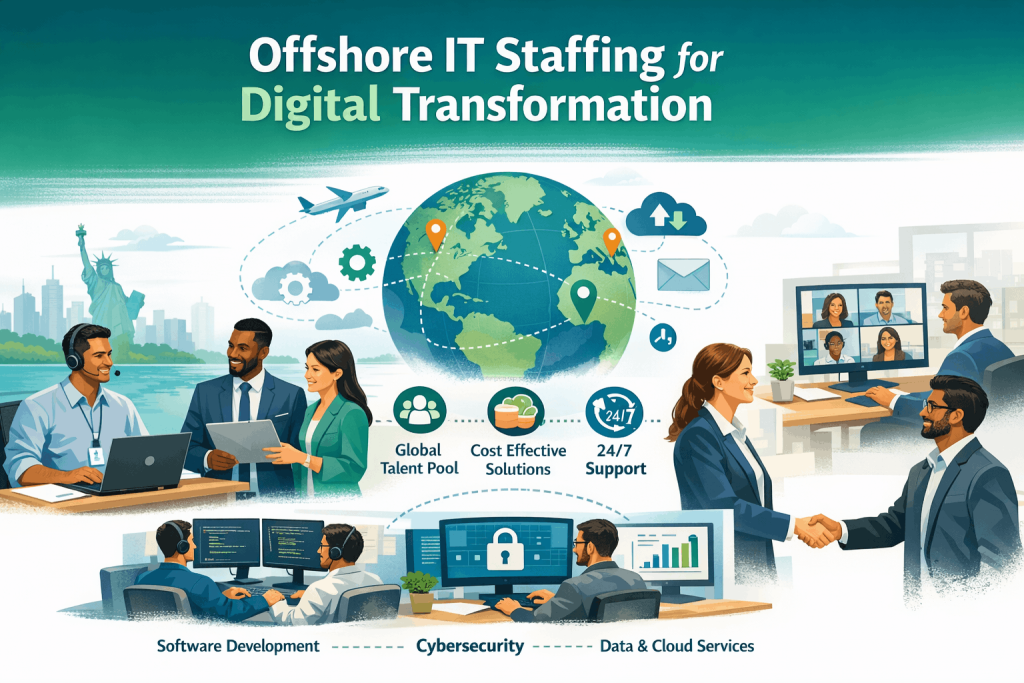
The rapid acceleration of digital transformation has made specialized tech talent a scarce commodity. Organizations are increasingly turning to offshore IT staffing to bridge critical skill gaps in AI, cloud computing, and cybersecurity. By leveraging global talent pools, businesses can reduce operational costs by up to 70% while accelerating product delivery timelines. This strategic approach allows companies to remain agile in a competitive market by transforming staffing from a back-office function into a primary driver of digital innovation.
Why is offshore staffing essential for digital transformation?
Offshore staffing is the practice of hiring skilled IT professionals or entire development teams from foreign countries to execute digital initiatives. It is essential because it provides immediate access to specialized expertise such as Generative AI and DevOps that may be unavailable or prohibitively expensive in local markets. This model enables 24/7 development cycles and significant cost redirection toward core innovation.
Key Statistics: The State of Offshore Staffing in 2026
The reliance on remote and offshore talent is no longer a temporary trend but a foundational business strategy. Recent data highlights the scale and impact of this shift:
- Global Market Growth: The offshore software development market is projected to reach $204.32 billion in 2026, growing at a compound annual growth rate (CAGR) of 14.6%.
- Operational Efficiency: Approximately 50% of organizations achieved over 20% in savings through Global Business Services (GBS) models that utilize offshore centers.
- The Talent Crisis: By 2026, it is estimated that 90% of organizations worldwide will be affected by the IT skills crisis, potentially resulting in $5.5 trillion in losses due to product delays and lost business.
- Global business service models that integrate flexible remote and offshore talent see up to 50% higher productivity and significantly lower employee stress levels.
- Sector Demand: The Banking, Financial Services, and Insurance (BFSI) sector remained the largest adopter of IT staffing in 2025, holding a 24.15% market share.
Strategic Benefits of Offshore IT Staffing for Digital Initiatives
Digital transformation is not a one-time project but a continuous evolution. Remote staffing through offshore partners provides the structural flexibility required to sustain this momentum.
1. Rapid Scalability and Flexibility
Modern enterprises must pivot quickly. Whether you are launching a new fintech app or migrating legacy systems to the cloud, offshore staffing allows you to scale your team up or down within 2 to 4 weeks. This prevents the hiring lag that often stalls major digital projects.
2. Access to Niche Technical Expertise
Local markets often suffer from a saturation of generalist developers but a vacuum of specialists. Offshore hubs in India, Eastern Europe, and Latin America have invested heavily in reskilling. According to Mordor Intelligence (2026), generative AI roles are forecast to grow at an 11.75% CAGR, a demand that offshore providers are meeting more rapidly than domestic markets.
3. Continuous Follow the Sun Development
By utilizing time zone differences, companies can establish a 24-hour development cycle. An onshore team can hand off tasks at the end of their day to an offshore team who then provides updates by the following morning. This reduces time-to-market by an estimated 25% to 30%.
4. Reduced Total Cost of Ownership (TCO)
Beyond hourly wages, offshore hiring eliminates the overhead of office space, hardware, and localized benefits packages. These invisible savings allow mid-market firms to compete with the digital budgets of enterprise-level giants.
Quick Facts: Offshore Staffing at a Glance
| Feature | In-House Staffing | Offshore IT Staffing |
|---|---|---|
| Time-to-Hire | 3 to 6 Months | 2 to 4 Weeks |
| Cost Basis | Fixed (Salaries + Benefits) | Variable (Project-based) |
| Talent Pool | Local / Regional | Global / Unlimited |
| Availability | Standard Business Hours | 24/7 (Follow-the-Sun) |
| Focus | Core Business Strategy | Technical Execution |
Emerging Hubs: Where to Hire in 2026
While India and Poland remain dominant players, new regions have emerged as high-value destinations for offshore staffing.
- Mexico: Now ranked among the top three preferred locations for Global Business Services due to talent availability and proximity to the U.S
- Portugal: Has officially entered the top 10 preferred global delivery countries, offering a bridge between European compliance and competitive costs.
- The Philippines: Remains the leader for cost reduction in software development, with potential savings of up to 77% compared to U.S. salaries.
The Role of AI in Offshore Staffing Models
In 2026, the offshore model has shifted from “more people” to “more capability.” AI is no longer just a tool but a foundational element of how these teams operate.
1. AI-Augmented Development
Offshore teams now use AI agents to automate routine tasks such as unit testing, documentation, and code refactoring. This allows human engineers to focus on high-level architecture and complex problem-solving. Gartner predicts that 40% of enterprise applications will integrate task-specific AI agents by the end of 2026.
2. Managing the AI Skills Gap
The shortage of AI talent is a primary driver for offshore hiring. With 33.9% of tech professionals reporting a shortage in AI security skills, organizations are turning to specialized offshore partners who have already trained their workforces in these niche domains.
Overcoming Challenges in Remote Staffing
While the benefits are substantial, managing a global workforce requires intentionality. Success in digital transformation through offshoring depends on addressing three primary pillars: communication, culture, and security.
1. Effective Communication and Governance
Misalignment is a primary risk in remote work. Top-tier offshore partners now utilize project management tools that integrate real-time oversight and audit trails. Deloitte (2025) reports that 55% of organizations with a global leader for their service centers achieved significantly higher savings through unified governance.
2. Data Security and Compliance
Handing over proprietary code or sensitive customer data to an offshore team requires rigorous vetting. Ensure your partner adheres to:
- ISO 27001 / SOC 2 certifications.
- GDPR or HIPAA compliance for regional data protection.
- Strong Non-Disclosure Agreements (NDAs) and intellectual property (IP) protections.
3. Cultural Integration
Successful offshore staffing is moving away from blind delegation toward strategic partnership. This involves treating offshore developers as an extension of the internal team. Effective leaders include them in daily stand-ups and foster a shared understanding of the brand mission.
Case Study: Digital Transformation in Action
Consider a global financial services firm that needed to modernize its legacy banking platform. By partnering with an offshore team in India and Poland, the firm was able to:
- Reduce Project Costs: Saved $4.2 million in labor costs over 18 months.
- Accelerate Deployment: Achieved bi-weekly release cycles by utilizing a 24-hour development loop.
- Bridge Skill Gaps: Integrated 15 specialized blockchain and AI engineers that were unavailable in their local market.
The result was a 40% increase in mobile app engagement and a significantly more resilient technical infrastructure.
Key Takeaways for Business Leaders
- Prioritize Value Over Cost: While saving money is a benefit, the primary goal should be accessing high-quality talent that accelerates innovation.
- Focus on AI Readiness: Seek offshore partners who are already integrating AI-driven threat detection and automated code reviews.
- Stay Agile: Use staff augmentation to fill specific gaps like a DevOps engineer for 6 months rather than committing to permanent overhead.
- Ensure Security First: Only work with vendors who provide documented proof of security protocols and compliance.
- Adopt Hybrid Models: Combine offshore cost-efficiency with nearshore agility to balance communication and budget.
Conclusion
Offshore IT staffing has evolved from a simple cost-saving tactic into a sophisticated engine for digital transformation. By 2026, the ability to integrate global talent will separate market leaders from those struggling with the domestic skills gap. By leveraging the scalability, niche expertise, and cost-efficiency of remote staffing, your organization can execute complex digital initiatives with speed and precision.
Ready to accelerate your digital journey? Contact Neuhire today to discover how our premium offshore and remote staffing solutions can provide the specialized talent your business needs to thrive in the digital age.
Would you like me to create a specific roadmap for transitioning your current IT project to a hybrid offshore model?