Global Capability Center vs Offshore Staffing: Should You Build a GCC in India or Partner?
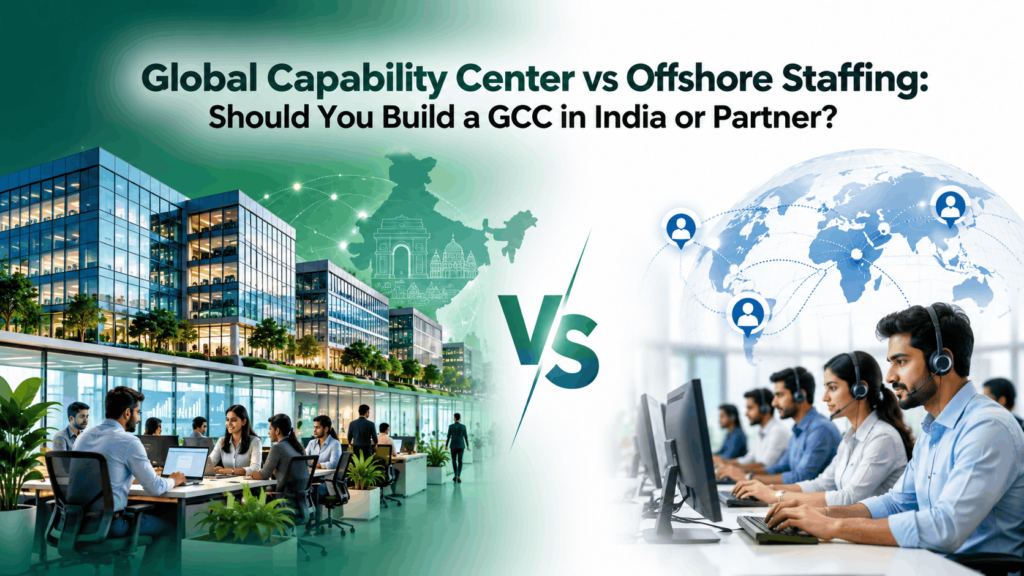
Global capability center vs offshore staffing is defined as the choice between building your own captive subsidiary in India and hiring dedicated Indian professionals through a staffing partner. A GCC gives full ownership and control but needs a legal entity, capital and 6 to 12 months to launch. An offshore staffing partner delivers vetted talent in weeks with no entity.
Key Takeaways
- In the global capability center vs offshore staffing decision, a GCC is a captive offshore subsidiary that a company owns, staffs and runs in a country such as India.
- An offshore staffing partner employs, pays and manages compliance for dedicated Indian professionals who work full time inside your team.
- A GCC usually makes financial sense once a company plans to sustain roughly 100 or more roles in India for five years or longer.
- The build operate transfer (BOT) model lets a partner build and run a center first, then hand ownership to the client later.
- Mid-size companies can get GCC-style benefits, such as dedicated talent, IP control and lower costs, by starting with offshore staffing.
What Is a Global Capability Center (GCC) in India?
A Global Capability Center in India is defined as an offshore unit that a foreign company owns and operates directly, usually as an Indian private limited subsidiary. It runs technology, analytics, finance, HR or customer operations for the parent company, with its own leadership, payroll, office and compliance obligations under Indian law.
GCCs were once called captive centers or offshore development centers. Early centers handled back-office work, while today companies such as Walmart, Target, Lowe’s and JPMorgan Chase run product engineering, AI and cybersecurity teams from Bengaluru, Hyderabad, Chennai and Pune.
Why are so many GCCs being set up in India?
India combines a deep STEM talent pool, mature real estate and supportive state policies. According to the Press Information Bureau of India (2025), GCC revenue in India rose from $40.4 billion in FY19 to $64.6 billion in FY24.
The model is also spreading beyond the Fortune 500. According to Zinnov (2026), 480+ mid-market GCCs employing over 210,000 professionals now make up 27% of India’s GCC landscape. That growth explains why the mid-market GCC has become a common boardroom question in 2026.
Global Capability Center vs Offshore Staffing: Cost, Speed and Control
The difference between a global capability center vs offshore staffing partner is ownership. A GCC means you own the entity, carry setup costs and manage Indian compliance yourself. Offshore staffing means a partner employs the talent and handles payroll, benefits and compliance, while each professional works only on your projects under your direction.
The table below compares global capability center vs offshore staffing across seven practical factors.
| Factor | Global Capability Center | Offshore Staffing Partner |
|---|---|---|
| Legal entity in India | Required (subsidiary) | Not required |
| Upfront investment | High: entity, office, leadership, HR | Low: monthly fee per professional |
| Time to first hire | Typically 6 to 12 months | Typically 2 to 4 weeks |
| Control over team | Full, including culture and processes | Daily work control; partner runs HR |
| Compliance burden | Yours: labour codes, tax, payroll | Handled by the partner |
| Best team size | Roughly 100+ roles | 1 to 50 roles |
| Exit flexibility | Slow and costly to close | Scale up or down with notice |
How does a GCC compare with an offshore staffing partner on cost?
On cost, global capability center vs offshore staffing comparisons depend on scale. A GCC has the lowest cost per head only at scale, because fixed costs such as an India leadership team, legal, finance, HR, facilities and IT security are spread across hundreds of employees. Below that scale, those overheads push the effective cost per role close to, or above, a staffing partner’s fee.
Captive and shared models do deliver savings when they are large enough. According to Deloitte (2025), approximately 50% of responding organizations achieved over 20% savings from their global business services centers. Offshore staffing in India often delivers 60% to 80% savings per role versus US salaries, because the client pays only for productive talent.
How fast can each model start delivering?
Speed is the clearest global capability center vs offshore staffing gap. A new GCC must register an entity, lease space, hire a center head and build HR before the first engineer starts. An offshore staffing partner with a pre-vetted bench can present shortlisted candidates in days. Speed matters because talent gaps are widening. According to Robert Half (2026), only 6% of US hiring managers said they have the talent they need to complete high-priority projects.
What Is the Build Operate Transfer Model for a GCC in India?
The build operate transfer model is defined as a hybrid GCC approach where a partner builds the India center, operates it under its own entity for a set period, usually two to four years, and then transfers the employees, assets and operations to the client’s own subsidiary at a pre-agreed price.
BOT reduces launch risk because the partner already has recruiters, offices and compliance processes. It suits companies that know they want ownership eventually but want proof of performance first. Here are the four stages of a typical BOT engagement:
- Build: the partner recruits the team, sets up facilities and connects to your tools.
- Operate: the partner runs payroll, HR and compliance while the team delivers your work.
- Prepare: you register an Indian entity and agree transfer terms for employees and assets.
- Transfer: employees and operations move to your subsidiary, often with the partner advising afterward.
Partners such as VIVA USA run managed global capability centers in Chennai, Coimbatore and Bangalore so a company can use a dedicated India center before committing to its own entity.
When Does a Global Capability Center Make Sense vs Offshore Staffing?
A Global Capability Center makes sense when a company needs a large, permanent India workforce, wants full IP ownership, and can fund setup costs. In a global capability center vs offshore staffing review, staffing makes more sense when a company needs fewer than 50 specialists, wants results within a month, or is still testing the India model.
At what team size does a GCC make sense?
Most advisors place the break-even point between 50 and 150 full-time roles, with 100 roles a practical rule of thumb. Below that size, overhead roles such as a center head, HR manager, finance controller and facilities staff consume too much of the budget. Use this checklist before you build a GCC in India:
- You plan to sustain 100 or more roles in India for at least five years.
- You have executive sponsorship and a budget for entity setup and leadership hiring.
- The work is core to your product, data or IP and benefits from a permanent team.
- You can manage Indian labour codes, transfer pricing and tax filings.
How can mid-size companies get GCC-style benefits without building one?
Mid-size companies can get dedicated, full-time Indian talent, IP assignment and 60% to 80% savings through an offshore staffing partner. The professionals work your hours, use your tools and report to your managers, which mirrors a GCC team without the entity. Our guide to staff augmentation vs managed services vs dedicated offshore teams explains each engagement model in detail.
If you only need compliant payroll for people you already found, read our comparison of employer of record vs staffing agency in India. Companies that later outgrow staffing can move to a managed center such as Savvysoft’s agile offshore pods in Chennai, Bangalore and Coimbatore, which run within client systems and governance.
How Neuhire Supports Offshore Staffing as a GCC Alternative
Neuhire supports companies weighing a global capability center vs offshore staffing by placing pre-vetted, full-time professionals from India in about two weeks. Neuhire handles sourcing, payroll, benefits and compliance, while your managers direct daily work, so you get a dedicated India team without registering an entity.
Mini case study: a large university in Maryland needed a senior data engineer for AI and BI work but could not justify building an India center for a single role. Neuhire placed a 10-year data engineer from India at $35 per hour, delivering 78% cost savings and over $232,800 in annual staffing savings. The university gained GCC-level talent with none of the setup risk.
Many US startups follow the same path, as our article on why US startups are choosing India for innovation hubs shows. They start with 5 to 20 offshore professionals, prove the model, and only consider a GCC or BOT once headcount and strategy justify ownership.
Conclusion: Choosing Between a Global Capability Center and Offshore Staffing
The global capability center vs offshore staffing decision comes down to scale, speed and ownership. A GCC suits companies committing to 100 or more long-term India roles. BOT offers a phased route to ownership. Offshore staffing delivers dedicated Indian talent in weeks for teams of 1 to 50. Contact Neuhire to build your offshore staffing or remote staffing team in India today.
Help Center
Frequently asked questions: Global Capability Center vs Offshore Staffing
A Global Capability Center in India is an offshore subsidiary that a foreign company owns and runs directly. It handles technology, analytics, finance, HR or operations for the parent company, with its own Indian entity, leadership team, payroll and office. GCCs were previously called captive centers or offshore development centers.
The difference is ownership. A GCC is your own Indian subsidiary, so you carry setup costs, leadership hiring and compliance. Offshore staffing means a partner such as Neuhire employs the professionals and handles payroll and compliance, while the talent works full time on your projects under your direction.
Setting up a GCC in India requires spending on entity registration, office space, IT security, a center head, HR and finance staff before productive hiring begins. These fixed costs only pay off at scale, which is why most advisors suggest a GCC once a company plans roughly 100 or more long-term roles in India.
A new GCC in India typically takes 6 to 12 months from entity registration to a working team, because the company must incorporate, lease space, hire leadership and build HR processes first. An offshore staffing partner with a pre-vetted talent pool can place dedicated professionals in roughly 2 to 4 weeks.
The build operate transfer (BOT) model is a hybrid approach where a partner builds an India center, operates it under its own entity for two to four years, and then transfers employees, assets and operations to the client's subsidiary at a pre-agreed price. It lowers launch risk for companies that want eventual ownership.
A GCC usually makes sense once a company plans to sustain about 100 or more full-time roles in India for five years or longer. Below that size, overhead roles such as a center head, HR manager and finance team tip any global capability center vs offshore staffing analysis toward staffing.
A mid-market GCC is a captive India center set up by a company with mid-size revenue rather than a Fortune 500 enterprise. According to Zinnov, 480+ mid-market GCCs employ over 210,000 professionals and make up 27% of India's GCC landscape, showing that smaller firms are adopting the model.
An offshore development center (ODC) is a dedicated software team in another country, run either by the client or by a vendor. A GCC is broader: it is a company-owned subsidiary that can host engineering, analytics, finance and operations. Many vendor-run ODCs work like offshore staffing teams rather than owned GCCs.
Mid-size companies can hire dedicated, full-time Indian professionals through an offshore staffing partner such as Neuhire. The team works your hours, uses your tools and assigns IP to you, delivering GCC-style control and 60% to 80% savings per role without registering an Indian entity or funding a multi-year setup.
Yes. Many companies start with an offshore staffing partner to prove the India model with 5 to 50 professionals, then move to a build operate transfer or captive GCC once headcount passes about 100 roles. Planning transfer terms and IP assignment in the staffing contract early makes that transition smoother.

Marketing professional with a passion for people, creativity, and growth. I love turning ideas into campaigns that connect and inspire. Currently part of the Neuhire team, helping businesses find the right talent fast.

Marketing professional with a passion for people, creativity, and growth. I love turning ideas into campaigns that connect and inspire. Currently part of the Neuhire team, helping businesses find the right talent fast.