
Staff Augmentation vs Managed Services vs Dedicated Offshore Team: Which Model Fits?
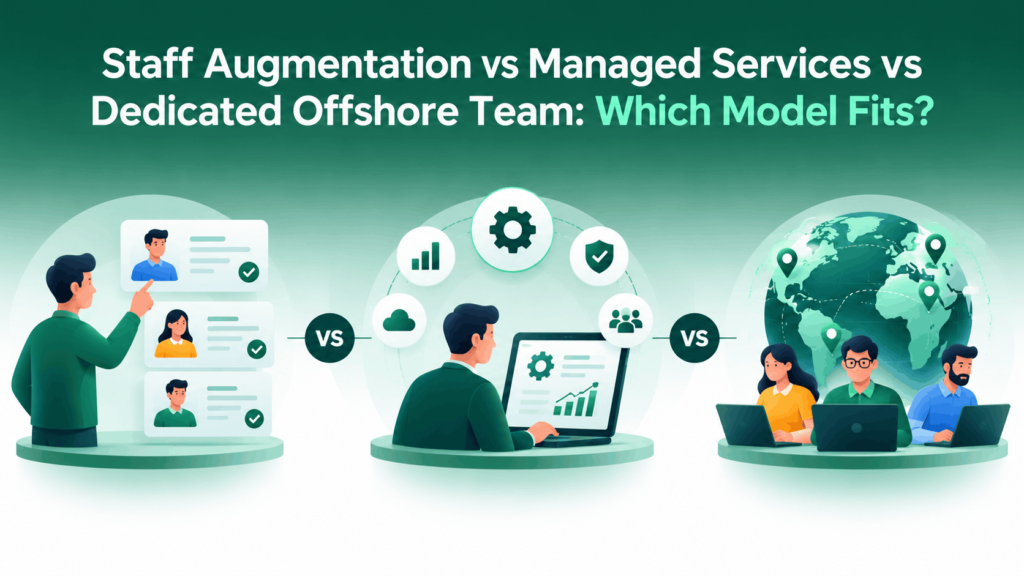
Staff augmentation vs managed services is defined as the choice between adding external professionals who work under your own managers and outsourcing an entire function to a provider that owns the outcome. A dedicated offshore team sits between them: full-time remote staff who work only for you, managed by you, with the partner handling hiring, payroll and HR.
Key Takeaways
- Staff augmentation adds individual specialists to your team, and you direct their daily work.
- Managed services transfer responsibility for a defined function, such as IT support or security monitoring, to a provider that is paid against service level agreements (SLAs).
- A dedicated offshore team gives you long-term, full-time professionals in a country like India who work only on your projects.
- Staff augmentation is usually billed hourly or monthly per person, while managed services are billed as a fixed monthly fee per scope.
- Companies can switch models later, and a 90-day knowledge transfer plan makes the move far less risky.
Staff Augmentation vs Managed Services vs Dedicated Offshore Team: Key Differences
The difference between staff augmentation vs managed services is who owns the result. With staff augmentation, you manage the people and own delivery. With managed services, the provider manages its own people and owns delivery against SLAs. A dedicated offshore team gives you direct control over full-time remote staff without building a foreign entity.
The comparison table below shows how the three staffing engagement models differ on the factors buyers ask about most.
| Factor | Staff Augmentation | Managed Services | Dedicated Offshore Team |
|---|---|---|---|
| Who directs daily work | Your managers | The provider | Your managers |
| Who owns outcomes | You | The provider, via SLAs | You |
| Typical pricing | Hourly or monthly rate per person | Fixed monthly fee per scope | Monthly rate per full-time person |
| Typical length | 3 to 12 months | 1 to 3 year contracts | 12 months or longer |
| Knowledge retention | Moderate | Stays with the provider | High, stays with your team |
| Best for | Skill gaps and project peaks | Stable, repeatable functions | Long-term scaling at lower cost |
What is the difference between staff augmentation, managed services and a dedicated team?
Staff augmentation is the temporary extension of your team with outside talent, such as a React developer or a Salesforce administrator. Managed services is an outcome contract, such as a managed security operations center or 24/7 help desk. A dedicated offshore team is a stable group of remote employees, often in Bengaluru, Pune or Hyderabad, who work as part of your company. Some providers call the middle ground a co-sourcing model or offshore staff leasing.
Who Controls the Work in Staff Augmentation vs Managed Services?
In staff augmentation, your company controls tasks, priorities, tools and code reviews, while the staffing partner controls employment, payroll and compliance. In managed services, the provider controls the people, the process and the tooling, and you control only the scope and the SLA targets. A dedicated offshore team follows the staff augmentation control pattern.
Who controls the people, the process and the outcomes in each model?
- People: In offshore staff augmentation and dedicated teams, you interview and approve every hire. In managed services, the provider staffs the account and can rotate people without asking.
- Process: Augmented staff follow your Jira boards, sprint rituals and Slack channels. Managed service providers use their own ITIL processes and ticketing tools such as ServiceNow.
- Outcomes: With augmentation, quality depends on your management. With managed services, the provider pays service credits when it misses SLA targets.
Control matters more in 2026 because skills are scarce. According to Robert Half (2026), only 6% of U.S. hiring managers say they have the talent needed to complete high-priority projects. Teams that keep direct control over specialists can redirect them to those priority projects quickly.
Staff Augmentation vs Managed Services Pricing and Contracts
Staff augmentation vs managed services pricing differs in what you pay for. Staff augmentation charges for time, usually an hourly or monthly rate per professional, so costs scale with headcount. Managed services charge for outcomes, usually a fixed monthly fee tied to a defined scope, ticket volume or number of devices, with penalties for missed SLAs.
How do pricing and contracts differ between the three models?
- Staff augmentation contracts are time and materials agreements with short notice periods, often 2 to 4 weeks, which suits project peaks.
- Managed services contracts are master service agreements with a statement of work, SLAs, service credits and terms of one to three years.
- Dedicated offshore team contracts set a monthly rate per full-time professional, include IP ownership and confidentiality clauses, and usually run for 12 months or more.
Recurring service contracts are also proving stable. According to Gartner (2025), worldwide IT services spending was forecast to reach about $1.69 trillion in 2025, up 4.4% from 2024, with managed services among the most stable categories. Before signing any agreement, review the points in Neuhire’s guide to the legal and compliance risks of offshore staffing.
Staff Augmentation vs Managed Services for Short Projects or Long-Term Scaling
Staff augmentation fits short projects and urgent skill gaps because you can add a specialist in weeks and release them when the work ends. Managed services fit stable, well-defined functions you do not want to manage. A dedicated offshore team fits long-term scaling, when you need permanent capacity at a lower cost than local hiring.
Demand for flexible talent is rising. According to Robert Half (2026), 55% of U.S. hiring managers expect to increase contract hiring to meet immediate needs.
When does offshore staff augmentation make the most sense?
- You need a skill your team lacks, such as AWS DevOps, Power BI or test automation, for 3 to 9 months.
- You have strong internal managers who can onboard and direct new people.
- You want to test an offshore working model before committing to a larger team.
When should you choose managed services or a dedicated offshore team?
Choose managed services when the function is standard and measurable, such as network monitoring, payroll processing or tier 1 help desk support. Choose a dedicated offshore team when the work is core to your product or customers and you want the knowledge to stay inside your company. Neuhire’s step-by-step guide to building an offshore team explains how to set one up.
Can You Switch from Staff Augmentation to Managed Services Later?
Yes, you can switch between staff augmentation and managed services later, and many companies do. The safest move is a phased transition with documented processes, overlapping staff and clear exit clauses in the original contract. Companies also move the other way, bringing outsourced work back in-house or into a dedicated offshore team.
According to Deloitte (2024), 70% of executives have selectively insourced scope previously held by a third party over the last five years.
Outsourcing itself is not shrinking. According to Deloitte (2024), 80% of executives plan to maintain or increase investment in third-party outsourcing. The trend is toward mixing models rather than abandoning them.
Here are the top five steps to switch staffing engagement models safely:
- Document every process, credential and runbook the current team uses.
- Agree on notice periods and knowledge transfer duties in writing.
- Run the old and new teams in parallel for 2 to 4 weeks.
- Move one workstream at a time and track SLA or sprint metrics weekly.
- Confirm IP, code and data ownership before the old contract ends.
Staff Augmentation vs Managed Services in Practice: A Real-World Example
A large public university in Maryland needed a senior AI and BI data engineer but had a limited budget. Instead of signing a managed analytics contract, it used Neuhire to hire a 10-year data engineer from India at $35 per hour who worked inside the university’s own team.
Neuhire’s case study reports about $5,600 per month in cost against an estimated $24,000 to $26,000 for a comparable U.S. hire, a 78% reduction. The engineer was integrated within two weeks, and the university kept full control of its data pipelines and dashboards.
How Neuhire Helps You Choose Between Staff Augmentation vs Managed Services
Neuhire helps U.S. companies weigh staff augmentation vs managed services by first mapping the work, then recommending offshore staff augmentation or a dedicated offshore team from India. A dedicated account manager defines the role, and Neuhire shares a shortlist of three pre-screened candidates, with most roles delivered in about two weeks.
- Savings of up to 80% compared with U.S. hiring costs, with transparent upfront pricing.
- A three-month guarantee with a free replacement if a hire does not meet expectations.
- Talent across software engineering, QA, data, customer support, marketing and administration.
To see how the numbers work for other U.S. companies, read Offshore Staffing ROI: Real Numbers From U.S. Companies.
Conclusion: Staff Augmentation vs Managed Services
The staff augmentation vs managed services decision comes down to three points. Staff augmentation keeps control with you for short-term skill gaps. Managed services transfer a stable function and its outcomes to a provider. A dedicated offshore team delivers long-term capacity at lower cost while your knowledge stays in-house. Ready to build yours? Contact Neuhire for offshore staffing and remote staffing from India.
Help Center
Frequently asked questions: Staff Augmentation vs Managed Services

Marketing professional with a passion for people, creativity, and growth. I love turning ideas into campaigns that connect and inspire. Currently part of the Neuhire team, helping businesses find the right talent fast.

Marketing professional with a passion for people, creativity, and growth. I love turning ideas into campaigns that connect and inspire. Currently part of the Neuhire team, helping businesses find the right talent fast.