
Why Healthcare Organizations Are Hiring Global Talent: The Rise of Global Healthcare Staffing
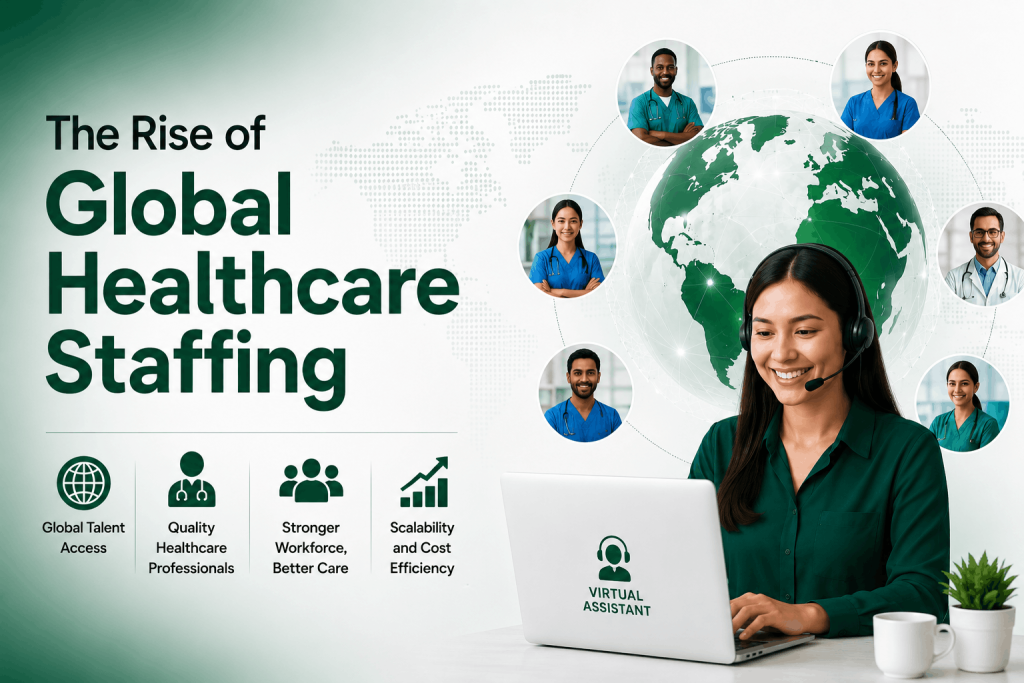
Global healthcare staffing is the practice of recruiting clinical, administrative, and support talent from outside a healthcare organization’s home country to fill critical workforce gaps. Hospitals, clinics, and health systems use it to solve chronic staffing shortages, reduce labor costs, and access specialized skills unavailable locally.
Key Takeaways
- Global healthcare staffing helps organizations close workforce gaps that domestic hiring alone cannot fill fast enough.
- The World Health Organization projects a shortfall of roughly 10 million health workers worldwide by 2030, concentrated in low- and middle-income countries.
- The Association of American Medical Colleges projects a U.S. physician shortage of up to 86,000 physicians by 2036.
- International healthcare recruitment gives organizations access to credentialed nurses, physicians, medical coders, and revenue cycle specialists at lower total cost.
- Offshore and nearshore healthcare staffing models are expanding beyond clinical roles into billing, coding, telehealth support, and back-office operations.
- Healthcare workforce shortage pressures are pushing more U.S. and European health systems to build long-term global talent pipelines instead of relying only on short-term staffing agencies.
What Is Global Healthcare Staffing and Why Does It Matter?
Global healthcare staffing is defined as the strategic sourcing of healthcare professionals and support staff from international labor markets to address domestic hiring shortfalls. It matters because healthcare workforce shortage trends in the United States, United Kingdom, and much of Europe have made it nearly impossible for many organizations to staff purely with local talent.
Healthcare leaders are not choosing global talent in healthcare as a temporary patch. They are building it into long-term workforce strategy because the shortage is structural, not cyclical.
How Severe Is the Current Healthcare Workforce Shortage?
The healthcare workforce shortage is severe enough that multiple national and global bodies now treat it as a long-term structural problem rather than a temporary staffing dip. Projections point to millions of unfilled clinical and support positions worldwide within the next five to ten years.
- According to the World Health Organization (2022), the world faces a projected shortfall of 11 million health workers by 2030, concentrated mostly in low- and lower-middle-income countries.
- According to the Association of American Medical Colleges (2024), the United States is projected to face a shortage of up to 86,000 physicians by 2036, driven by an aging population and physician retirements.
This shortage is not limited to physicians. Nursing, medical coding, billing, and administrative roles are experiencing similar strain, which is why healthcare staffing shortages now extend well beyond the exam room into revenue cycle and operations teams.
Which Healthcare Roles Are Hardest to Fill Domestically?
The hardest healthcare roles to fill domestically are typically registered nurses, primary care physicians, medical coders, revenue cycle analysts, and behavioral health specialists. These roles combine high demand, long training pipelines, and geographic maldistribution, which makes local-only hiring slow and expensive.
Common hard-to-fill roles include:
- Registered nurses and licensed practical nurses
- Primary care and rural physicians
- Medical coders and billing specialists
- Behavioral health and mental health counselors
- Radiology and lab technicians
- Revenue cycle and prior authorization staff
Global Healthcare Staffing as a Strategic Response to Talent Shortages
Global healthcare staffing works as a strategic response because it widens the hiring pool beyond a single national labor market. Instead of competing for the same limited domestic candidates, organizations can recruit credentialed professionals from countries with strong healthcare training systems and lower cost structures.
International healthcare recruitment agencies and offshore staffing partners now handle everything from credential verification to compliance, which lowers the operational burden on internal HR teams.
What Is the Difference Between Onshore, Nearshore, and Offshore Healthcare Staffing?
The difference between onshore, nearshore, and offshore healthcare staffing is primarily geographic distance, time zone overlap, and cost. Onshore staffing hires within the same country, nearshore staffing hires from neighboring regions with similar time zones, and offshore staffing hires from farther markets that typically offer the largest cost savings.
| Model | Typical Location | Time Zone Overlap | Cost Savings | Best For |
|---|---|---|---|---|
| Onshore | Same country | Full | Low | Clinical roles requiring in-person licensure |
| Nearshore | Neighboring region (e.g., Latin America for U.S. firms) | High | Moderate | Real-time collaboration, customer-facing support |
| Offshore | Distant regions (e.g., South Asia, Philippines) | Low to moderate | High | Back-office, coding, billing, data-heavy work |
Why Are More Health Systems Choosing Offshore Talent Over Traditional Staffing Agencies?
Health systems are choosing offshore talent over traditional staffing agencies because agencies typically offer short-term, high-markup contracts, while offshore global healthcare staffing partners build dedicated, long-term teams at a lower blended cost. This shift supports budget predictability and reduces dependence on expensive travel nurse and locum tenens contracts.
According to Deloitte (2024), health system leaders continue to cite workforce shortages and rising labor costs as top disruptors to their operating models.
According to Statista (2024), the global healthcare staffing market continues to expand as providers diversify sourcing beyond domestic labor pools.
Benefits of International Healthcare Recruitment for Hospitals and Clinics
International healthcare recruitment gives hospitals and clinics three core benefits: faster time-to-fill for open roles, access to specialized or hard-to-find skill sets, and meaningful reductions in labor cost compared to domestic-only hiring or agency staffing.
Organizations that build global talent pipelines also gain scheduling flexibility, since offshore teams in different time zones can extend coverage windows for administrative and support functions without requiring overnight shifts from local staff.
How Does Global Talent in Healthcare Reduce Operating Costs?
Global talent in healthcare reduces operating costs primarily by lowering wage differentials for non-bedside roles such as coding, billing, transcription, and administrative support, while maintaining the same quality and compliance standards through structured training and oversight.
According to Robert Half (2024), employers across industries, including healthcare, continue to report difficulty filling skilled roles, which keeps domestic wage pressure elevated.
Common cost advantages include:
- Lower base compensation for equivalent skill levels in offshore markets
- Reduced reliance on premium-rate travel and agency staff
- Lower overhead for training when partnering with an established staffing firm
- Reduced turnover costs when offshore roles are structured as long-term positions
What Real-World Example Shows Global Healthcare Staffing Working at Scale?
A mid-sized U.S. multi-specialty group facing a 20 percent vacancy rate in its billing and coding department partnered with an offshore staffing provider to build a dedicated remote team of certified coders. Within six months, claim denial rates dropped and days-in-accounts-receivable improved, while total staffing cost for that function fell by roughly a third compared to the prior agency-staffed model.
This mirrors a broader pattern documented across the industry: healthcare staffing shortages are pushing organizations toward structured, long-term global teams rather than one-off contract placements.
Conclusion: Global Healthcare Staffing Is Now a Core Workforce Strategy
Healthcare workforce shortages are structural, not temporary, which is why global healthcare staffing has moved from a stopgap measure to a core strategy for hospitals, clinics, and healthcare businesses. International healthcare recruitment and offshore staffing models give organizations faster access to skilled talent, meaningful cost savings, and greater scheduling flexibility, while reducing dependence on expensive agency contracts.
Organizations that build long-term global talent pipelines position themselves to absorb future staffing shocks more effectively than those relying solely on domestic hiring.
Ready to build a reliable, cost-effective offshore team for your healthcare organization? Contact Neuhire today to explore tailored offshore staffing solutions built specifically for healthcare operations.
Help Center
Frequently asked questions

Marketing professional with a passion for people, creativity, and growth. I love turning ideas into campaigns that connect and inspire. Currently part of the Neuhire team, helping businesses find the right talent fast.

Marketing professional with a passion for people, creativity, and growth. I love turning ideas into campaigns that connect and inspire. Currently part of the Neuhire team, helping businesses find the right talent fast.