Fake Job Candidates and Deepfakes: How to Verify Remote Talent Before You Hire
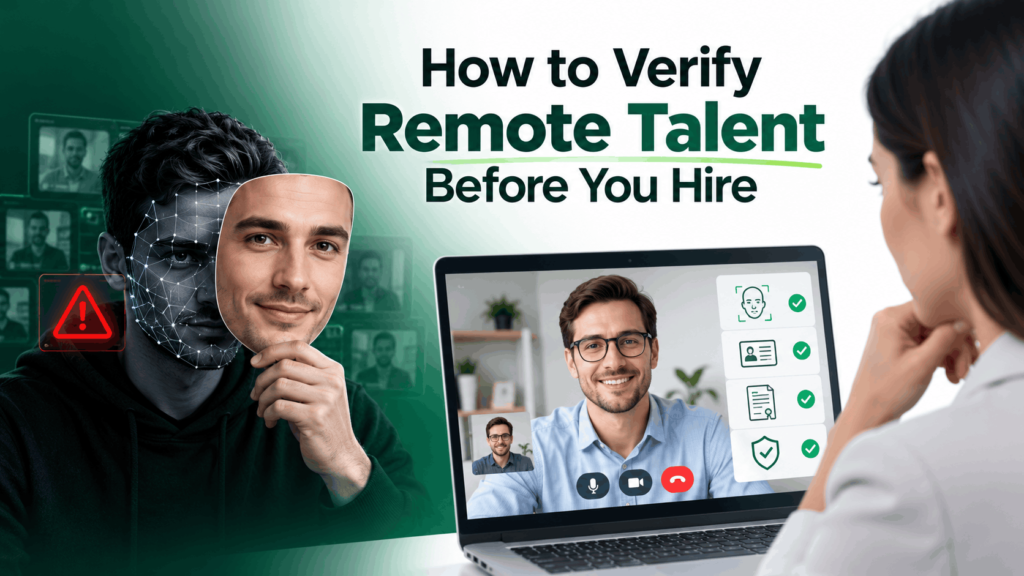
Fake job candidates are defined as applicants who misrepresent their identity, skills, or location to win a job, often using deepfake video, voice cloning, stolen identities, or proxy interviewers. US employers stop them by combining liveness-checked ID verification, structured live interviews, independent background checks, and vetted staffing partners before any offer is made.
Key Takeaways: Fake Job Candidates Quick Facts
- Gartner predicts that by 2028, one in four candidate profiles worldwide will be fake.
- In a 2025 Gartner survey of 3,000 job seekers, 6% admitted to participating in interview fraud.
- The US Department of Justice found North Korean IT workers had obtained remote jobs at more than 100 US companies.
- Deepfake interviews can be exposed with live, unscripted tasks such as turning the head, covering part of the face, or sharing a screen.
- Government ID checks with liveness detection, independent reference calls, and verified device shipping are the strongest identity controls.
What Are Fake Job Candidates?
Fake job candidates are people who apply for roles under a false identity or with fabricated qualifications. They range from individuals using AI to exaggerate a resume to organized groups using deepfake video, stolen Social Security numbers, and laptop farms to collect salaries and access company systems in remote roles.
What Is a Deepfake Job Interview?
A deepfake job interview is a video or phone interview where the candidate uses AI-generated video or a cloned voice to impersonate another person. Fraudsters use real-time face-swap software in Zoom, Microsoft Teams, or Google Meet so the face on screen matches a stolen identity or a polished fake profile.
Why Is Remote Hiring Fraud Rising in 2026?
Remote hiring fraud is rising because generative AI makes fake resumes, faces, and voices cheap to produce, and fully remote roles remove in-person checkpoints. Software engineering, data, DevOps, and cybersecurity roles are prime targets because they pay well and grant access to source code, cloud accounts, and customer data.
Fake Job Candidates by the Numbers: 2025 to 2026 Data
Fake job candidates are no longer a fringe problem. Research from Gartner, Robert Half, Forbes, and the US Department of Justice shows that AI-assisted fraud is now common in technical hiring, and that verification has become one of the biggest bottlenecks for recruiters and hiring managers in 2026.
- According to Forbes (2026), 38.5% of 19,368 candidates in AI-powered interviews were flagged for AI-cheating behavior, rising to 48% for technical roles.
- According to Robert Half (2026), 65% of US hiring managers say AI-generated applications have made candidate skills harder to verify.
- According to Gartner (2025), one in four candidate profiles worldwide will be fake by 2028.
- According to the US Department of Justice (2025), North Korean IT workers using stolen identities obtained remote jobs at more than 100 US companies, causing at least $3 million in losses.
How to Spot Fake Job Candidates and Deepfake Interviews
To spot fake job candidates, compare what the candidate claims with what they can prove live. Watch for inconsistent work histories, scripted answers, video glitches, and refusal to turn on cameras. Then test the candidate in real time with tasks that AI tools and proxy interviewers cannot easily fake.
How Do You Detect a Deepfake in a Video Interview?
You detect a deepfake in a video interview by forcing real-time actions that face-swap software renders poorly, then checking for audio and visual mismatches. Here are the top 6 ways to detect a deepfake job interview on Zoom, Microsoft Teams, or Google Meet:
- Ask the candidate to turn their head fully left and right.
- Ask them to pass a hand slowly in front of their face.
- Watch for lip movements that lag behind the audio.
- Look for blurring around the hairline, glasses, and ears.
- Ask unscripted follow-up questions about specific past projects.
- Request a live screen share while they write or debug code.
What Are the Common Types of Remote Hiring Fraud?
The difference between AI-assisted cheating and identity fraud is that cheating misrepresents skills, while identity fraud misrepresents who the person is. Both create risk, but identity fraud can expose your source code, cloud accounts, and customer data to criminal or state-sponsored actors.
| Fraud Type | Warning Signs | Best Defense |
|---|---|---|
| Deepfake video | Lag, blurring, odd lighting | Live movement tests, liveness ID check |
| Proxy interviewer | Different voice or skill level after hire | Record interviews, verify on day one |
| AI-assisted answers | Pauses, eyes reading off-screen | Live coding, follow-up questions |
| Stolen or synthetic identity | Thin online history, new LinkedIn | ID verification, background check |
| Laptop farm | Changed shipping address, VPN use | Ship devices only to verified addresses |
How to Verify Remote Talent and Stop Fake Job Candidates
To verify remote talent and stop fake job candidates, layer identity, skills, and employment checks before an offer, then confirm the same person shows up on day one. Use liveness-checked ID verification, independent reference calls, recorded technical interviews, and a staffing partner that documents every step.
How Do You Verify a Remote Employee’s Identity?
You verify a remote employee’s identity by confirming that a real, documented person matches the candidate you interviewed, the name on payroll, and the person who logs in on day one. Follow these six steps for reliable candidate identity verification:
- Run government ID verification with a liveness check using tools such as Persona, Jumio, or CLEAR.
- Order a background check through providers such as Checkr, HireRight, or Sterling.
- Call references using phone numbers you find independently, not ones the candidate supplies.
- Match the name on the ID, payroll account, and tax documents.
- Ship laptops only to a verified home address and flag change requests.
- Repeat a short live video check on the first day of work.
For offshore hires in India, ask your partner to verify government ID and prior employment records before onboarding. Our offshore staffing partner checklist lists the questions to ask, and our guide to offshore staffing compliance risks covers data security clauses.
Real-World Example: The North Korean IT Worker Scheme
In June 2025, the US Department of Justice announced actions against North Korean IT workers who used more than 80 stolen US identities to win remote jobs. US facilitators hosted company laptops in “laptop farms” so the workers appeared to be in the United States.
Agents seized about 200 computers, and the Massachusetts case alone generated more than $5 million for the scheme. The lesson for employers is clear: verify identity and device location, not just skills.
How Can Neuhire Help You Avoid Fake Job Candidates?
Neuhire places dedicated, pre-screened remote professionals from India with US companies. You interview every candidate yourself, and each hire works as a long-term member of your team rather than an anonymous freelancer. Learn how this compares in offshore staffing vs freelancers and our quality control best practices.
Conclusion: Hiring Real Talent in the Age of Fake Job Candidates
Fake job candidates are a growing threat, with Gartner projecting one in four profiles will be fake by 2028. Deepfake interviews can be exposed through live, unscripted tasks. Layered identity checks, independent references, and verified onboarding stop most fraud before it reaches your systems.
Want verified, pre-screened remote talent from India? Contact Neuhire to build your offshore team with confidence.
Help Center
FAQs About Fake Job Candidates
These answers address the questions HR leaders, recruiters, and CTOs ask most often about fake job candidates, deepfake interviews, and candidate identity verification.
Each answer stands alone, so you can use it as a quick reference when updating your 2026 hiring and onboarding process for remote roles.
Fake job candidates are applicants who lie about their identity, skills, or location to get hired. Methods include AI-written resumes, deepfake video interviews, voice cloning, stolen identities, and proxy interviewers who pass interviews on behalf of someone else who later does the job.
To detect a deepfake job interview, ask the candidate to turn their head, pass a hand in front of their face, and share their screen while solving a live problem. Watch for lip-sync lag, blurring around hair and glasses, and unnatural lighting changes.
Verify a remote employee's identity with a government ID check that includes liveness detection, a background check, and independent reference calls. Then confirm the name matches payroll records, ship equipment only to a verified address, and repeat a live video check on day one.
Common warning signs of fake applicants include a brand-new LinkedIn profile, gaps between the resume and live answers, refusal to turn on video, requests to ship laptops to a different address, and payroll details that do not match the name on the identity documents.
Remote hiring fraud most often targets software developers, data engineers, DevOps engineers, cloud engineers, and cybersecurity analysts. These roles pay well, are often fully remote, and provide access to source code, production systems, and customer data that criminal groups can steal or ransom.
Candidate identity verification tools include Persona, Jumio, and CLEAR for ID and liveness checks, and Checkr, HireRight, and Sterling for background screening. Recorded interviews in Zoom or Microsoft Teams also help confirm that the person hired matches the person interviewed.
Candidate fraud is widespread in 2026. Gartner found that 6% of job seekers admitted to interview fraud, and Robert Half reports that 65% of hiring managers say AI-generated applications make skills harder to verify. Gartner predicts one in four profiles will be fake by 2028.
Candidate fraud detection for offshore hiring uses the same principles but relies on local checks. A staffing partner in India can verify national ID, prior employment records, and education credentials locally, while you still run live technical interviews and a first-day video check.
AI tools can flag suspicious behavior such as reading from a second screen or synthetic video artifacts, but they are not foolproof. The most reliable approach combines automated detection with trained interviewers, live tasks, and human review of identity documents and references.
A staffing partner reduces the risk of fake job candidates by pre-screening applicants, verifying identity and work history locally, and employing placed professionals on long-term contracts. Partners such as Neuhire also let you interview candidates directly before you commit to a hire.

Marketing professional with a passion for people, creativity, and growth. I love turning ideas into campaigns that connect and inspire. Currently part of the Neuhire team, helping businesses find the right talent fast.

Marketing professional with a passion for people, creativity, and growth. I love turning ideas into campaigns that connect and inspire. Currently part of the Neuhire team, helping businesses find the right talent fast.