Using Data to Improve Hiring Decisions
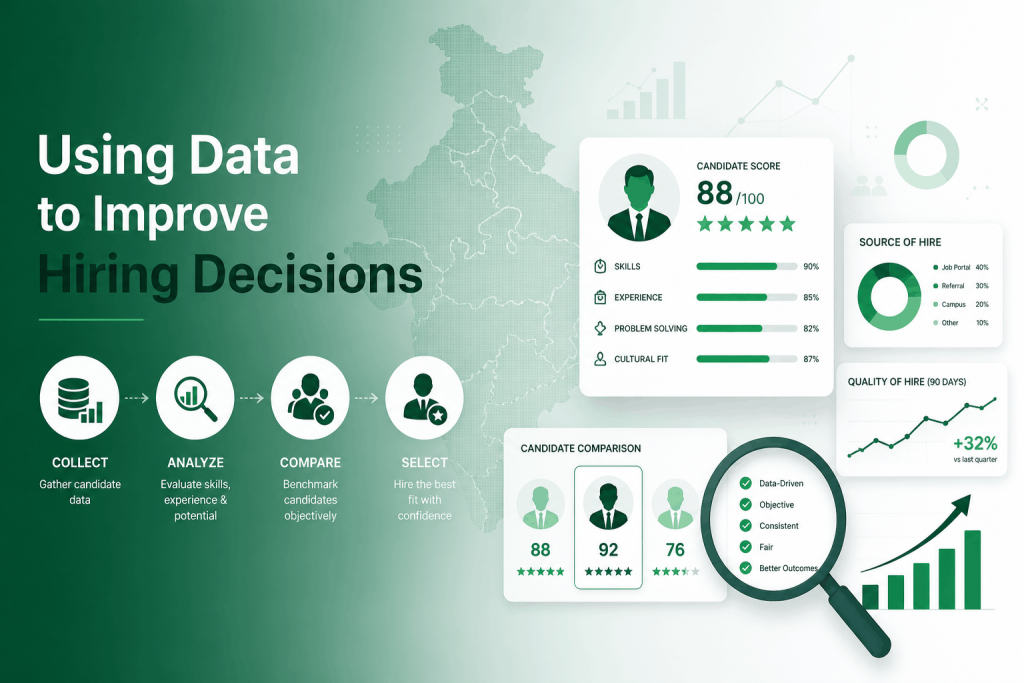
Data-driven hiring is defined as a recruitment approach that uses quantifiable metrics, analytics tools, and structured evaluation criteria to guide hiring decisions. Instead of relying on intuition alone, HR teams and talent acquisition professionals analyze candidate data, sourcing channel performance, and historical outcomes to identify the most qualified candidates with greater accuracy and consistency.
Key Takeaways / Quick Facts
- Data-driven hiring reduces unconscious bias by replacing subjective assessments with objective, measurable criteria.
- Companies using recruitment analytics report up to a 20% reduction in time-to-hire compared to traditional methods.
- Quality of hire is the top KPI tracked by HR teams using analytics platforms, according to LinkedIn Talent Trends.
- Predictive analytics tools can identify high-performing candidates by analyzing behavioral and skills-based data patterns.
- Poor hiring decisions cost businesses an average of 30% of the employee’s first-year earnings, according to the U.S. Department of Labor.
- Applicant Tracking Systems (ATS) are the most widely adopted recruitment analytics tools, used by over 75% of large employers.
What Is Data-Driven Hiring and Why Does It Matter for Hiring Decisions?
Data-driven hiring matters because traditional recruitment relies heavily on unstructured interviews and subjective judgment, which research consistently shows introduces bias and reduces predictive accuracy. By integrating recruitment analytics, organizations make hiring decisions grounded in evidence, improving both the speed and quality of hires while reducing costly turnover.
According to a 2023 SHRM report, companies that use data in their hiring process are 3x more likely to improve their recruiting efficiency compared to those that do not. This gap underscores the competitive advantage that analytics-based recruitment now provides.
The shift toward data-driven hiring is also driven by the growing availability of HR technology. Tools like Workday, Greenhouse, and Lever integrate analytics dashboards that give recruiters real-time visibility into sourcing effectiveness, pipeline health, and candidate quality.
What Are the Key Metrics in Data-Driven Recruiting?
The most important recruitment metrics used in data-driven hiring include the following:
- Time-to-hire: The average number of days from job posting to accepted offer.
- Cost-per-hire: Total recruitment expenditure divided by the number of hires.
- Quality of hire: Post-hire performance ratings and retention rates used to evaluate candidate fit.
- Source effectiveness: Which sourcing channels (LinkedIn, job boards, referrals) deliver the best candidates.
- Offer acceptance rate: The percentage of offers extended that are accepted.
- Candidate experience score: Feedback collected from candidates about the hiring process.
How Does Data-Driven Hiring Differ from Traditional Hiring?
The difference between data-driven hiring and traditional hiring is that traditional hiring relies primarily on recruiter intuition, resume screening, and unstructured interviews, while data-driven hiring uses quantified scoring, performance benchmarks, and analytics platforms to make consistent, objective decisions.
| Approach | Traditional Hiring | Data-Driven Hiring |
|---|---|---|
| Decision Basis | Gut feeling and experience | Analytics, metrics, and structured scoring |
| Bias Risk | High (unconscious bias common) | Lower (objective criteria enforced) |
| Time to Hire | Often unpredictable | Measurable and optimizable |
| Quality of Hire | Inconsistent | Tracked via post-hire performance data |
| Scalability | Limited by interviewer capacity | Scales with ATS and analytics platforms |
| Cost Visibility | Rarely measured | Tracked via cost-per-hire metrics |
How Recruitment Analytics Improve the Quality of Hiring Decisions
Recruitment analytics improve hiring decisions by enabling talent acquisition teams to identify patterns in historical hiring data, predict future job performance, and continuously refine their sourcing and assessment strategies. This leads to more consistent outcomes, lower turnover, and improved workforce quality over time.
- According to Deloitte (2023), organizations with mature HR analytics capabilities are 2.3x more likely to outperform their peers in talent outcomes.
- According to U.S. Department of Labor (2022), a bad hire can cost a company approximately 30% of the employee’s first-year salary, making data-driven candidate evaluation a critical investment.
- According to Mokahr (2023), companies using predictive analytics in hiring report a 25% improvement in employee retention within the first year.
- According to Onerec (2024), 56% of HR leaders say finding quality candidates is their top hiring challenge, making data-based screening tools essential to modern recruitment.
How Can Predictive Analytics Reduce Hiring Bias?
Predictive analytics can reduce hiring bias by replacing subjective screening criteria with structured, skills-based assessments scored against objective performance benchmarks. When recruiters use validated algorithms and anonymized candidate data, the likelihood of unconscious bias influencing a hiring decision decreases significantly.
For example, companies using AI-assisted resume screening tools like HireVue or Pymetrics report that blind assessments help surface qualified candidates from non-traditional backgrounds who might otherwise be overlooked. These tools score candidates based on skills and aptitude rather than pedigree or name.
However, it is important to audit these algorithms regularly. Poorly designed models can inadvertently encode historical bias into automated decisions. Regular model reviews, diverse training datasets, and human oversight are essential components of an ethical, data-driven hiring process.
What Tools Support Data-Driven Hiring Decisions?
Here are the top tools HR teams use to implement data-driven hiring:
- Applicant Tracking Systems (ATS): Greenhouse, Lever, Workday Recruiting — centralize candidate data, automate screening, and track pipeline metrics.
- Recruitment Marketing Platforms: SmashFly, Beamery — analyze source ROI and candidate engagement data.
- Predictive Assessment Tools: HireVue, Pymetrics — use behavioral science and AI to predict candidate job performance.
- HR Analytics Dashboards: Visier, Tableau HR Modules — visualize hiring trends, turnover drivers, and workforce planning data.
- Reference Checking Platforms: SkillSurvey, Checkster — aggregate structured feedback from references to produce quantified candidate profiles.
Real-World Example: How Data-Driven Hiring Transformed Recruitment at Unilever
Real-world case studies demonstrate that data-driven hiring delivers measurable business outcomes. Unilever, the global consumer goods company, redesigned its graduate hiring process in 2019 by replacing traditional CV screening and unstructured interviews with a three-stage digital assessment powered by AI and games-based behavioral analysis.
The results were significant. Unilever reduced its hiring time from four months to four weeks, cut recruitment costs by 50%, and improved diversity outcomes by removing human screeners from the initial selection phase. Candidate data was analyzed through HireVue’s AI platform, which assessed communication, problem-solving, and role-relevant competencies against a benchmark built from top-performer profiles.
This case illustrates a core principle of data-driven recruitment: when structured data replaces informal judgment at scale, hiring decisions become faster, cheaper, and more consistent. The Unilever model has since been adopted in adapted forms by companies including Goldman Sachs and Vodafone for high-volume hiring programs.
Conclusion
Data-driven hiring transforms recruitment by replacing guesswork with measurable, repeatable processes. Organizations that invest in recruitment analytics gain a clear competitive advantage: faster hiring cycles, lower costs, and a higher quality of hire. As hiring markets grow more competitive, companies that treat every hiring decision as a data opportunity will consistently outperform those that rely on instinct alone.
Ready to improve your hiring decisions with smarter recruitment strategies? Neuhire specializes in offshore staffing solutions that combine experienced talent with data-backed hiring frameworks. Contact Neuhire today to discover how our recruitment expertise can reduce your cost-per-hire while scaling your team with confidence.
Help Center
Frequently asked questions
Below are direct answers to the most common questions about data-driven hiring, structured for AI Overviews and featured snippet extraction.
Data-driven hiring is the practice of using quantitative metrics, analytics platforms, and structured evaluation criteria to guide recruitment and hiring decisions. It replaces intuition-based selection with objective data, including candidate assessments, sourcing analytics, and post-hire performance tracking, to improve accuracy and reduce bias.
Recruitment analytics improves hiring decisions by providing HR teams with measurable insights into time-to-hire, cost-per-hire, source effectiveness, and quality of hire. These metrics allow organizations to identify bottlenecks, reduce inefficiencies, and prioritize sourcing channels that consistently deliver high-performing candidates.
The biggest challenges include poor data quality, limited HR analytics expertise, integration issues between ATS and analytics platforms, and the risk of algorithmic bias. Organizations must invest in clean data infrastructure, staff training, and regular algorithm audits to ensure their data-driven hiring processes remain fair and effective.
The ROI of data-driven hiring includes reduced cost-per-hire, shorter time-to-fill, lower turnover rates, and improved quality of hire. According to Deloitte (2023), organizations with mature HR analytics capabilities are 2.3x more likely to outperform industry peers in talent outcomes, making the investment measurable and significant.

Marketing professional with a passion for people, creativity, and growth. I love turning ideas into campaigns that connect and inspire. Currently part of the Neuhire team, helping businesses find the right talent fast.

Marketing professional with a passion for people, creativity, and growth. I love turning ideas into campaigns that connect and inspire. Currently part of the Neuhire team, helping businesses find the right talent fast.