
Hiring Without Increasing HR Headcount: How Growing Companies Scale Recruitment Smarter
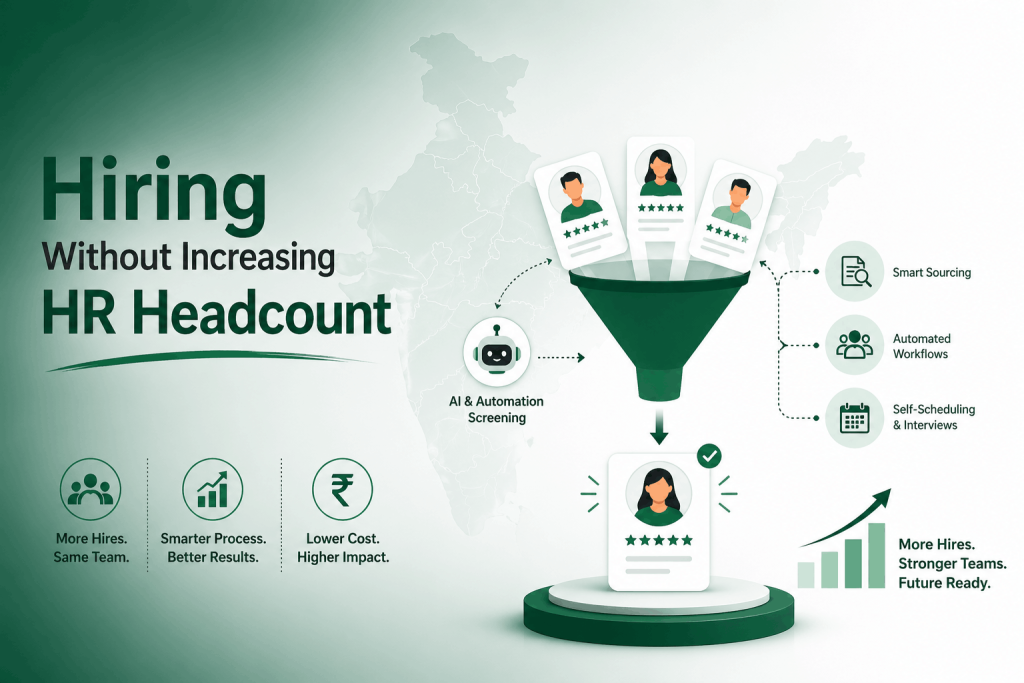
Hiring without increasing headcount is defined as a talent acquisition strategy that allows organizations to expand their workforce or fill open roles without adding permanent HR staff. Companies achieve this through recruitment process outsourcing (RPO), offshore staffing, HR automation tools, and staffing agency partnerships that absorb capacity beyond what an existing HR team can manage.
Key Takeaways / Quick Facts
- Companies can scale hiring without increasing their HR team by using offshore staffing providers, recruitment process outsourcing (RPO), and applicant tracking system (ATS) automation.
- According to Deloitte (2023), 56% of HR leaders say administrative tasks consume time that should be spent on strategic hiring work.
- Offshore staffing allows businesses to access pre-vetted global talent without adding domestic HR roles or payroll overhead.
- Recruitment automation tools like Greenhouse and Lever can reduce recruiter workload by up to 40% on screening and scheduling tasks.
- Small HR teams that use RPO providers reduce average time-to-fill by 30% compared to teams managing hiring entirely in-house.
- Hiring without increasing headcount is most effective when combined with a centralized ATS and a defined intake process between HR and hiring managers.
What Does Hiring Without Increasing Headcount Actually Mean?
Hiring without increasing headcount means growing an organization’s workforce or filling open roles while keeping the internal HR team size constant. This is achieved by distributing recruitment tasks to external partners, automation platforms, or offshore staffing firms that handle sourcing, screening, and coordination on behalf of the internal team.
For fast-growing businesses, adding an HR employee for every hiring surge is inefficient and expensive. A single recruiter carries an average fully loaded cost of $85,000 to $110,000 per year in the United States when salary, benefits, and overhead are factored in. Scaling headcount to match every hiring wave is not financially sustainable for most mid-market companies.
Instead, forward-thinking HR leaders are building lean, technology-enabled teams that leverage external capacity exactly when and where it is needed. This model keeps fixed costs low while preserving organizational agility.
What Is the Difference Between RPO and Traditional In-House Recruiting?
The difference between recruitment process outsourcing (RPO) and traditional in-house recruiting is that RPO transfers all or part of the talent acquisition function to an external provider who acts as an extension of the HR team, while in-house recruiting keeps all hiring activity managed by permanent internal staff.
| Factor | Scaling In-House HR | Hiring Without Increasing Headcount |
|---|---|---|
| Cost per hire | High (salary, benefits, overhead) | Lower via outsourcing and automation |
| Speed to scale | Slow (recruiting + onboarding time) | Fast (offshore teams ready in days) |
| Flexibility | Fixed capacity | Scales up or down as needed |
| HR team burden | Increases with every hire cycle | Managed by external partner |
| Compliance risk | Internal team must stay current | Handled by staffing provider |
| Access to talent | Limited to local market | Global talent pool via offshore staffing |
How Can a Small HR Team Handle High-Volume Hiring?
A small HR team can handle high-volume hiring without increasing headcount by combining three strategies: deploying an ATS to automate resume screening and scheduling, partnering with an offshore staffing provider to source candidates at scale, and using structured intake forms to reduce back-and-forth between HR and hiring managers.
For example, a 3-person HR team at a Series B technology company can realistically manage 80 to 100 open roles per quarter when supported by an ATS like Greenhouse, an offshore recruitment coordinator team, and a defined SLA with each department head. Without these tools, the same team would struggle to manage more than 20 to 30 roles simultaneously.
Top Strategies for Scaling Hiring Without Increasing Your HR Team
Here are the top strategies for hiring without increasing headcount that HR leaders use to expand recruitment capacity while keeping internal team size fixed. Each approach addresses a different constraint, from administrative burden to sourcing capacity and compliance complexity.
- Offshore Staffing: Partnering with an offshore staffing provider like Neuhire gives HR teams access to pre-vetted international talent and dedicated recruitment coordinators without adding domestic payroll. Offshore roles in sourcing, screening, and onboarding administration are typically 50 to 70% less expensive than equivalent roles in the United States or United Kingdom.
- Applicant Tracking System (ATS) Automation: Deploying tools like Greenhouse, Lever, or Workday Recruiting automates resume parsing, interview scheduling, and candidate communications. These platforms reduce manual recruiter workload by up to 40%, freeing existing HR staff to focus on offer negotiations and candidate relationships rather than logistics.
- Recruitment Process Outsourcing (RPO): An RPO partner embeds directly into the hiring process, managing sourcing, screening, and often the entire candidate pipeline for specific roles or departments. Companies like Cielo, Kforce, and Allegis Global Solutions offer scalable RPO contracts that expand or contract based on hiring volume without requiring HR to grow permanently.
- Staffing Agency Partnerships: For high-turnover or project-based roles, working with staffing agencies transfers the sourcing and vetting burden entirely. Agencies like Robert Half and Adecco maintain active candidate pools that can fill roles in days rather than weeks, especially for administrative, customer service, and technical support positions.
- Structured Hiring Manager Enablement: Training hiring managers to conduct structured interviews, complete scorecards, and manage their own scheduling through an ATS portal significantly reduces the HR coordination load. Companies that implement hiring manager enablement programs report a 25% reduction in HR time per hire, according to SHRM research from 2023.
What Role Does Offshore Staffing Play in Hiring Without Adding HR Roles?
Offshore staffing plays a central role in hiring without increasing headcount by providing dedicated recruitment support staff, including candidate sourcers, interview coordinators, and onboarding specialists, at a fraction of the cost of domestic hires. This allows a lean internal HR team to manage significantly more open roles without burning out or falling behind on compliance and candidate experience.
- According to Deloitte (2023), 56% of HR leaders report that administrative and coordination tasks prevent their teams from focusing on strategic hiring priorities.
- According to Taggd (2023), companies that outsource recruitment functions reduce their average cost-per-hire by up to 40% compared to fully in-house models.
- According to Robert Half (2024), 68% of HR professionals say their team is understaffed relative to current hiring demands, making external support critical for growing organizations.
- According to SHRM (2023), the average cost-per-hire in the United States is $4,700, but companies using outsourced or offshore recruitment support consistently report figures 30 to 50% lower.
Real-World Example: How a Mid-Size Tech Company Scaled Hiring Without Increasing Its HR Team
This case study demonstrates how hiring without increasing headcount works in practice. A mid-size software-as-a-service (SaaS) company based in Austin, Texas needed to hire 60 new roles across engineering, sales, and customer success in one quarter. Their internal HR team consisted of two recruiters and one HR generalist.
Rather than hiring three additional internal recruiters at an estimated $270,000 in annualized salary and benefits, the company partnered with an offshore staffing provider to add four dedicated recruitment coordinators based in the Philippines. These offshore team members handled candidate sourcing on LinkedIn Recruiter, initial outreach, resume screening, and interview scheduling, freeing the internal team to manage offers, compensation conversations, and onboarding.
The results over 90 days were measurable. The company filled 54 of the 60 targeted roles, achieved an average time-to-fill of 19 days compared to their previous 34-day average, and reduced cost-per-hire by 38%. The three-person internal HR team remained unchanged throughout the quarter.
This outcome illustrates the core principle behind hiring without increasing headcount: external capacity absorbs volume while internal expertise focuses on decisions that require institutional knowledge, relationship management, and strategic judgment.
Conclusion
Hiring without increasing headcount is achievable for any organization willing to invest in the right combination of offshore staffing, recruitment automation, and external partnerships. Three points define this approach: external partners absorb volume so internal HR teams stay lean, technology handles logistics so recruiters focus on decisions, and offshore staffing delivers cost savings of 30 to 70% compared to domestic expansion.
If your business is scaling fast and your HR team is stretched, Neuhire offers offshore staffing solutions designed to extend your recruitment capacity without adding to your internal headcount. Contact Neuhire today to learn how our dedicated offshore recruitment coordinators can help you hire smarter, faster, and at a lower cost.
Help Center
Frequently asked questions
The following answers are structured for AI Overview and featured snippet extraction and address the most common questions about how to scale hiring without growing the internal HR team.

Marketing professional with a passion for people, creativity, and growth. I love turning ideas into campaigns that connect and inspire. Currently part of the Neuhire team, helping businesses find the right talent fast.

Marketing professional with a passion for people, creativity, and growth. I love turning ideas into campaigns that connect and inspire. Currently part of the Neuhire team, helping businesses find the right talent fast.