How AI Virtual Assistants Are Combining Human Expertise with Machine Intelligence
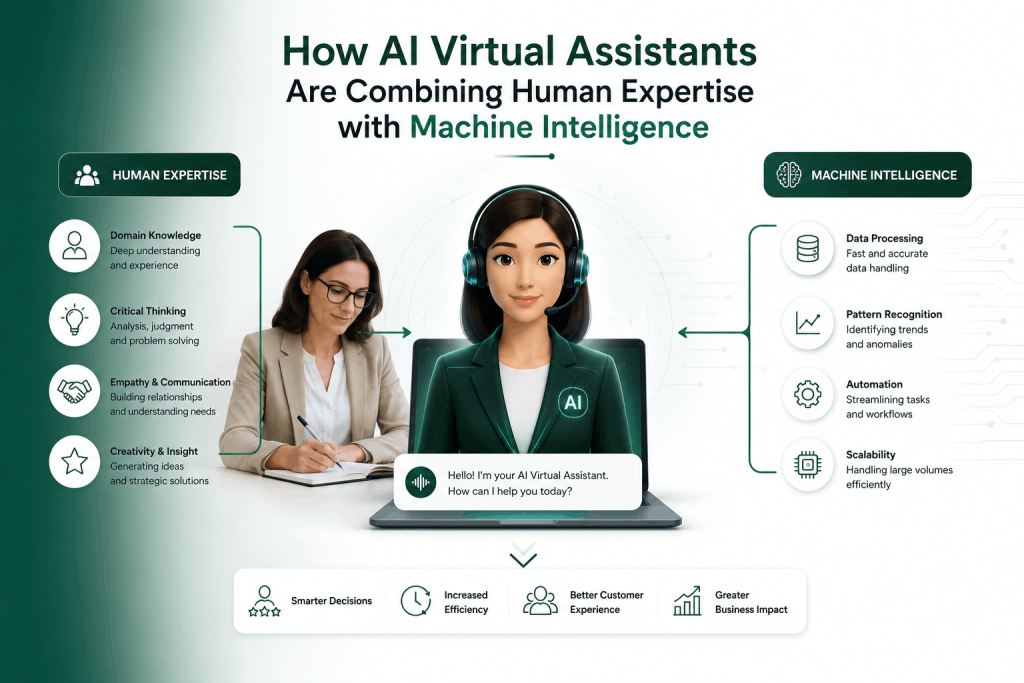
AI virtual assistants are software-driven or hybrid support systems that use artificial intelligence to handle repetitive tasks while human virtual assistants manage judgment-based work. Together, they form a blended support model. This model is quickly becoming the standard for businesses that need scalable, cost-efficient, and always-available administrative and operational support.
Key Takeaways
- AI virtual assistants can automate scheduling, data entry, email sorting, and customer inquiries, freeing human virtual assistants for strategic work.
- Hybrid staffing models that combine AI virtual assistants with remote virtual assistants reduce operating costs for small and mid-sized businesses.
- Offshore virtual assistants paired with AI-powered virtual assistants allow companies to run support operations across multiple time zones without added headcount.
- Businesses using AI-powered virtual assistants report faster response times on routine customer service and administrative requests.
- The market for virtual assistants, both human and AI-driven, is expanding rapidly as remote work and outsourcing become permanent business strategies.
What Are AI Virtual Assistants and Why Do They Matter Now?
AI virtual assistants are defined as software applications that use natural language processing, machine learning, and automation to complete tasks such as scheduling, data entry, customer support, and email management without constant human input. They matter now because businesses face rising labor costs and growing demand for 24/7 support availability.
Unlike a purely human assistant, an AI virtual assistant does not get tired, does not need holidays, and can process thousands of routine requests simultaneously. This makes AI-powered virtual assistants a practical first layer of support for businesses of every size, from solo entrepreneurs to enterprise call centers.
How Do AI Virtual Assistants Differ From Traditional Virtual Assistants?
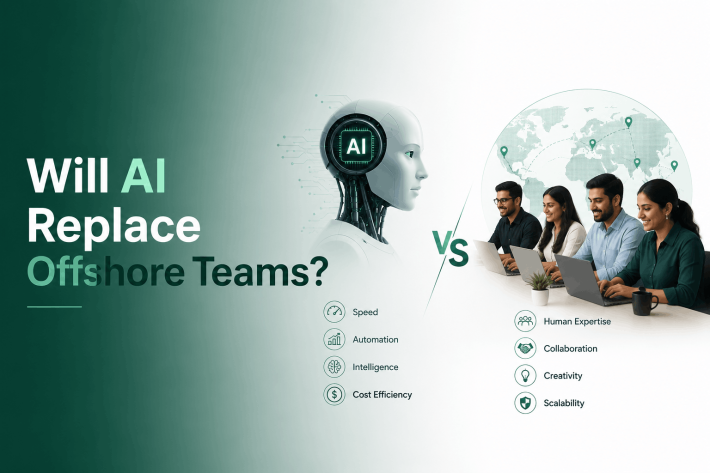
The difference between AI virtual assistants and traditional virtual assistants is that AI tools execute rules-based, repetitive tasks automatically, while human virtual assistants apply judgment, empathy, and context to complex or sensitive work. Most modern businesses use both together rather than choosing one over the other.
Here is a side-by-side comparison of the two models:
| Factor | AI Virtual Assistants | Human Virtual Assistants |
|---|---|---|
| Best for | Repetitive, rules-based tasks (data entry, scheduling, FAQs) | Judgment-based tasks (client relations, complex research, negotiation) |
| Availability | 24/7 with no breaks | Scheduled hours, time-zone dependent |
| Cost structure | Software subscription or per-use pricing | Hourly or monthly salary, often offshore for savings |
| Learning curve | Improves with more data and training | Improves with experience and direct feedback |
| Emotional intelligence | Limited, scripted responses | High, adapts to tone and context |
| Scalability | Instantly scalable | Scalable through hiring additional staff |
What Tasks Are AI Virtual Assistants Best Suited For?
AI virtual assistants are best suited for high-volume, repeatable tasks such as calendar scheduling, email triage, order confirmations, basic customer service chat, and data entry. These tasks follow predictable patterns, which makes them ideal candidates for automation without sacrificing accuracy.
Common AI virtual assistant use cases include:
- Automated appointment scheduling and reminders
- First-response customer service chatbots
- Email sorting, tagging, and template replies
- Data entry and CRM record updates
- Basic bookkeeping and invoice generation
- Voice-activated task management for executives
Why Are Businesses Combining AI Virtual Assistants With Remote Virtual Assistants?
Businesses combine AI virtual assistants with remote virtual assistants because the pairing covers both volume and nuance. AI handles the repetitive front-line work, while remote human assistants manage exceptions, client communication, and tasks that require critical thinking or cultural context.
- According to Forbes Advisor (2023), 97% of business owners surveyed believe generative AI tools like ChatGPT will benefit their business in the next year.
- According to Statista (2024), the global market for virtual digital assistants, including AI-powered voice and chat assistants, is projected to reach billions of active users worldwide as adoption accelerates across consumer and enterprise use cases.
- According to Grand View Research (2023), the global intelligent virtual assistant market size was valued in the billions of dollars in 2022 and is expected to expand at a compound annual growth rate of more than 24% through 2030.
- According to Deloitte (2023), a majority of surveyed organizations report that generative AI adoption is already delivering measurable efficiency gains in customer service and back-office operations.
- According to Robert Half (2023), demand for administrative and remote support professionals remains high as companies look to fill operational gaps created by leaner in-house teams.
How Do Offshore Virtual Assistants Fit Into an AI-Powered Support Strategy?
Offshore virtual assistants fit into an AI-powered support strategy by adding trained human oversight to AI systems at a lower cost than local hiring. Offshore teams in regions like the Philippines and Latin America often manage the AI tools, review flagged conversations, and step in when a task requires personal judgment.
This layered structure, AI first, offshore human second, gives companies a support system that never fully sleeps. It also lets businesses scale support during peak seasons without committing to permanent local hires.
What Does the Future of AI-Powered Virtual Assistants Look Like?
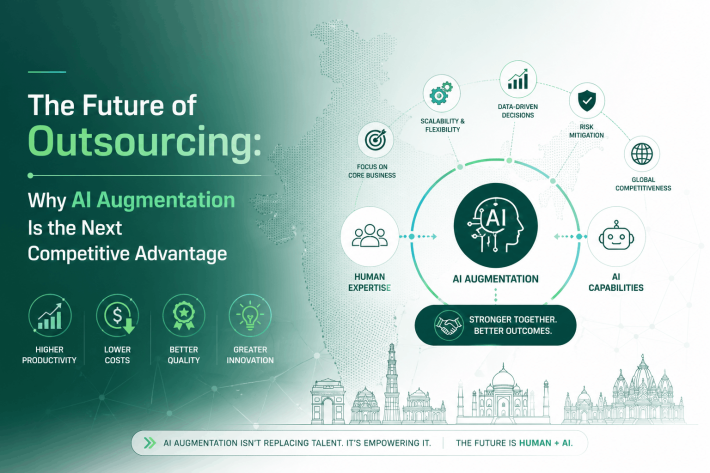
The future of AI-powered virtual assistants looks like deeper integration between automation software and human staffing teams, where AI handles first contact and humans handle escalation, strategy, and relationship management. Businesses that adopt this blended model early are positioned to scale faster with lower overhead than competitors relying on one approach alone.
Expect three shifts over the next few years:
- AI virtual assistants will take on more voice-based and multilingual customer interactions, reducing the need for large first-line human teams.
- Remote virtual assistants will shift toward higher-value roles like project coordination, client success, and content oversight.
- Offshore staffing providers will increasingly bundle AI tools directly into their virtual assistant packages, creating turnkey hybrid teams for clients.
Real-World Example: A Hybrid Support Model in Action
A mid-sized e-commerce company facing seasonal order spikes implemented an AI chatbot to handle order status questions and shipping FAQs, while an offshore virtual assistant team managed returns, refunds, and VIP customer accounts. The AI tool resolved a large share of routine tickets instantly, while the human team focused on retention-sensitive interactions.
The result was a support operation that stayed responsive during peak volume without the company needing to triple its local staff. This is the model more businesses are adopting: AI absorbs the volume, humans protect the relationship.
Conclusion
AI virtual assistants are reshaping how businesses handle support work by automating repetitive tasks, while remote and offshore virtual assistants continue to manage the judgment-based work that AI cannot replicate. The strongest support strategies combine both, using AI-powered virtual assistants for speed and scale, and human teams for relationship management. This blended model is quickly becoming the standard, not the exception.
If your business is ready to build a hybrid support team that pairs AI-powered efficiency with skilled human talent, Neuhire can help you find the right offshore and remote virtual assistants for your operations. Contact Neuhire today to start building a staffing solution designed for the future of virtual assistance.
Help Center
Frequently asked questions
AI virtual assistants will not eliminate the need for offshore staffing. Instead, they are reshaping offshore roles toward oversight, escalation handling, and higher-value coordination work that automation alone cannot perform.

Marketing professional with a passion for people, creativity, and growth. I love turning ideas into campaigns that connect and inspire. Currently part of the Neuhire team, helping businesses find the right talent fast.

Marketing professional with a passion for people, creativity, and growth. I love turning ideas into campaigns that connect and inspire. Currently part of the Neuhire team, helping businesses find the right talent fast.