

How Virtual Assistants Can Reduce Administrative Costs by Up to 80%
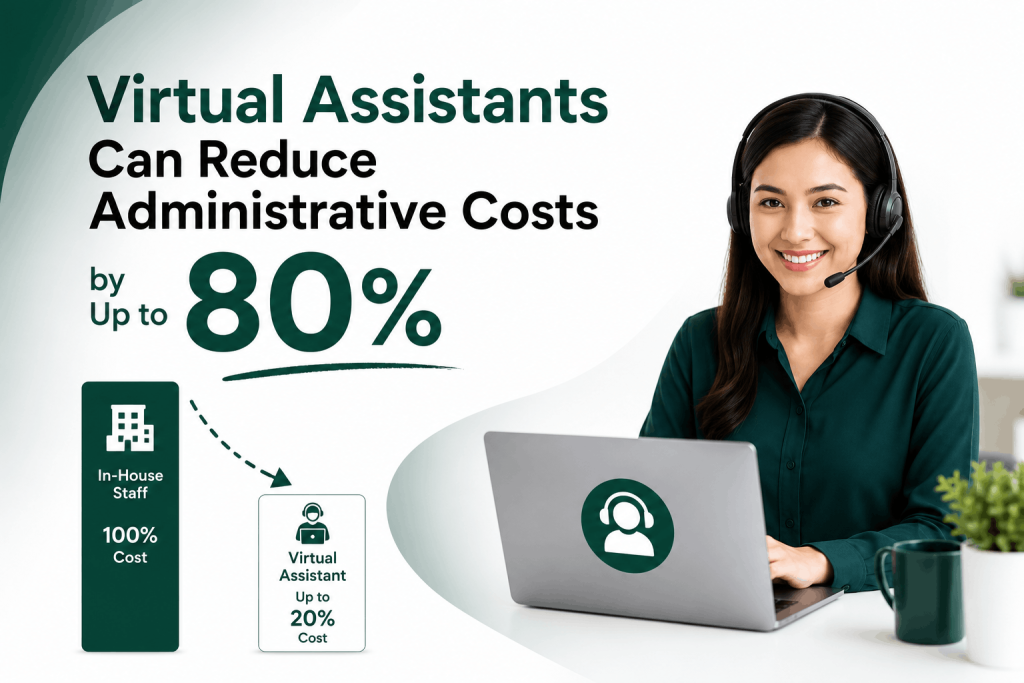
Virtual assistants are remote professionals who handle administrative, technical, or creative tasks for businesses without occupying in-house office space. Hiring virtual assistant services instead of full-time in-house staff can cut administrative costs by up to 80% through lower salaries, no overhead, and flexible hours.
Key Takeaways
- Virtual assistant services typically cost 60% to 80% less than hiring full-time in-house administrative staff.
- Offshore virtual assistants in regions like the Philippines and India charge $5 to $15 per hour, compared to $25 to $40 per hour for onshore U.S. administrative staff.
- Remote staffing eliminates office space, equipment, and benefits costs, which make up roughly 30% of a typical in-house employee’s total cost.
- Deloitte’s 2023 Global Outsourcing Survey found cost reduction remains the top-cited driver for outsourcing administrative and business functions.
- Businesses that hire virtual assistants can redirect 10 to 20 hours per week per employee back into revenue-generating work.
- The global virtual assistant services market is projected to grow significantly through 2030, driven by remote staffing adoption across small and mid-sized businesses.
What Are Virtual Assistants and How Do They Cut Administrative Costs?
Virtual assistants are defined as remote contractors or employees who perform administrative, scheduling, data entry, customer support, or bookkeeping tasks from an offsite location. They cut administrative costs by removing salary overhead, payroll taxes, office space, and equipment expenses that come with traditional in-house hires.
Businesses that hire virtual assistant services pay only for hours worked or a fixed monthly retainer. There is no need to provide health insurance, paid leave, workstations, or software licenses tied to a physical office. This structure is why remote staffing and offshore staffing have become standard cost-reduction strategies for small and mid-sized companies.
How Much Can Hiring a Virtual Assistant Save on Payroll?
Hiring a virtual assistant can save a business between 60% and 80% on payroll costs compared to a full-time in-house administrative hire. According to Wishup (2026), small businesses report saving thousands annually by shifting repetitive administrative work to remote or offshore virtual assistants.
A U.S.-based administrative assistant earns an average of $42,000 to $52,750 per year according to Robert Half’s 2024 Salary Guide, not including benefits, taxes, and equipment. An offshore virtual assistant performing the same tasks often costs $12,000 to $20,000 per year.
What Tasks Do Virtual Assistant Services Typically Handle?
Virtual assistant services typically handle repetitive, time-consuming administrative work that does not require an in-office presence. This lets internal teams focus on strategy, sales, and client relationships instead of routine tasks.
Common tasks include:
- Email and calendar management
- Data entry and CRM updates
- Customer service and live chat support
- Bookkeeping and invoice processing
- Social media scheduling and content coordination
- Travel and appointment booking
- Research and report preparation
Why Do Businesses Hire Virtual Assistant Services for Administrative Support?
Businesses hire virtual assistant services for administrative support because it lowers fixed labor costs while maintaining coverage during business hours. Remote virtual assistants can be scaled up or down based on workload, which reduces the risk of overstaffing during slow periods.
According to Statista (2024), the global virtual assistant market was valued in the billions of dollars in 2023 and is forecast to grow at a compound annual growth rate above 20% through 2030, driven largely by remote staffing adoption in North America and Europe.
Owl Labs’ State of Remote Work report (2023) found that companies embracing remote and distributed staffing models report higher retention and lower overhead than fully in-office teams.
What Is the Difference Between In-House Staff and Remote Virtual Assistants?
The difference between in-house staff and remote virtual assistants is that in-house staff require office space, equipment, benefits, and full-time salaries, while remote virtual assistants work offsite, are paid hourly or per project, and do not require employer-funded benefits in most arrangements.
| Factor | In-House Administrative Staff | Remote Virtual Assistant |
|---|---|---|
| Average annual cost | $40,000 to $55,000+ | $12,000 to $25,000 |
| Office space required | Yes | No |
| Benefits and payroll tax | Yes | Usually not |
| Hiring timeline | Weeks to months | Days |
| Scalability | Limited, fixed headcount | Flexible, scale up or down |
| Coverage hours | Standard business hours | Extended or 24/7 possible |
Real-World Example: Administrative Cost Reduction Through Offshore Staffing
A U.S.-based e-commerce company with three in-house administrative employees spent approximately $150,000 annually on salaries, benefits, and office overhead. After shifting to offshore virtual assistants for order processing, customer support, and data entry, the same workload was covered for approximately $36,000 annually, a reduction of roughly 76%. This mirrors the up to 80% cost reduction range reported across small business case studies using remote and offshore staffing models.
How to Hire a Virtual Assistant for Maximum Administrative Cost Savings
To hire a virtual assistant for maximum cost savings, businesses should compare offshore staffing rates, verify English proficiency and task-specific skills, and start with a trial period before committing to a long-term contract. Offshore virtual assistant services generally offer the lowest hourly rates without sacrificing task quality.
Is Offshore Virtual Assistant Staffing Cheaper Than Local Remote Staffing?
Offshore virtual assistant staffing is generally cheaper than local remote staffing because labor costs in countries such as the Philippines, India, and Colombia are significantly lower than in the United States, United Kingdom, or Australia. Offshore virtual assistants typically charge $5 to $15 per hour, compared to $20 to $35 per hour for local remote virtual assistants in higher-cost countries.
Dun & Bradstreet has noted in small business resources that labor arbitrage through offshore staffing remains one of the most consistent ways companies control operating costs without reducing output.
What Are the Top Ways to Reduce Administrative Costs With Virtual Assistants?
Here are the top ways to reduce administrative costs with virtual assistants:
- Hire offshore virtual assistants for repetitive tasks like data entry and scheduling.
- Use hourly or task-based pricing instead of fixed full-time salaries.
- Consolidate multiple part-time roles into one skilled virtual assistant.
- Automate recurring workflows and let the virtual assistant manage the automation.
- Scale virtual assistant hours up during peak seasons and down during slow periods.
- Use a remote staffing agency to handle vetting, payroll, and compliance.
Conclusion
Virtual assistants reduce administrative costs by replacing expensive in-house overhead with flexible, hourly remote or offshore staffing. Offshore virtual assistant services consistently deliver savings of 60% to 80% compared to traditional hires, while remote staffing keeps administrative support running without office space or benefits costs. Businesses that hire virtual assistant services free up internal teams to focus on growth instead of routine tasks.
Ready to cut administrative costs without cutting quality? Contact Neuhire today to build your offshore or remote team with vetted virtual assistants.
Help Center
Frequently asked questions

Marketing professional with a passion for people, creativity, and growth. I love turning ideas into campaigns that connect and inspire. Currently part of the Neuhire team, helping businesses find the right talent fast.

Marketing professional with a passion for people, creativity, and growth. I love turning ideas into campaigns that connect and inspire. Currently part of the Neuhire team, helping businesses find the right talent fast.