The Future of Outsourcing: Why AI Augmentation Is the Next Competitive Advantage
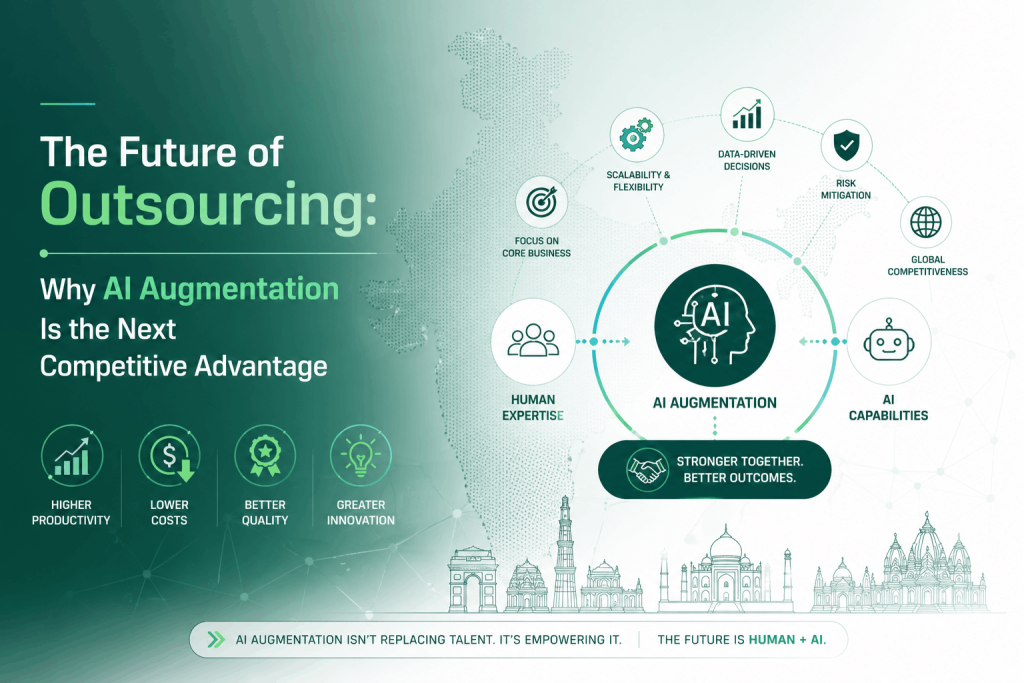
AI augmentation in outsourcing refers to equipping offshore and remote workers with artificial intelligence tools such as generative AI platforms, NLP systems, and predictive analytics to enhance their output speed, accuracy, and value. Rather than replacing human talent, AI augmentation amplifies what outsourced teams can deliver, making it the defining competitive advantage in global staffing strategies for 2025 and beyond.
The future of outsourcing is no longer just about cutting costs. It is about combining skilled offshore and remote staffing with AI augmentation to drive smarter, faster business outcomes. Companies that integrate AI tools with outsourced talent are outperforming competitors on speed, quality, and scalability. This shift is redefining what it means to build a global workforce in 2025 and beyond.
The Future of Outsourcing: How AI Augmentation Is Reshaping Global Staffing
The outsourcing industry has undergone a fundamental transformation. For decades, businesses leveraged offshore staffing primarily to reduce operational costs. Today, that model is evolving rapidly. AI augmentation, which is the practice of empowering human workers with artificial intelligence tools, is emerging as the defining competitive advantage for companies that rely on remote and offshore teams.
Rather than replacing outsourced workers, forward-thinking businesses are using AI to amplify their capabilities, increase throughput, and deliver higher-value outputs at reduced turnaround times.
Why AI Augmentation Is the Future of the Offshore Staffing Model
AI augmentation means workers are equipped with intelligent tools such as generative AI platforms, automated workflow systems, and predictive analytics dashboards. These tools help teams perform tasks with greater accuracy and speed. In an offshore staffing context, this translates to faster project delivery, fewer errors, and measurable productivity gains without proportional increases in headcount or cost.
According to Deloitte’s 2023 Global Outsourcing Survey, 76% of executives cited digital transformation, including AI adoption, as a top driver for outsourcing decisions. This marks a notable shift from cost reduction being the sole priority.
Key Statistics on AI Augmentation and Remote Staffing
Understanding the momentum behind this shift requires looking at the numbers. Here are the most relevant data points shaping the conversation:
- According to Businesswire , the global outsourcing market is projected to reach $904.9 billion by 2027, with technology-driven services accounting for the fastest-growing segment.
- According to Deloitte’s Global Outsourcing Survey (2023), 57% of companies use outsourcing to focus on core business functions, while an increasing number cite AI-enabled productivity as a key outsourcing benefit.
- According to MIT Sloan School Of Management, businesses that integrate AI tools into their workforce operations report productivity gains of up to 40% compared to teams that rely on traditional workflows.
- According to Businesswire, the AI software market is expected to grow to $126 billion by 2025, much of which will be deployed in enterprise workforce and outsourcing environments.
How AI Augmentation Creates a Competitive Advantage in Remote Staffing
AI-Powered Tools That Are Elevating Offshore Staffing Performance
The practical impact of AI augmentation on outsourced teams is already visible across industries. Here are the primary areas where AI is creating measurable competitive advantages:
- Automated quality assurance: AI tools can review code, content, and data outputs in real time, reducing the need for extensive manual review cycles.
- Intelligent task routing: Workflow automation platforms direct tasks to the most qualified available team members, cutting idle time and improving throughput.
- Natural language processing (NLP) tools: Offshore customer service and support teams use AI-driven NLP platforms to handle higher ticket volumes with greater consistency.
- Predictive analytics: Remote staffing managers can use AI dashboards to forecast workload spikes, enabling proactive resource planning.
A widely cited example is the use of AI writing assistants and research tools in offshore content and marketing teams, which have been shown to reduce content production time by 30 to 50% without sacrificing quality.
The Role of Remote Staffing in an AI-First Business Strategy
Remote staffing and AI augmentation are natural partners. Distributed teams already operate within digital-first environments, making them well-positioned to adopt AI tools quickly. When companies hire skilled offshore professionals and equip them with the right AI platforms, the result is a workforce that is both cost-efficient and high-performing.
This model is especially powerful for:
- Software development and QA testing — AI-assisted coding and automated testing accelerate delivery cycles.
- Finance and accounting — AI-powered reconciliation and reporting tools reduce manual errors and processing time.
- Customer support — Chatbots handle tier-1 queries while offshore agents focus on complex, high-value interactions.
- Data entry and management — Intelligent automation handles repetitive tasks, freeing offshore staff for analytical work.
Overcoming the Challenges of AI-Augmented Offshore Staffing
Common Barriers to AI Adoption in Outsourcing and How to Address Them
Despite the clear benefits, many companies face real challenges when implementing AI augmentation within their outsourced teams. These include:
- Skills gaps: Not all offshore workers are trained on the latest AI tools. The solution is to partner with staffing providers that offer AI-readiness training as part of their onboarding process.
- Data security concerns: Sharing sensitive data with AI platforms requires strict protocols. Companies should ensure their outsourcing partners comply with SOC 2, GDPR, or ISO 27001 standards.
- Integration complexity: Connecting AI tools with existing workflows and systems requires careful planning. A phased rollout approach reduces disruption.
- Change management: Team adoption of AI tools depends on clear communication, leadership buy-in, and ongoing support.
Addressing these challenges proactively is what separates companies that extract real value from AI augmentation from those that see limited results.
Key Takeaways: AI Augmentation and the Future of Outsourcing
- The future of outsourcing combines offshore talent with AI tools to maximize productivity and business value.
- AI augmentation does not replace outsourced workers. It amplifies their capabilities and output.
- The global outsourcing market is projected to reach $904.9 billion by 2027, driven heavily by technology-enabled services.
- 76% of executives cite digital transformation as a top driver for outsourcing decisions (Deloitte, 2023).
- Companies using AI in their workforce report productivity gains of up to 40% (Forbes, 2024).
- Remote staffing teams are well-positioned to adopt AI tools quickly due to their digital-first work environments.
- Key industries benefiting from AI-augmented offshore staffing include software development, finance, customer support, and data management.
- Overcoming skills gaps, data security concerns, and integration challenges is critical to successful AI adoption in outsourcing.
What the Future of Outsourcing Looks Like by 2026 and Beyond
The next phase of outsourcing will be defined by strategic partnerships between businesses and staffing providers that can offer AI-ready talent. Companies will no longer just ask “how much does this cost?” They will ask “how much value can this team generate?”
AI-augmented remote staffing models will allow businesses of all sizes to access enterprise-level productivity without enterprise-level overhead. The competitive gap between companies that embrace this model and those that do not will widen significantly over the next two to three years.
The organizations that act now, building offshore teams equipped with AI tools, supported by strong training, and integrated with clear workflows, will be best positioned to lead in their industries.
Conclusion: Build Your AI-Augmented Workforce with Neuhire
The future of outsourcing is already here. AI augmentation is transforming offshore and remote staffing from a cost-saving tactic into a true strategic advantage. Businesses that align skilled global talent with powerful AI tools are achieving faster results, higher quality, and greater scalability than ever before.
If you are ready to build an AI-ready offshore or remote team that gives your business a measurable competitive edge, Neuhire is here to help. Our staffing solutions connect you with highly skilled professionals equipped to work with today’s most powerful AI platforms.
Contact Neuhire today to learn how our offshore and remote staffing solutions can help your business harness the full power of AI augmentation.

Marketing professional with a passion for people, creativity, and growth. I love turning ideas into campaigns that connect and inspire. Currently part of the Neuhire team, helping businesses find the right talent fast.

Marketing professional with a passion for people, creativity, and growth. I love turning ideas into campaigns that connect and inspire. Currently part of the Neuhire team, helping businesses find the right talent fast.