
What to Automate in Hiring and What Not To: A Strategic Guide
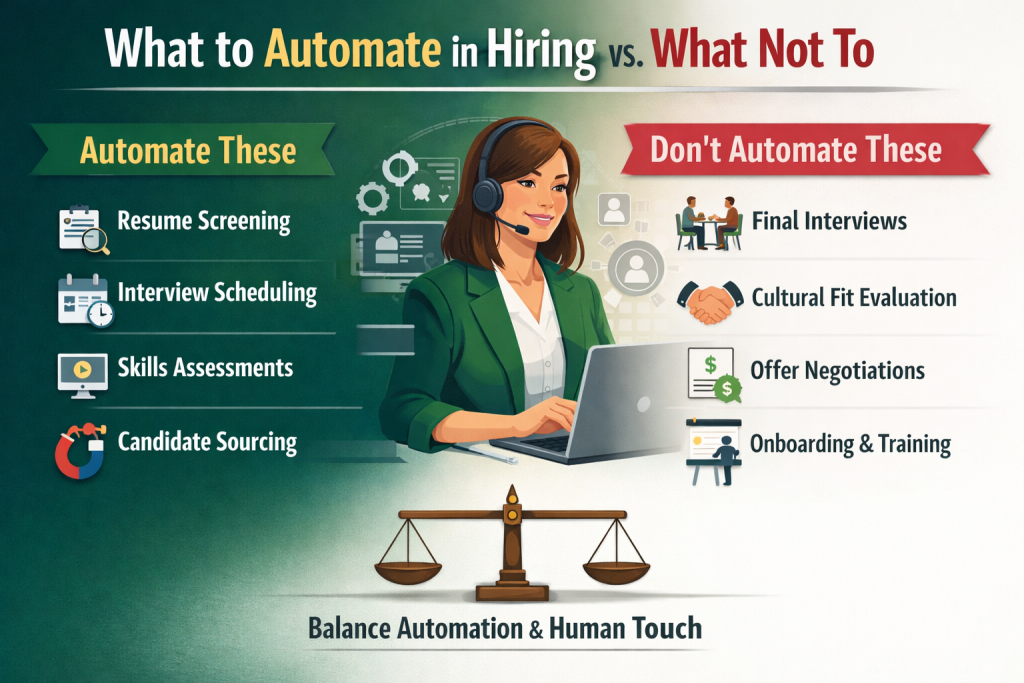
To stay competitive in 2026, companies must balance efficiency with empathy. Automation in hiring should focus on high-volume, repetitive tasks like resume screening and interview scheduling to save time. Conversely, final interviews, cultural fit assessments, and offer negotiations must remain human-led to ensure quality hires and a positive candidate experience.
Quick Facts: Recruitment Automation at a Glance
- 99% of hiring managers now use AI in some capacity within their recruitment process.
- 70% reduction in time-to-hire can be achieved through effective recruitment automation.
- 93% of leaders emphasize that human involvement remains essential despite AI adoption.
- $11,000 is the average annual saving per employee for companies optimizing remote and automated workflows.
The Rising Role of AI in Hiring
The global landscape of talent acquisition has shifted. Companies no longer view Recruitment Automation as a luxury but as a necessity for managing the sheer volume of digital applications. By Using AI to Screen Candidates, organizations can move the needle on productivity while allowing recruiters to focus on high-value human interactions.
Current Statistics on Automation in Hiring
Recent data highlights how rapidly these technologies are being integrated into the modern workplace:
- Efficiency Gains: According to Insight Global (2025), 98% of hiring managers saw significant improvements in hiring efficiency by using AI for tasks like scheduling and resume screening.
- Investment Trends: As reported by SmartRecruiters (2024), 81% of surveyed companies planned to invest in AI-driven solutions to automate and enhance their recruiting processes.
- Market Growth: Workable (2024) notes that the AI recruitment industry’s global market size reached approximately $590 billion in 2023 and continues to expand as 78.9% of professionals foresee an increase in AI importance.
What to Automate in Hiring?
Automation is most effective when applied to the “mechanical bridges” of recruitment. These are the steps that link major milestones but often become bottlenecks due to manual data entry or back and forth communication.
1. High-Volume Resume Screening
Using AI to Screen Candidates is perhaps the most impactful use of automation. AI tools can analyze thousands of resumes in seconds, identifying key skills and qualifications that match the job description. This ensures that recruiters spend their time talking to the top 5% of applicants rather than sorting through the bottom 95%.
2. Interview Scheduling and Reminders
Coordination is a major time-sink. Automated scheduling tools allow candidates to select available slots directly from a recruiter’s calendar. This eliminates the “email tag” game and reduces candidate drop-off rates by providing an immediate next step.
3. Initial Candidate Communication
Automated “thank you” emails, status updates, and FAQ chatbots keep candidates engaged. In a market where 64% of candidates withdraw due to poor communication, these automated touchpoints protect your employer brand.
4. Background Checks and Compliance
Standardized tasks like criminal record checks, employment verification, and drug testing can be triggered automatically once a candidate reaches a specific stage in your Applicant Tracking System (ATS).
| Sector | Average Time-to-Fill (Days) | Key Bottleneck |
|---|---|---|
| Finance & Accounting | 35–45 Days | Compliance & Background Checks |
| Technology / IT | 40–55 Days | Technical Assessments |
| Human Resources | 35 Days | Cultural Fit Evaluations |
| Administrative Support | 25–30 Days | High Application Volume |
| Healthcare | 50+ Days | Credentialing Requirements |
What Not to Automate in Hiring?
While AI in Hiring is powerful, it lacks the emotional intelligence (EQ) and nuance required for the final stages of the journey. Over-automation can make your company feel cold and transactional, driving away top-tier talent.
1. Cultural Fit and Values Assessment
AI can tell you if a person can do the job, but it cannot tell you if they should do it within your specific team. Assessing a candidate’s alignment with company values requires a human connection and the ability to read subtle social cues.
2. Final Interviews and Relationship Building
The final interview is as much about the candidate interviewing you as it is about you interviewing them. This is the stage for building trust and selling the vision of the company. Automating this stage often leads to a poor candidate experience and lower acceptance rates.
3. Offer Negotiations and Closing
Salary, benefits, and start dates often require nuance and flexibility. A human recruiter can navigate the “gray areas” of a negotiation, addressing a candidate’s specific concerns or motivations in a way an algorithm cannot.
4. Personalized Rejections for Finalists
Receiving an automated rejection after three rounds of interviews is a leading cause of negative Glassdoor reviews. Human-led feedback for finalists shows respect for their time and keeps the door open for future roles.
Best Practices for Using AI to Screen Candidates
To maximize the benefits of Automation in hiring without falling into common traps, follow these guidelines:
- Regularly Audit for Bias: AI models can replicate human biases if trained on flawed historical data. Conduct quarterly audits to ensure your screening tools are not unfairly penalizing specific demographics.
- Prioritize Data Quality: Automation is only as good as the data feeding it. Ensure your ATS records are clean and up to date to prevent “ghosting” candidates or sending irrelevant outreach.
- Maintain the “Human-in-the-Loop” Model: Use AI to suggest and rank, but let humans make the final selection. This hybrid approach combines the speed of tech with the accountability of people.
Case Study: Speed vs. Personalization
A major airline, faced challenges with resource-intensive walk-in interviews. By implementing a full-stack recruitment automation solution for initial screening and assessments, they reduced hiring costs by 3x and significantly slashed their time-to-hire. However, they maintained human-led panels for the final selection to ensure that the “face” of the company remained empathetic and professional.
Conversely, Amazon famously had to scrap an AI recruiting tool that showed bias against women because the historical data used to train the model was predominantly male. This serves as a vital reminder that AI in Hiring requires constant human oversight.
Conclusion: Balancing Tech and Touch
The goal of Recruitment Automation is not to replace the recruiter but to empower them. By automating the mundane, you create the “space” necessary to be truly human where it matters most: in the interviews, the negotiations, and the onboarding. A successful 2026 hiring strategy uses AI to handle the volume and humans to handle the value.
Are you looking to scale your team without losing the human touch? Neuhire specializes in finding the perfect balance between technology and talent. Whether you need offshore staffing solutions or advice on optimizing your recruitment tech stack, we are here to help.

Marketing professional with a passion for people, creativity, and growth. I love turning ideas into campaigns that connect and inspire. Currently part of the Neuhire team, helping businesses find the right talent fast.

Marketing professional with a passion for people, creativity, and growth. I love turning ideas into campaigns that connect and inspire. Currently part of the Neuhire team, helping businesses find the right talent fast.