
The Borderless Office: How to Manage a Team Across 5 Different Time Zones
Managing a team across different time zones takes skill, strategy, and discipline. When done right, remote staffing and offshore staffing unlock access to a global talent pool while boosting productivity and innovation. This guide explains how to lead teams in five or more time zones with proven techniques designed for growth, engagement, and peak performance.
Managing teams across different time zones requires clear communication, flexible scheduling, and strong processes that support collaboration anywhere in the world. With the rise of remote staffing and offshore staffing, leaders must learn how to coordinate work across geographic boundaries while maintaining productivity and team unity.
Quick Facts
- 22.5 percent of U.S. employees worked remotely in December 2025, reflecting the ongoing shift toward distributed work.
- Time zone challenges are cited as a major hurdle by remote workers, impacting communication and collaboration.
- Remote work now accounts for millions of workers, with 32.6 million Americans reporting remote work in 2025.
Why Offshore Staffing and Remote Staffing Matter in a Borderless Office
Offshore staffing and remote staffing allow companies to hire top talent worldwide without geographic limits. These models provide 24 hour coverage, access to specialized skills, and flexible work arrangements that benefit both employers and employees.
However, working across five different time zones brings challenges. Differences in work hours can slow decision making, create misaligned expectations, and make scheduling synchronous meetings difficult. The key is to design processes that turn these differences into strengths.
The Challenges of Managing Across Different Time Zones
What Are the Core Time Zone Challenges?
Managing teams across multiple time zones often leads to:
- Reduced overlap hours for real time collaboration.
- Delays in responses and decision making.
- Communication gaps and misunderstandings.
- Difficulty scheduling meetings that suit all team members.
According to workplace research, time zone differences are one of the top challenges in remote work, affecting team coordination and productivity.
Best Practices for Leading Across 5 Time Zones
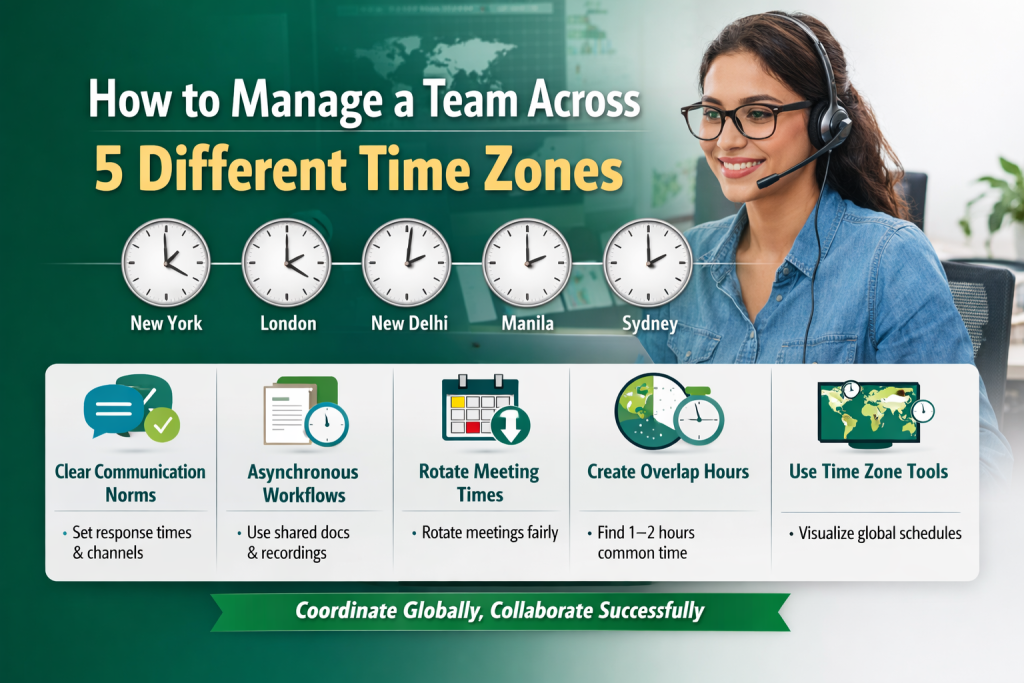
Establish Clear Communication Norms
Clear communication standards ensure everyone understands how and when to interact regardless of location.
Under this strategy, you should:
- Define response time expectations (for example within 24 hours).
- Use consistent communication channels (like Slack, Teams, or email).
- Document decisions and project plans for asynchronous review.
Tip: Set team norms for when to use real time chats versus async updates.
Embrace Asynchronous Workflows
Asynchronous work means that team members do not need to be online at the same time to be productive.
- Use shared documents for project updates.
- Record meetings with summaries so those in other time zones stay informed.
- Allow flexible contributions outside standard hours.
This style of work helps avoid bottlenecks when teams span continents and supports remote staffing structures where synchronous overlap is minimal.
Rotate Meeting Times to Share Load
Meeting times should be rotated regularly so that no one region always bears the inconvenience of late nights or early mornings.
Example rotation plan:
| Week | Time Zone Group A | Time Zone Group B |
|---|---|---|
| 1 | Best overlap | Moderate |
| 2 | Moderate | Best overlap |
| 3 | Least overlap | Most overlap |
This creates fairness and prevents burnout for team members in distant time zones.
Create Overlap Windows
Even with five time zones, you can identify limited overlap windows where most team members are available for live collaboration.
- Determine at least 1–2 hours of shared overlap.
- Use these windows for team syncing, planning, and collaboration.
- Outside of overlap, rely on asynchronous updates and documentation.
Use Time Zone Tools and Visual Aids
Tools that visualize global schedules help avoid confusion and reduce errors when planning calls or deadlines.
- Tools like World Time Buddy or Google Calendar time zones.
- Shared team dashboards with time zone displays.
These tools prevent simple mistakes like late night meetings for some team members.
Tools that Help Bridge Time Zones
To manage teams across 5 different time zones, the right technology stack is crucial:
- Communication Platforms like Slack, Microsoft Teams, or Discord.
- Project Tracking Tools such as Asana, Trello, or Jira.
- Shared Document Platforms like Google Workspace or Confluence.
- Time Zone Visualizers to plan shared times.
These tools help teams stay aligned, informed, and productive regardless of location.
Case Study: Scaling a Global Team
Scenario: A tech startup hires developers in India, designers in the Philippines, marketing specialists in Europe, and sales reps in North America.
Challenges faced:
- Minimal overlap between European and Asian time zones.
- Different national holidays and work weeks.
- Deadline confusion due to unclear timestamp references.
Solutions implemented:
- Standardized team norms for communication and decision documentation.
- Asynchronous workflows for design handoffs and sprint updates.
- Rotating schedules for weekly stand-ups to ensure no one always stays late.
- Shared project timeframes with clear deadlines by timezone stamps.
The result was higher team satisfaction, reduced delays, and consistent delivery of project milestones.
How to Improve Collaboration Across Time Zones
Here are specific, actionable tips:
- Clarify deadlines with exact time zone stamps (for example 5pm EST).
- Encourage team members to share working hours and local holidays in calendars.
- Establish a culture of documentation that reduces dependency on synchronous consensus.
Key Takeaways
- Offshore staffing and remote staffing drive access to talent worldwide but create time zone challenges.
- Clear communication norms and asynchronous workflows improve coordination across time zones.
- Tools and processes that visualize time differences prevent scheduling errors.
- Rotating meeting times fosters fairness and reduces team fatigue.
- Success in distributed teams comes from intentional design and sustained collaboration practices.
Conclusion
Managing a team across five different time zones is achievable with thoughtful processes, the right tools, and a focus on clear communication. By embracing remote staffing and offshore staffing, businesses can tap into top global talent while building cohesive, productive teams. Use overlap windows wisely, rotate meeting responsibilities, and support asynchronous workflows to keep your borderless office running smoothly.
Ready to build a high performance global team? Contact Neuhire for expert offshore staffing solutions and streamline your distributed workforce today.

Marketing professional with a passion for people, creativity, and growth. I love turning ideas into campaigns that connect and inspire. Currently part of the Neuhire team, helping businesses find the right talent fast.

Marketing professional with a passion for people, creativity, and growth. I love turning ideas into campaigns that connect and inspire. Currently part of the Neuhire team, helping businesses find the right talent fast.