

Offshore vs Nearshore vs Onshore Staffing: What’s Best Now?
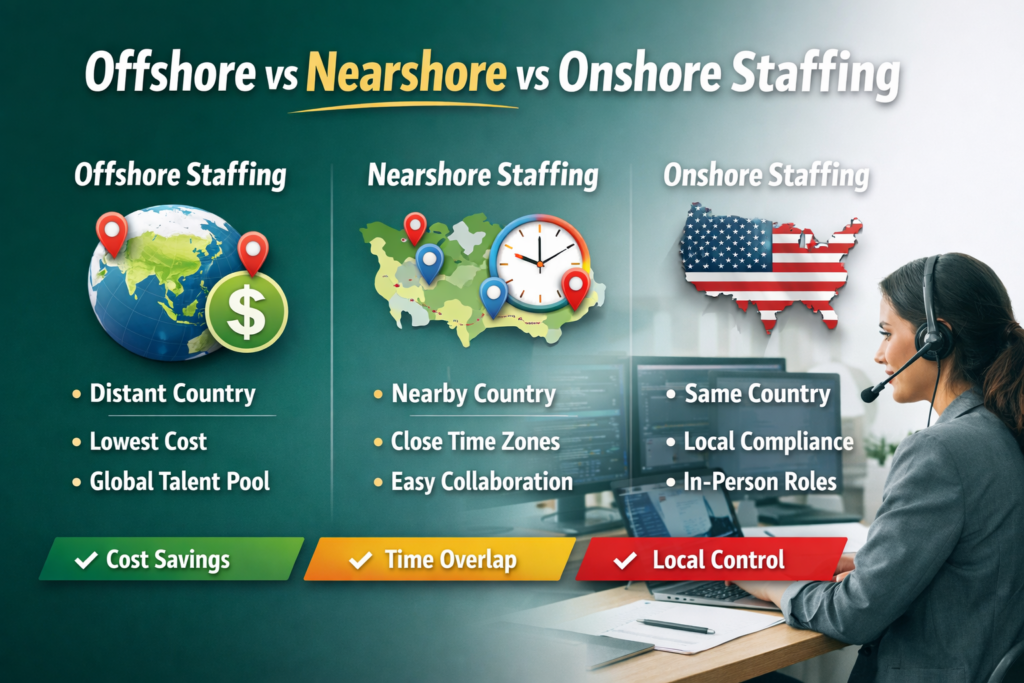
Offshore staffing is often the best choice right now for companies that need to scale quickly, reduce costs, and access hard-to-find talent without sacrificing quality. While nearshore staffing and onshore staffing can be ideal for certain roles, offshore staffing stands out in 2026 because it expands your hiring reach globally, supports round-the-clock productivity, and helps teams deliver more with leaner budgets.
Quick Facts: Offshore vs Nearshore vs Onshore Staffing
- Offshore staffing is best for cost savings, fast scaling, and expanding specialized talent access.
- Nearshore staffing works well for real-time collaboration when time zone overlap is essential.
- Onshore staffing is ideal for regulated roles, leadership positions, or in-person requirements.
Recent Offshore and Global Staffing Statistics (2023–2025)
Here are recent numbers that explain why offshore staffing continues to grow:
- According to Deloitte, 2024, business and technology leaders continue to use outsourcing to increase efficiency and focus on core operations, reinforcing why offshore staffing remains a strategic model, not just a cost-cutting tactic.
- According to Grand View Research, 2024, the global IT services outsourcing market was estimated at USD 744.6 billion in 2024, showing strong enterprise demand for offshore and distributed delivery models.
- According to Precedence Research, June 11, 2025, the global IT services outsourcing market was estimated at USD 611.80 billion in 2024 and is projected to grow substantially through 2034.
- According to Investopedia (citing U.S. Bureau of Labor Statistics time use data), 2023, 35% of full-time employees worked remotely at least part of the time, which supports the broader normalization of global and offshore staffing models.
- According to Forbes, October 21, 2022, global business process outsourcing (BPO) spend was projected to reach $212 billion in 2023, showing how outsourcing continues to be a major lever for growth and operational resilience.
Offshore Staffing vs Nearshore vs Onshore Staffing: What’s the Difference?
Offshore staffing means hiring talent in a distant country to lower costs and access a wider talent pool. Nearshore staffing means hiring in nearby countries for closer time zone overlap. Onshore staffing means hiring in your own country for maximum alignment and compliance simplicity.
Comparison Table
| Staffing Model | Best For | Biggest Advantage | Biggest Tradeoff |
|---|---|---|---|
| Offshore Staffing | Scaling fast and cost-effectively | Lowest cost + broadest talent pool | Time zone and process discipline needed |
| Nearshore Staffing | Agile collaboration with overlap | Real-time teamwork | Higher cost than offshore |
| Onshore Staffing | Regulated or in-person work | Compliance and culture fit | Highest cost, slower hiring |
Why Offshore Staffing Is Often the Best Choice Right Now?
Offshore staffing is often the best option today because it helps companies reduce hiring costs, scale teams faster, and access global skills that are limited or expensive locally. It is especially effective when you have clear roles, measurable deliverables, and a strong onboarding process that supports distributed collaboration.
In a market where speed matters and budgets are under pressure, offshore staffing gives companies room to grow without constantly sacrificing scope or timelines.
Top Benefits of Offshore Staffing (and Why Companies Prefer It)
Offshore staffing has evolved. It is no longer a “cheap labor” option. Done right, it is a strategic advantage.
1) Offshore staffing gives you a bigger talent pool instantly
One of the biggest challenges with onshore staffing is scarcity. Even if your budget is competitive, you may still struggle to find:
- Cloud engineers
- Data analysts and data engineers
- Full-stack developers
- QA automation specialists
- DevOps and SRE talent
Offshore staffing expands your access to skilled professionals in markets where supply is stronger and hiring pipelines move faster.
2) Offshore staffing reduces costs without reducing output
Offshore staffing typically provides a better cost-to-delivery ratio than onshore hiring because:
- Labor costs are lower
- Scaling headcount is easier
- Your local team can stay focused on strategy and stakeholder management
This can be the difference between building a product in 6 months versus extending timelines to accommodate budget constraints.
3) Offshore staffing can accelerate delivery with “follow-the-sun” productivity
Offshore staffing can support near 24/7 execution when structured correctly. For example:
- Your U.S. team closes out the day with priorities
- Your offshore team continues progress overnight
- Work is ready for review the next morning
This model can shorten development cycles, increase release frequency, and reduce turnaround time for bug fixes.
When Offshore Staffing Beats Nearshore Staffing and Onshore Staffing
Offshore staffing is the best option when cost efficiency, speed-to-scale, and skill availability matter more than constant real-time collaboration. While nearshore staffing and onshore staffing are valuable in specific contexts, offshore staffing is often the most powerful model for businesses that need fast execution and reliable delivery at scale.
Offshore staffing tends to outperform other models when:
- Your hiring market is too competitive locally
- You are building internal tools, platforms, or product features
- You need specialized skills quickly
- You want to scale without doubling payroll costs
Offshore Staffing Use Cases That Deliver the Highest ROI
Below are some of the most common areas where offshore staffing performs exceptionally well.
Offshore software development teams
Offshore staffing works well for product engineering because success is measurable. You can track:
- Velocity and sprint completion
- Code quality and defect rates
- Cycle time and release frequency
- Story points delivered
This makes offshore staffing easy to manage, optimize, and scale.
Offshore QA and test automation
QA is one of the highest ROI offshore staffing categories because it improves product quality while reducing long-term engineering rework.
Offshore QA teams can cover:
- Manual regression testing
- Automated test scripts
- Performance testing
- Cross-device testing
Offshore support and operations
If your business needs extended hours, offshore staffing enables:
- After-hours help desk support
- Infrastructure monitoring
- Incident response escalation support
- Ticket triage and resolution queues
This is especially valuable for companies with global customers.
Offshore Staffing Challenges (And How to Solve Them)
Offshore staffing succeeds when you plan for operational structure, communication, and accountability. The risks are real, but they are manageable with the right approach.
Challenge 1: Time zone differences
Time zones can slow approvals and create delays if teams depend on constant back-and-forth.
Solution: Create 2–4 hours of overlap and use clear async workflows:
- Daily written updates
- Task boards in Jira or Azure DevOps
- Loom walkthroughs for handoffs
- Documented acceptance criteria
Challenge 2: Communication and context gaps
Offshore staffing fails when requirements are vague or constantly changing without alignment.
Solution: Improve clarity using:
- Defined user stories
- Strong product documentation
- Recorded sprint kickoffs
- A single source of truth for requirements
Challenge 3: Quality control concerns
Some companies worry offshore staffing will reduce quality. Usually, quality issues come from poor onboarding, not geography.
Solution: Set standards early:
- Code reviews and QA checklists
- Definition of done
- PR templates and testing requirements
- Structured onboarding and shadowing
Offshore vs Nearshore Staffing: Which Is Better for Agile Teams?
Offshore staffing is better for agile teams when your sprints are well-defined and the team can work independently with clear deliverables. Nearshore staffing may be better when your work requires constant meetings, live collaboration, or rapid stakeholder feedback throughout the day.
A practical way to decide:
- Choose offshore staffing when you need scale and output
- Choose nearshore staffing when you need live collaboration
- Combine both when you want speed plus flexibility
Offshore vs Onshore Staffing: Which Is Better for Compliance and Security?
Onshore staffing is usually better for highly regulated environments, but offshore staffing can still be secure when managed with the right controls. Many organizations successfully use offshore staffing while meeting security standards by implementing strong access rules and governance.
Offshore staffing can be a safe option if you apply:
- Role-based access controls (RBAC)
- SSO and MFA for systems
- VPN and device policies
- Auditing and logging
- Clear contract and IP protection terms
The Best Model Now: Offshore-First Staffing with Onshore Leadership
For many companies today, the best approach is offshore-first staffing, supported by onshore leadership for strategy, compliance, and stakeholder alignment. This model creates a strong balance between efficiency and control.
Offshore-first structure example
Here is a model that works well in practice:
- Onshore: Product owners, solution architects, security leadership
- Offshore: Developers, QA, data teams, DevOps support
- Optional nearshore: Agile coordinators or integration teams for overlap
This approach maximizes value while minimizing costs.
Key Takeaways: Offshore Staffing vs Nearshore Staffing vs Onshore Staffing
- Offshore staffing is often the best choice now for cost savings, scalability, and access to specialized talent.
- Nearshore staffing is helpful for high-collaboration workflows but is usually more expensive than offshore.
- Onshore staffing is ideal for regulated, executive-facing, or location-dependent roles.
- The highest-performing organizations use an offshore-first strategy with strong processes.
- The best results come from clear expectations, measurable outputs, and structured management.
Conclusion: What’s Best Now?
Offshore staffing has become the strongest option for many companies because it enables faster growth, better access to talent, and significant cost efficiency in a competitive hiring market. Nearshore staffing and onshore staffing still have a place, especially for roles requiring constant collaboration or strict local compliance, but offshore staffing often delivers the best ROI when managed correctly.
Ready to build an offshore team that delivers? If you want to scale faster and reduce hiring costs without sacrificing quality, contact Neuhire for offshore staffing and remote staffing solutions built for speed, performance, and long-term success.

Marketing professional with a passion for people, creativity, and growth. I love turning ideas into campaigns that connect and inspire. Currently part of the Neuhire team, helping businesses find the right talent fast.

Marketing professional with a passion for people, creativity, and growth. I love turning ideas into campaigns that connect and inspire. Currently part of the Neuhire team, helping businesses find the right talent fast.