

How the Offshore Hiring Process Has Changed in the Last 5 Years
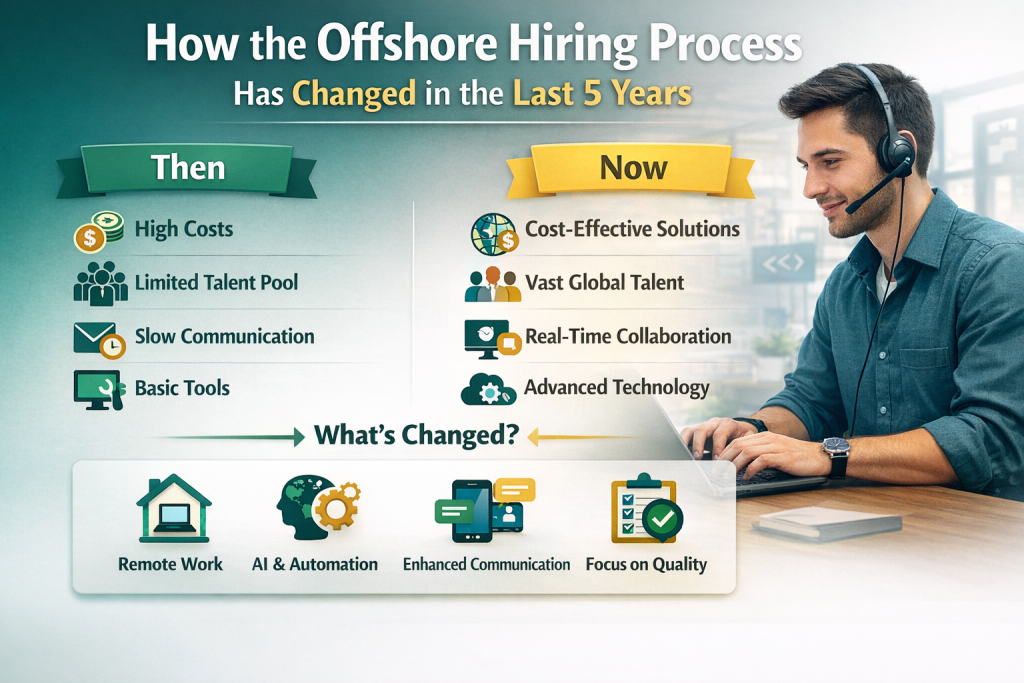
The offshore hiring process has evolved from a simple cost-saving tactic into a sophisticated, AI-driven strategy for accessing global innovation. Since 2021, the shift toward remote-first cultures and advanced recruitment technologies has shortened hiring cycles and prioritized high-value technical skills over geographical proximity. Today, businesses use offshore recruitment to build integrated, 24/7 global teams that drive 50% higher productivity through hybrid and distributed work models.
Key Takeaways on Offshore Hiring Trends
- Speed to Hire: AI-driven screening has reduced time-to-fill for offshore roles by nearly 30% since 2022.
- Cost Efficiency: Companies still achieve 40% to 80% labor cost savings by hiring in hubs like India and the Philippines.
- Market Growth: The global IT offshoring market is projected to surpass $500 billion by 2025.
- Cultural Integration: Modern offshore recruitment focuses on “culture-add” rather than just “culture-fit” to ensure long-term retention.
- Tech Dominance: IT services now account for approximately 75% of all global offshore contract values.
The Evolution of the Offshore Hiring Process
What was once a manual, resume-heavy ordeal has become a streamlined digital experience. Five years ago, the offshore hiring process primarily involved third-party vendors handling the “black box” of recruitment. You would send a job description and hope for the best.
Today, the process is transparent and collaborative. Hiring managers now have direct access to global talent pools through specialized platforms and AI-powered sourcing tools. This shift allows for more precise matching of specialized skills, especially in fields like AI development and cybersecurity.
According to Industry Data:
- Forbes (2024): 66% of U.S. companies now outsource at least one department, with roughly 300,000 jobs moved offshore annually to maintain competitiveness.
- Deloitte (2024): Firms adopting flexible and offshore talent models reported 74% less employee stress and a 50% increase in overall productivity.
- Statista (2024): Global IT outsourcing spending is expected to reach $731 billion by 2025, driven by rapid digital transformation.
- Grand View Research (2024): The HR Business Process Outsourcing (BPO) market reached $33.3 billion in 2024, highlighting the shift toward externalizing the recruitment process itself.
How AI and Automation Are Transforming Offshore Recruitment
How has AI changed recruitment in the last few years? AI now handles the heavy lifting of candidate sourcing and initial screening, allowing recruiters to focus on cultural alignment and complex technical assessments. Automated platforms can now analyze thousands of international resumes in seconds to identify the top 1% of talent.
1. Precision Sourcing
Modern offshore hiring uses predictive analytics to identify candidates who are not just qualified but likely to stay long-term. This has mitigated the “churn” often associated with high-growth offshore hubs.
2. Automated Technical Assessments
In 2020, technical interviews were often conducted over laggy video calls with manual whiteboarding. In 2025, candidates undergo automated, proctored coding challenges that provide objective data on their skill levels before they ever meet a hiring manager.
3. Asynchronous Interviewing
Time zone barriers used to be a major hurdle. Now, the offshore recruitment process utilizes asynchronous video interviews. Candidates record responses to set questions on their own time, which the hiring team reviews during their own business hours.
Comparing Old vs. New: Offshore Hiring Process
| Feature | The 2020 Model | The 2025 Model |
|---|---|---|
| Primary Goal | Cost reduction only | Access to specialized talent + Cost |
| Sourcing Method | Manual job boards/Vendors | AI-driven talent marketplaces |
| Interview Style | Synchronous video calls | Hybrid (Async + Live) |
| Onboarding | Paper-heavy and localized | Fully digital and cloud-based |
| Performance Tracking | Hourly check-ins | Output-based via integrated tools |
The Rise of New Offshore Recruitment Hubs
Five years ago, India and the Philippines dominated the conversation. While they remain leaders, the offshore hiring process has expanded into “nearshore” regions and new emerging markets. Latin America has become a powerhouse for North American firms seeking time-zone alignment, while Eastern Europe remains a go-to for high-end software architecture.
Emerging Markets to Watch:
- Latin America (Colombia, Mexico): Preferred for real-time collaboration.
- Southeast Asia (Vietnam, Thailand): Rapidly growing hubs for gaming and mobile dev.
- Eastern Europe (Poland, Romania): Known for deep expertise in R&D and cybersecurity.
Strategies for Optimizing Your Offshore Recruitment in 2026
To rank well in the current market, your offshore hiring process must be agile. Success no longer depends on finding the cheapest labor but on finding the most effective integration.
Prioritize Cybersecurity and Compliance
With the rise of remote work, data security has become the top priority in offshore recruitment. Ensure your process includes:
- ISO and SOC2 Compliance: Only partner with agencies that meet international security standards.
- Hardware Management: Use remote management software to secure offshore workstations.
- Strict NDAs: Standardize legal frameworks across different jurisdictions.
Focus on Employer Branding Globally
Top offshore talent now has more choices than ever. To attract the best, you must market your company as a “Global Employer of Choice.” This includes offering competitive local benefits, professional development opportunities, and a clear path for career growth within your organization.
Common Challenges and Modern Solutions
Challenge: Cultural Misalignment
2025 Solution: Incorporate cultural intelligence (CQ) testing into the interview stage. Use “soft skills” assessments to ensure the candidate can communicate effectively in a distributed team environment.
Challenge: High Attrition Rates
2025 Solution: Implement “stay interviews” and local-market-aligned compensation. Many companies now offer “offshore-first” benefits like health insurance that covers local providers.
Expert Tip: According to recent recruiting benchmarks, a sourced (outbound) offshore applicant is 5 times more likely to be hired than an inbound applicant. Proactive sourcing is now the gold standard for quality hires.
The Future of Offshore Hiring: What Comes Next?
As we look toward the end of the decade, the distinction between “local” and “offshore” will continue to blur. The “Global Capability Center” (GCC) model is becoming the standard for large enterprises. In this model, companies don’t just hire a few developers; they build entire functional departments overseas that operate with the same autonomy and authority as their domestic counterparts.
Blockchain technology is also beginning to play a role in offshore hiring by verifying candidate credentials and automating cross-border payments through smart contracts, ensuring transparency and trust for both parties.
Summary and Next Steps
The offshore hiring process has transitioned from a tactical necessity to a strategic advantage. By leveraging AI-driven sourcing, embracing asynchronous workflows, and focusing on cultural integration, businesses can build resilient teams that operate around the clock. The last five years have taught us that talent has no borders, and the most successful companies are those that build the best bridges to reach it.
Ready to Scale Your Global Team?
Navigating the complexities of modern offshore recruitment requires expertise and the right technology. If you are looking to tap into top-tier global talent without the overhead, Neuhire can help. We specialize in connecting forward-thinking companies with the world’s best professionals.

Marketing professional with a passion for people, creativity, and growth. I love turning ideas into campaigns that connect and inspire. Currently part of the Neuhire team, helping businesses find the right talent fast.

Marketing professional with a passion for people, creativity, and growth. I love turning ideas into campaigns that connect and inspire. Currently part of the Neuhire team, helping businesses find the right talent fast.