
How Data-Driven Hiring Improves Retention
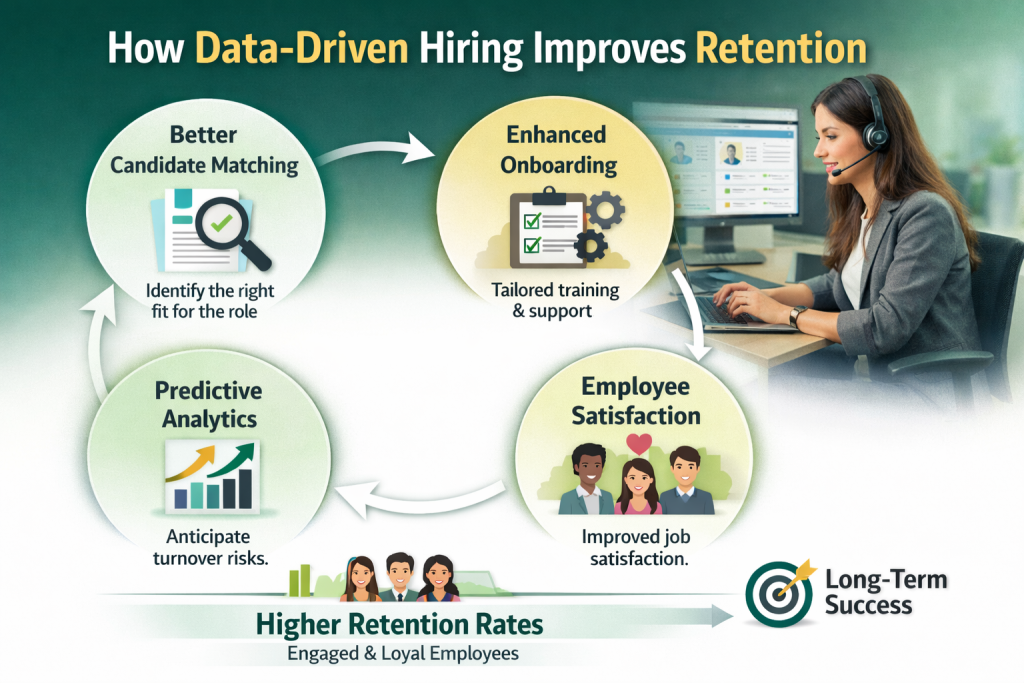
Data-driven hiring is one of the fastest ways to improve employee retention because it replaces guesswork with measurable signals of fit, performance, and engagement. Instead of relying on intuition alone, companies use recruitment analytics to predict which candidates are most likely to succeed, stay longer, and thrive in specific roles and teams.
In this guide, you’ll learn exactly how data-driven recruitment improves retention, what metrics to track, and how to build a process that reduces regrettable turnover.
Quick Facts: Data-Driven Hiring and Retention
- Data-driven recruitment improves quality of hire by aligning candidates to role requirements using measurable evidence.
- Better hiring decisions reduce early attrition, one of the most expensive types of turnover.
- Recruitment analytics helps identify what predicts long-term success, including skills, motivation, and team fit.
- Companies can build repeatable hiring processes that scale without lowering retention.
What Is Data-Driven Hiring?
Data-driven hiring is the practice of using structured data, measurable signals, and recruitment analytics to make better hiring decisions. It helps companies move beyond gut instinct by evaluating candidates using consistent criteria like skills assessments, performance indicators, and role success patterns.
Data-driven hiring typically includes:
- Skills-based screening and structured interviews
- Recruiting funnel metrics and conversion rates
- Quality of hire measurement after onboarding
- Predictive indicators tied to retention outcomes
When done right, it improves retention by selecting candidates who are more likely to succeed long-term.
Why Data-Driven Hiring Improves Retention
Data-driven hiring improves retention because it increases hiring accuracy. Companies select candidates based on evidence of job fit, skills match, and performance predictors, which reduces early turnover and “regrettable attrition.” It also helps teams refine job requirements and interview processes based on real outcomes, not assumptions.
5 Recent Hiring and Retention Statistics
Here are 5 current, retention-relevant stats that support the business case for data-driven recruitment and analytics.
- Turnover costs are massive
According to Work Institute, 2024, U.S. companies spent nearly $900 billion to replace employees who quit in 2023. - Quits remain high enough to require retention-focused hiring
According to Work Institute, 2024, the U.S. had a 37% quit-rate increase since 2014, showing turnover remains a structural workforce challenge. - Organizations are still operating with complex workforce pressures
According to Deloitte, 2024, organizations are navigating major workforce shifts and redefining how work gets done, requiring stronger talent strategies that include data and workforce insights. - Skills-based hiring is becoming a mainstream filter
According to WIRED citing LinkedIn data, 2023, more than 40% of hirers are using skills to screen and search for candidates on LinkedIn. - Turnover is often preventable, which makes hiring strategy critical
According to Work Institute (via ASIS), 2025, 63% of job exits were preventable in 2024, driven by issues like career stagnation, work-life balance, and management failures
How Recruitment Analytics Predicts Retention Outcomes
Recruitment analytics predicts retention by measuring patterns between hiring inputs and employee outcomes. For example, companies can connect assessment results, interview scores, and candidate experience data to retention milestones like “still employed at 6 months” or “promoted within 12 months.”
This shifts hiring from reactive to predictive.
Common predictive indicators include:
- Prior role stability and progression patterns
- Skills proficiency levels (tested, not assumed)
- Interview performance in job-relevant competencies
- Alignment between candidate expectations and job reality
- Manager effectiveness signals in the target team
Data-driven hiring supports workforce planning too
Data-driven hiring also improves workforce planning, which supports long-term retention. When hiring decisions are aligned with business demand forecasting, capacity planning, and skills coverage, teams can avoid both over-hiring and employee burnout. For enterprise organizations, this directly reduces churn caused by workload imbalance and role mismatch.
To explore how this strategy strengthens planning and retention outcomes at scale, read VIVA USA’s guide on data-driven workforce planning for large enterprises.
How Data-Driven Hiring Reduces Early Turnover
Data-driven hiring reduces early turnover by preventing misalignment in the first place. Many employees leave in the first 90 to 180 days because the job is not what they expected, the skills mismatch is too large, or the manager fit is wrong.
Here’s how analytics addresses that:
1) It clarifies what “good” looks like
Instead of vague requirements like “strong communication skills,” teams define measurable success indicators such as:
- Ability to handle specific workflows
- Accuracy or speed benchmarks
- Collaboration behaviors tied to performance
2) It creates consistent evaluation
Structured interviews and scoring rubrics reduce subjective decision-making, which lowers mismatch risk.
3) It improves expectation matching
When you track candidate questions, offer declines, and early churn reasons, you can identify where job messaging creates unrealistic expectations.
The Best Data-Driven Recruitment Metrics to Track for Retention
The best recruitment analytics metrics for retention are the ones that connect hiring decisions to long-term employee outcomes. If you only track time-to-fill, you may accidentally optimize for speed instead of quality.
Track these metrics in your hiring dashboard
Hiring Funnel Metrics (top of funnel)
- Source-to-hire conversion rate
- Pass-through rate by stage
- Candidate drop-off rate
Quality of Hire Metrics (post-hire)
- 90-day performance rating
- Hiring manager satisfaction score
- Ramp time to productivity
Retention Metrics (what you really care about)
- 90-day retention rate
- 6-month retention rate
- 12-month retention rate
- Regrettable turnover rate
Data-Driven Hiring vs Traditional Hiring (Comparison Table)
| Category | Traditional Hiring | Data-Driven Hiring |
|---|---|---|
| Decision Style | Gut instinct and resumes | Evidence and structured evaluation |
| Interview Format | Unstructured, inconsistent | Structured, scored, comparable |
| Predicting Success | Based on past titles | Based on verified skills and competencies |
| Bias Risk | Higher | Lower (when designed correctly) |
| Retention Impact | Unclear and reactive | Measured and optimized over time |
This is why data-driven recruitment is a retention strategy, not just a recruiting strategy.
How Data-Driven Recruitment Improves Quality of Hire
Data-driven recruitment improves quality of hire by using measurable signals that correlate with job performance and retention. Instead of hiring based on “who interviewed best,” companies can hire based on who demonstrates the strongest match to the role’s success profile.
Quality-of-hire improvements usually come from:
- Skills assessments tied to actual job tasks
- Interview scorecards aligned to competencies
- Data from past high-performing employees
- Better calibration between hiring managers and recruiters
This directly improves retention because the employee is more likely to succeed without burnout, confusion, or performance issues.
Case Example: Turning High Turnover into a Measurable Hiring Upgrade
Imagine a customer support team experiencing churn every 4 to 6 months. They assume it is “just the market.”
A data-driven approach reframes the problem:
Step 1: Audit retention patterns
Recruitment analytics reveals turnover is highest among hires who:
- had no prior experience in high-volume ticket environments
- expected sales-like commissions
- were assigned to managers with heavier team workloads
Step 2: Update the hiring model
The company introduces:
- a short simulation test for ticket prioritization
- clearer job previews and expectation-setting
- a structured interview rubric focused on resilience and task-switching
Step 3: Measure outcomes
After 2 quarters, the company tracks:
- higher 6-month retention
- faster ramp time
- fewer performance-based terminations
This is the core retention advantage of data-driven hiring: you learn, improve, and repeat.
How to Build a Data-Driven Hiring Process (Step-by-Step)
A data-driven hiring process improves retention when it connects hiring decisions to performance and stay-rate outcomes over time. The key is building feedback loops, not collecting data for its own sake.
Step 1: Define retention success criteria
Examples:
- Retained 12+ months
- Meets expectations by day 90
- Strong manager feedback at 6 months
Step 2: Standardize candidate evaluation
Use:
- Structured interview questions
- Consistent scoring rubrics
- Job-relevant skills testing
Step 3: Use a skills-first screening approach
Skills-first filters help reduce overreliance on degrees or brand-name employers and can widen access to qualified talent.
Step 4: Track quality-of-hire outcomes by source
Not all recruiting sources produce equal retention. Compare:
- Job boards vs referrals
- Internal mobility vs external hires
- Agencies vs direct sourcing
Step 5: Optimize onboarding based on churn signals
Hiring and retention are linked. If your data shows churn at day 45, that is an onboarding issue you can fix.
Common Mistakes Companies Make with Recruitment Analytics
Even strong teams can misuse data-driven recruitment.
Avoid these common mistakes:
- Tracking only time-to-fill (speed is not retention)
- Ignoring hiring manager variance (some teams churn more due to leadership load)
- Over-automating hiring decisions (data informs, humans decide)
- Using outdated job requirements (your “ideal candidate” might not exist anymore)
- Failing to close the loop (no post-hire measurement = no improvement)
Key Takeaways: Data-Driven Hiring and Retention
- Data-driven hiring improves retention by reducing mismatch and improving quality of hire.
- Recruitment analytics helps identify which candidate signals predict long-term success.
- Measuring 90-day and 12-month retention creates feedback loops that improve hiring decisions.
- Structured interviews and skills assessments reduce bias and increase consistency.
- Turnover is expensive, and a meaningful share of exits are preventable with smarter hiring practices.
Conclusion: Retention Starts with Smarter Hiring
Data-driven recruitment gives teams a measurable way to reduce turnover, improve quality of hire, and build a workforce that stays longer. By tracking the right recruiting metrics, standardizing evaluation, and using analytics to improve hiring decisions over time, companies can reduce churn and protect productivity.
Need help building a retention-focused talent pipeline? Contact Neuhire for offshore and remote staffing solutions designed to improve quality of hire and long-term retention.

Marketing professional with a passion for people, creativity, and growth. I love turning ideas into campaigns that connect and inspire. Currently part of the Neuhire team, helping businesses find the right talent fast.

Marketing professional with a passion for people, creativity, and growth. I love turning ideas into campaigns that connect and inspire. Currently part of the Neuhire team, helping businesses find the right talent fast.