Skip to content
Neuhire Logo
  • Solutions
  • Hiring ROI
  • Company
    • Why Choose Us
    • Insights
  • Get Started
Get Started

Insights

  • Home
  • Insights
  • Page 3
Insights

What Roles Can Be Hired Remotely from India: How Businesses Achieve Up to 80% Cost Saving

December 10, 2025 Rajkumar R Comments Off on What Roles Can Be Hired Remotely from India: How Businesses Achieve Up to 80% Cost Saving

Businesses can hire top talent from India across IT, data, marketing, and support roles while saving up to 80% through lower labor costs, reduced overhead, and scalable offshore staffing models.

offshore-staffing-myths-truths
Insights

Debunking the Myths: Common Misconceptions About Offshore Staffing and the Strategic Truths

December 10, 2025 Rajkumar R Comments Off on Debunking the Myths: Common Misconceptions About Offshore Staffing and the Strategic Truths

A comprehensive guide that debunks common myths about offshore staffing and reveals how modern, dedicated global teams deliver high-quality talent, full control, scalability, and strategic business growth.

select-right-offshore-staffing-partner
Insights

How to Select the Right Offshore Staffing Partner: A Checklist for CTOs & CHROs

December 1, 2025 Rajkumar R Comments Off on How to Select the Right Offshore Staffing Partner: A Checklist for CTOs & CHROs

A practical checklist for CTOs and CHROs to select the best offshore or remote staffing partner by evaluating talent quality, compliance, scalability, cultural fit and overall value.

offshore-staffing-cost-saving
Insights

A Step-by-Step Guide to Building an Offshore Team for Your Company

November 26, 2025 Rajkumar R Comments Off on A Step-by-Step Guide to Building an Offshore Team for Your Company

Offshore staffing enables organizations to cut IT project costs by 40–60% while accessing global talent, reducing overhead, and accelerating delivery.

fortune-500-offshore-staffing
Insights

How Fortune 500 Companies Use Offshore Staffing to Stay Competitive

November 11, 2025 Rajkumar R Comments Off on How Fortune 500 Companies Use Offshore Staffing to Stay Competitive

Fortune 500 companies use offshore staffing to reduce costs, access specialized global talent, and achieve continuous operations for faster growth and innovation.

offshore-staffing
Insights

What Is Offshore Staffing? A Complete Guide for U.S. Companies

November 11, 2025 Rajkumar R Comments Off on What Is Offshore Staffing? A Complete Guide for U.S. Companies

Offshore staffing empowers U.S. companies to reduce costs, access skilled global talent, and scale operations efficiently with remote international teams.

offshore-staffing-india
Insights

Offshore Staffing in India: Accessing the World’s Largest Talent Pool

October 2, 2025 Rajkumar R Comments Off on Offshore Staffing in India: Accessing the World’s Largest Talent Pool

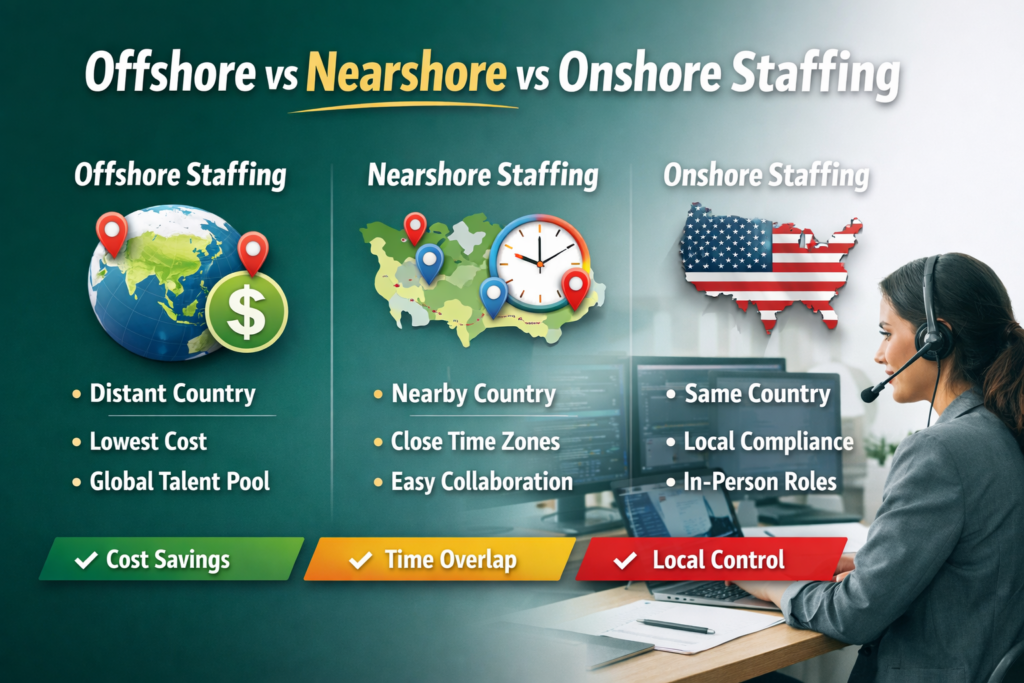
India is now a leading destination for offshore staffing, offering global enterprises unparalleled access to highly skilled, cost-effective talent across technology, operations, healthcare, finance, and more. With its vast workforce, strong English proficiency, and mature outsourcing ecosystem, India enables companies to scale quickly without compromising quality. In this article, we explore how offshore staffing in India works, the benefits, challenges, and how Neuhire helps you tap into this talent reservoir.  The Offshore Staffing Landscape: Why India Leads  India’s Dominant Market Position  According to offshoring industry data, India accounts for approximately 55% of the global offshoring market in many IT and business process sectors.  Offshore staffing in India can reduce labor costs by 30–70% compared to U.S. or European equivalents.  The India staffing and recruitment market was valued at US$ 18.06 billion in 2022, and is projected to grow to US$ 48.53 billion by 2030 (CAGR ~13.2%).  These numbers reflect not just cost savings, but sustained growth and structural strength in India’s workforce sector.  Benefits of Offshore Staffing in India  Here are the key advantages organizations gain:  1. Cost Efficiency and Scalability Lower wage structures, reduced overheads, and favorable operating costs allow companies to manage large offshore teams economically. Jensei reports that a software engineer in India may cost US $18,000–$30,000 annually, compared to US $90,000–$120,000 in the U.S.  2. Deep Talent Pool and Specialist Skills India produces a huge number of engineers, IT professionals, data scientists, and domain experts every year. This enables niche hiring and rapid scaling. Offshore staffing accounts for nearly 72% of global outsourcing contracts in IT services.  3. English Proficiency and Cultural Fit Many Indian professionals are educated in English, enabling seamless communication with clients in the U.S., U.K., Australia, and other markets. This reduces language barriers in remote collaboration.  4. 24/7 Coverage and Time Zone Leverage Indian teams can operate during U.S. off-hours or European late-hours, providing continuous progress on projects and quicker turnaround.  Offshore Staffing Services and Models  When companies offshore to India, they typically adopt one or more of these models:  Model Description Pros Considerations Staff Augmentation / Remote Staff Hire Indian professionals who function as part of your team High control, seamless collaboration Requires strong remote management Project-Based Teams Outsource full projects or modules Turnkey delivery, less overhead Less control over internal processes Managed Services / Offshore Vendor A third-party vendor provides full service Minimal client burden, vendor handles admin Dependent on vendor’s capabilities Global Capability Center (GCC) / Captive Unit Company sets up its own hub in India Maximum control, scalable, aligned with internal culture Greater setup cost, governance required Neuhire can work in any of these models, tailoring based on your business needs, risk tolerance, investment, and control preferences.  Common Use Cases and Industries  Offshore staffing in India supports a wide variety of sectors and functions:  Information Technology and Software Development: Full-stack development, backend systems, QA, cloud, DevOps, AI/ML, mobile apps  Business Process Outsourcing (BPO): Customer support, call centers, transcription, data entry  Finance and Accounting: Bookkeeping, tax, audit support, financial analysis  Healthcare and Life Sciences: Medical coding, telehealth support, clinical data management  Engineering and Manufacturing: CAD, design, simulation, testing  Administrative and Back Office: HR, scheduling, operations support  Challenges and Mitigation Strategies  No offshore model is without challenges. Here is how they appear and how Neuhire helps address them:  1. Time Zone and Communication Gaps Issue: Lack of real-time overlap can delay decisions and cause bottlenecks. Mitigation: Build overlap windows, implement “follow the baton” cycles, encourage asynchronous collaboration, and use tools like Slack, MS Teams, or Jira.  2. Managing Quality and Productivity Issue: Remote monitoring and accountability become difficult. Mitigation: Define clear SLAs, use milestone reviews, adopt OKRs and performance metrics, and schedule periodic audits.  3. Data Security and IP Protection Issue: Risks of leaks or compliance breaches exist. Mitigation: Apply NDAs, legal safeguards, restricted access, encryption, data localization, and work only with vetted providers.  4. Cultural Differences and Alignment Issue: Different work norms or communication styles can cause friction. Mitigation: Offer cross-cultural training, hold regular syncs, and create shared workflows.  5. Talent Attrition and Retention Issue: Market competition can increase turnover. Mitigation: Neuhire emphasizes career development, engagement programs, and competitive benefits.  How Neuhire Makes Offshore Staffing in India Work  1. Pre-Vetted Candidates Neuhire maintains a robust pipeline of vetted professionals across domains such as software, data, finance, healthcare, and engineering.  2. Flexible Deployment Models Whether you need a single remote developer or a full managed service, Neuhire adapts to your requirements.  3. Compliance and HR Support Neuhire manages payroll, contracts, benefits, and local labor laws so that you stay compliant.  4. Integration and Collaboration We set up collaboration stacks and ensure seamless workflow integration with your existing systems.  5. Continuous Oversight Dedicated delivery leads ensure performance reviews, alignment sessions, and consistent quality.  6. Retention and Engagement We implement recognition programs, mentorship, and career growth opportunities to reduce attrition.  Case Study Example  Client: U.S.-based SaaS scale-up Challenge: Needed to expand backend and DevOps teams rapidly but faced high U.S. costs. Solution: Partnered with Neuhire to staff 7 engineers in India, integrated into sprints and daily workflows. Results:  Reduced cost per engineer by about 60%  Delivered two feature releases on time  Improved retention and team cohesion  India vs Other Offshore Destinations  Country Strengths Challenges India Large talent pool, English proficiency, mature ecosystem, cost savings Time zone gaps with Europe, city-level wage pressure Philippines Strong BPO and customer service, cultural fit Smaller STEM talent base Eastern Europe Deep tech expertise, cultural alignment with Europe Higher costs, smaller labor market, geopolitical risks Trends in Offshore Staffing  AI and Automation: Indian teams increasingly use AI to streamline workflows.  High-Value Work: Beyond BPO, offshored teams deliver analytics and R&D.  Hybrid Models: Companies retain core strategy locally and offshore execution.  Remote-First Culture: Post-pandemic, global teams are more comfortable with remote integration.  Vendor Accountability: Clients expect strong SLAs and transparent reporting.  Getting Started with Neuhire  Define goals and scope of work  Assess governance and remote management capability  Partner with Neuhire for domain expertise and compliance support  Start with a pilot team, then scale  Measure performance with metrics and feedback  Build retention and engagement practices  Key Takeaways  India holds more than half of the global offshoring market in IT and business processes.  Offshore staffing in India can cut costs by 30–70% while delivering quality.  The

main-drivers-offshore-staffing
Insights

Exploring the Main Drivers of Offshore Staffing and How Neuhire Empowers Growth

October 2, 2025 Rajkumar R Comments Off on Exploring the Main Drivers of Offshore Staffing and How Neuhire Empowers Growth

Companies are increasingly adopting offshore staffing models to reduce costs, access untapped talent pools, speed up hiring, and improve return on investment (ROI). Neuhire offers a compelling case: remote staffing from India not only cuts expenses, but also improves hiring ROI by delivering measurable business value and faster time to productivity.  In this article, we explore the main drivers behind this shift, explain how hiring ROI should be calculated, and show how Neuhire’s approach aligns with high ROI strategies.  Main Drivers Motivating the Shift to Offshore Staffing  1. Significant Cost Optimization One of the principal attractions is the ability to lower labor and operating costs by 30–70 percent relative to in-country staffing, depending on role and location. By offloading administrative overhead, facilities, benefits, and compliance burdens, companies can reallocate capital to core innovation and growth.  2. Access to a Vast, Skilled Talent Pool Many developed markets suffer from shortages in specialized domains such as AI, data science, cybersecurity, and full-stack development. Offshore staffing opens up access to large, high-quality talent pools in India, enabling access to niche skills at scale.  3. Speed and Flexibility in Scaling Teams Offshore vendors often maintain candidate pipelines and scalable processes, allowing businesses to spin up teams quickly for new projects or expansions. This flexibility is especially useful in tech, startups, and product development cycles.  4. Focus on Strategic Functions By moving operational, support, or mid-level technical tasks offshore, in-house teams can concentrate on differentiation, leadership, customer experience, and growth initiatives.  5. Business Continuity and 24/7 Capability Due to time zone offsets, offshore teams can continue working while onshore teams sleep. This enables follow the sun workflows, continuous progress, and faster turnaround in global operations.  6. Mitigating Talent Scarcity in Local Markets In many regions (especially the United States, the United Kingdom, and parts of Europe), competition for tech and domain specialists is intense, and salaries are rising steeply. Offshore staffing bypasses that scarcity and cost inflation.  7. Compliance, Infrastructure and Technology Access Established offshore providers often bring infrastructure, security, collaboration tools, and compliance capabilities such as data protection, IP safeguards, and labor law expertise. This reduces the burden on the client organization to build these capabilities in-house.  8. Post-Pandemic Remote Work Acceptance Since remote and hybrid work models became normalized, offshore staffing is viewed less as outsourcing and more as an extension of distributed teams. Collaboration tools, asynchronous workflows, and remote management practices have matured.  What Is Hiring ROI (Return on Investment) and Why It Matters  Hiring ROI measures how effectively an organization’s investment in hiring contributes to actual business value. It goes beyond cost per hire or time to fill by evaluating how much return (in productivity, revenue, cost savings, or strategic impact) is generated by new hires.  How to Calculate Hiring ROI (Common Frameworks)  A common formula:  Hiring ROI (%) = (Value Delivered by New Hire – Total Cost of Hiring) ÷ Total Cost of Hiring × 100  Total Cost of Hiring includes recruitment marketing, sourcing, interviews, assessments, onboarding, training, benefits, and infrastructure.  Value Delivered can be measured in productivity gains, revenue generation, cost savings, or strategic contributions over a period.  Key Metrics That Influence Hiring ROI  Time to Productivity: How quickly a new hire becomes fully productive.  Quality of Hire: Measured via performance reviews, retention, and cultural fit.  Turnover or First Year Attrition: Early resignations severely erode ROI.  Offer Acceptance Rate: Low acceptance wastes recruiting investment.  Application Completion and Drop off Rates: High drop off means lost investment in candidate acquisition.  Improving these metrics directly boosts hiring ROI.  How Neuhire Positions Around Hiring ROI  Although the full data from Neuhire’s “Hiring ROI” page was inaccessible, the public summary indicates that Neuhire emphasizes ROI-driven staffing solutions from India.  Here is how Neuhire’s model aligns with maximizing hiring ROI:  Lower Input Costs: By leveraging India’s cost advantages, Neuhire helps reduce the “Total Cost of Hiring” denominator, making ROI more favorable.  Faster Ramp Up: Neuhire speeds up hiring and scaling, which improves time to productivity and increases the numerator (value delivered) more swiftly.  Scalable Remote Teams: Their model allows scaling teams for short or long durations, matching supply to demand and reducing overstaffing.  Domain Expertise and Pre Vetted Talent: Pre screened professionals reduce the risk of mismatch, improving quality of hire and lowering turnover risk.  Illustrative Example: How Hiring ROI Can Work in Practice  Let’s run a hypothetical scenario for a software engineer:  Total cost of hiring (recruitment, onboarding, salary, benefits for first year): USD 30,000  Value delivered in first year (revenue, cost savings, productivity): USD 60,000  Then:  Hiring ROI = (60,000 – 30,000) ÷ 30,000 × 100 = 100 percent  So for every dollar invested in that hire, the company gained another dollar in net value. By reducing cost of hiring through Neuhire’s offshore model or by accelerating productivity, ROI improves further.  Combining Offshore Staffing Drivers with Hiring ROI  The reasons companies switch to offshore staffing (cost, speed, talent access, continuity) are not isolated from ROI. They directly influence ROI improvements when implemented well.  Lower cost base reduces the denominator  Faster ramp and higher performance increase the numerator  Pre vetting and retention initiatives minimize losses from turnover  Flexible scaling reduces over investment or idle capacity  In essence, offshore staffing improves ROI across both sides of the equation.  Best Practices to Maximize Hiring ROI in Offshore Models  Define measurable goals up front (revenue targets, process improvements).  Use milestones and performance metrics early (30/60/90 day goals).  Track real productivity rather than just time employed.  Invest in onboarding and alignment so remote staff integrate quickly.  Monitor retention closely, since early exits can undermine ROI.  Use data and feedback loops to adjust hiring models.  Link hires to business outcomes such as feature delivery or cost savings.  Key Takeaways  Companies shift to offshore staffing to reduce costs, gain global talent access, increase speed, and maintain 24/7 operations.  Hiring ROI connects hiring investment to business returns.  Neuhire’s remote staffing model from India delivers ROI by lowering costs and accelerating productivity.  Key levers include time to productivity, quality of hire, turnover rates, and alignment with strategic goals.  Conclusion  Switching to offshore staffing models is not just about lowering costs. It is about creating sustainable, high return talent strategies. Offshore staffing becomes a multiplier for hiring ROI when structured intentionally.  If you want to explore how Neuhire can deliver measurable

offshore-staffing-services
Insights

Why U.S. and European Companies Are Shifting to Offshore Staffing Services

September 8, 2025 Rajkumar R Comments Off on Why U.S. and European Companies Are Shifting to Offshore Staffing Services

According to Forbes (2024), 66% of U.S. companies now outsource at least one department, with approximately 300,000 jobs being offshored each year. Offshore staffing agencies enable organizations to tap into regions with a surplus of specialized skills while reducing payroll costs and administrative burdens.  Key Offshore Staffing Statistics  Forbes (2024): 66% of U.S. firms outsourced at least one department, resulting in about 300,000 jobs moved overseas annually.  Statista (2023): The global staffing industry reached $650 billion in revenue in 2022, reflecting both domestic and offshore staffing growth.  Deloitte (2024): Asset management firms adopting flexible, hybrid, and remote work models (including offshore talent pools) see 74% less employee stress and 50% higher productivity.  Statista (2023): Global IT outsourcing spend hit $132 billion, with 37% of IT operations managed by external (often offshore) agencies.  What Is Offshore Staffing?  Offshore staffing refers to hiring qualified employees from foreign countries, usually via specialized offshore staffing agencies, to fill roles traditionally held in domestic offices. These staff can be dedicated remote employees or managed teams deployed for functions such as IT, customer service, payroll, or marketing.  Top Reasons Why Businesses Choose Offshore Staffing Services  1. Lower Labor Costs and Operational Savings  Offshore staffing helps companies reduce wage expenses, overhead, and taxes. Labor costs in popular offshore markets like India and the Philippines can be 60–70% lower than in the U.S. or Europe.  2. Access to Global Talent and Specialized Skills  Offshore agencies provide direct access to a pool of highly trained professionals such as software engineers, data analysts, and financial experts that may be in short supply domestically.  3. Scalability and Flexibility  Offshore staffing allows rapid scaling without increasing office space, infrastructure, or in-house HR teams. Companies can ramp up or down quickly according to project demands or seasonal requirements.  4. Enhanced Process Efficiency  Outsourcing repetitive or administrative tasks streamlines workflows, allowing domestic teams to focus on strategy and innovation.  How Offshore Staffing Agencies Work  Agencies source, screen, and manage overseas talent for client companies.  They provide payroll, compliance, and HR support, reducing legal complexity for the client.  Offshore teams can be fully remote or operate from dedicated agency offices.  Case Study: Offshore Staffing Drives Business Growth  A mid-sized U.S. marketing firm struggling with local talent shortages partnered with an offshore staffing agency for campaign management.   Results included:  40% reduction in payroll costs.  Improved campaign turnaround times.  Access to creative talent not available locally.  Increased profit margins and business scalability.  Pros and Cons of Offshore Staffing Services  Pros:  Substantial cost savings.  Greater access to skilled talent.  Improved business agility.  Cons:  Potential cultural and time zone challenges.  Data security concerns.  Less direct oversight of staff.  What’s Driving the Offshore Staffing Trend?  1. Remote Work Adoption  Deloitte (2024) found that investment management firms with flexible, hybrid, and remote work arrangements (often leveraging offshore talent) reported higher employee engagement and lower attrition than those mandating full-time office presence.  2. Digital Transformation and Tech Skills Gaps  With IT roles comprising 37% of all outsourced functions in 2023, digitalization has made offshore staffing a necessity for many organizations facing local skills shortages.  3. Economic Uncertainty and Cost Pressure  Firms are prioritizing efficiency amid inflation and global uncertainty, seeking offshoring solutions to boost productivity and preserve margins.  Key Takeaways / Quick Facts  66% of U.S. companies outsource at least one department (Forbes, Oct 2024).  The global staffing industry earned $650 billion in 2022 (Statista, Dec 2023).  Offshore staffing can reduce employee costs by up to 70%.  Remote or hybrid models using offshore teams lower stress and raise productivity by 50% (Deloitte, June 2024).  IT outsourcing now accounts for 37% of IT budgets worldwide (Statista, 2024).  Comparison Table: Offshore vs. Onshore Staffing Factor Onshore Staffing Offshore Staffing Labor Cost High Low Talent Availability Regional limits Global access Scalability Slower Faster Compliance Handling Local only Managed by the agency Communication Real-time Time zone gaps Offshore Staffing Services: Best Practices  How to Succeed With Offshore Staffing Agencies  Select experienced, reputable agencies with strong compliance records.  Define clear expectations, KPIs, and communication protocols.  Invest in cross-cultural training and collaboration tools.  Protect data and intellectual property with robust contracts.  Continuously review performance and address challenges proactively.  What Is an Offshore Staffing Agency?  An offshore staffing agency is a third-party provider that recruits, manages, and supports remote employees in foreign countries for businesses seeking cost-effective, scalable staffing solutions. Such agencies handle payroll, HR, compliance, and administrative tasks, allowing companies to focus on core business activities.  Real-World Examples of Offshore Staffing Success  Global brands like IBM, Microsoft, and Deloitte source specialized skills from major offshore talent pools including India, the Philippines, and Eastern Europe.  According to Forbes (Nov 2024), high-growth startups report quicker scaling and product launches by leveraging offshore marketing and IT teams.  Healthcare leaders optimize costs by offshoring non-clinical functions, as noted in Deloitte’s 2025 outlook.  How Offshore Staffing Supports Remote and Hybrid Work Models  Deloitte’s research indicates that self-selected work environments (including offshore and remote teams) improve employee happiness, energy levels, and productivity. Companies using offshore talent pools are more resilient and effective in transforming workplace culture.  Future Outlook for Offshore Staffing Services  Given ongoing economic challenges and rapid digitalization, the offshore staffing market is predicted to expand even further. Statista forecasts the global IT outsourcing market will grow by $812.7 billion by 2029. U.S. and European enterprises will increasingly integrate offshore staffing services for their critical growth strategies.  Key Takeaways  Offshore staffing adoption is accelerating across multiple sectors.  Agencies help companies save money, scale faster, and access hard-to-find talent.  Firms with flexible work models leveraging offshore employees show increased productivity and retention.  IT and business processes dominate offshored functions.  Conclusion  The shift to offshore staffing services empowers U.S. and European companies to remain competitive in a global market while reducing labor costs and gaining access to specialized talent. With the rise of offshore staffing agencies, businesses can build agile teams that drive innovation and growth.  For organizations seeking tailored offshore staffing solutions, contact Neuhire to discover how strategic talent partnerships can transform your business future Rajkumar RMarketing professional with a passion for people, creativity, and growth. I love turning ideas into campaigns that connect and inspire. Currently part of the Neuhire team, helping businesses find the right talent fast. neuhire.co/

building-a-global-team
Insights

How to Build a Global Team Aligned in Culture and Productivity

August 21, 2025 Rajkumar R Comments Off on How to Build a Global Team Aligned in Culture and Productivity

Building a globally distributed team that maintains cultural alignment and high productivity is one of the most significant challenges modern organizations face. With remote work now accounting for 22.8% of the US workforce and 16% of companies operating as fully remote globally, creating cohesive international teams has become a business imperative rather than a luxury.  A culturally aligned global team delivers measurable results: companies with strong cultural alignment see 21% higher profitability and 682% revenue growth over 11 years compared to just 166% growth for companies without thriving cultures. The key lies in implementing strategic frameworks that bridge geographical boundaries while fostering shared values and accountability.  Understanding the Global Team Alignment Challenge  1. The Scale of Modern Remote Work  The transformation to global remote work has been unprecedented. According to Owl Labs’ 2024 State of Hybrid Work report, managers report that their remote and hybrid teams are 62% more productive than in-office counterparts, yet team misalignment challenges have risen from 37% in 2023 to 44% in 2024.  Deloitte’s 2024 Global Human Capital Trends research shows only 3% of organizations are extremely effective at capturing the value created by workers.  2. The Cost of Misalignment  Team misalignment costs businesses significantly. Research indicates that 86% of executives cite lack of collaboration and communication as the main reason for workplace failures, with some businesses losing $1.5 million annually from broken team alignment.  Strategic Framework for Cultural Alignment  1. Establish Clear Cultural Values and Communication Standards  Cultural alignment begins with explicitly defined values that transcend geographical boundaries. According to Harvard Business Review research, organizations that prioritize positive culture experience a 32% increase in employee productivity.  Essential steps for cultural foundation:  Define non-negotiable core values that apply globally regardless of local customs  Create cultural ambassadors in each region to bridge local practices with global standards  Implement consistent communication protocols across all time zones  Establish decision-making frameworks that respect cultural differences while maintaining organizational coherence  2. Leverage Technology for Seamless Collaboration  The global remote team communication tools market, valued at $17.67 billion in 2023 and projected to reach $58.38 billion by 2032, provides unprecedented opportunities for team alignment.  Technology implementation best practices:  Centralize communication platforms (Slack, Microsoft Teams, or similar) to reduce confusion  Implement asynchronous communication tools that accommodate different time zones effectively  Use visual collaboration tools: 76% of survey respondents say visuals are very or extremely important to achieving shared understanding  Deploy project management systems that provide real-time visibility into team progress and individual contributions  Building Productive Global Teams Across Time Zones  1. Master Asynchronous Work Methodologies  Successful global teams operate on asynchronous principles that prioritize clarity over immediate availability. According to Forbes research, async rituals keep distributed teams aligned by focusing on deliberate communication rather than constant connectivity.  Asynchronous productivity strategies:  Documentation-first approach: Create comprehensive written records of decisions, processes, and project status  Rotating meeting schedules: Ensure no single team member consistently bears the burden of inconvenient meeting times  24-hour feedback cycles: Establish clear expectations for response times that respect work-life boundaries  Structured handoff processes: Create seamless project transitions between team members in different time zones  2. Implement Performance Management Systems  Remote work productivity statistics show that 77% of workers believe their productivity is higher when working from home, yet 85% of leaders struggle to have confidence in remote worker productivity.  Performance management solutions:  Outcome-based metrics rather than time-tracking systems  Regular check-ins focused on project progress and obstacle removal  Clear goal-setting frameworks using OKRs (Objectives and Key Results) methodology  Recognition systems that celebrate achievements across all regions equally  Fostering Cross-Cultural Communication Excellence  1. Address Language and Cultural Barriers  Managing international teams requires addressing inherent language and cultural barriers that can impede productivity. Research from the Global Management Admissions Council shows that 57% of global employers identify communication as the most desirable skill in potential recruits.  Communication enhancement strategies:  Provide language support tools and training for non-native speakers  Cultural sensitivity training for all team members, not just managers  Clear documentation standards that minimize misinterpretation  Regular cultural exchange sessions to build understanding and empathy  2. Build Trust Through Transparency  Trust becomes exponentially more important in distributed teams. According to Harvard Professional Development research, trust unleashes people to do their best work by creating psychological safety.  Trust-building mechanisms:  Radical transparency in decision-making processes  Regular feedback loops that include both positive recognition and constructive guidance  Consistent leadership presence across all geographical regions  Inclusive meeting practices that ensure all voices are heard regardless of time zone  Measuring and Maintaining Team Alignment  1. Key Performance Indicators for Global Teams  Tracking the right metrics ensures sustainable cultural alignment and productivity. Companies with aligned teams see a 24% decrease in employee turnover and 21% higher profitability.  Essential alignment metrics:  Employee engagement scores across different regions  Project completion rates and quality measures  Cross-cultural collaboration frequency and effectiveness  Knowledge sharing and documentation quality  Retention rates by geographical location  2. Continuous Improvement Processes  According to Gallup’s 2024 State of the Global Workplace, global employee engagement declined to 21%, making continuous improvement essential for maintaining team cohesion.  Improvement strategies:  Quarterly alignment assessments using anonymous feedback tools  Regular culture pulse surveys to identify emerging issues  Cross-regional mentorship programs to share best practices  Iterative policy adjustments based on team feedback and performance data  Conclusion  Building a global team aligned in culture and productivity requires intentional strategy, robust communication systems, and continuous refinement. The data clearly shows that organizations investing in cultural alignment and global team management see significant returns in productivity, profitability, and employee retention.  Success depends on establishing clear cultural foundations, leveraging appropriate technology, implementing asynchronous work methodologies, and maintaining transparent communication across all geographical boundaries. Companies that master these elements create competitive advantages that drive sustainable growth in an increasingly global marketplace.  Ready to Transform Your Global Team?  Building culturally aligned, productive global teams requires specialized expertise and strategic implementation. Contact Neuhire today to discover how our comprehensive staffing solutions can help you create high-performing international teams that drive measurable business results. Our proven methodologies have helped organizations achieve up to 40% improvements in team

Posts pagination

Previous 1 2 3 4 Next

Recent posts

  • hire-without-increasing-headcount
    Hiring Without Increasing HR Headcount: How Growing Companies Scale Recruitment Smarter
  • data-driven-hiring
    Using Data to Improve Hiring Decisions
  • AI-Augmentation
    The Future of Outsourcing: Why AI Augmentation Is the Next Competitive Advantage
Neuhire Logo
Quick Links
  • Solutions
  • Hiring ROI
  • Why Choose Neuhire
  • Insights
  • Get Started
Other Links
  • VIVA USA Inc
  • STARS Supplier Management
  • Savvysoft Technologies
Follow us on

2025 © Copyright, VIVA USA Inc. All Rights Reserved.

  • Terms & Conditions
  • Privacy Policy