

Legal and Compliance Risks of Offshore Staffing: What Every Business Must Know Before Hiring Globally
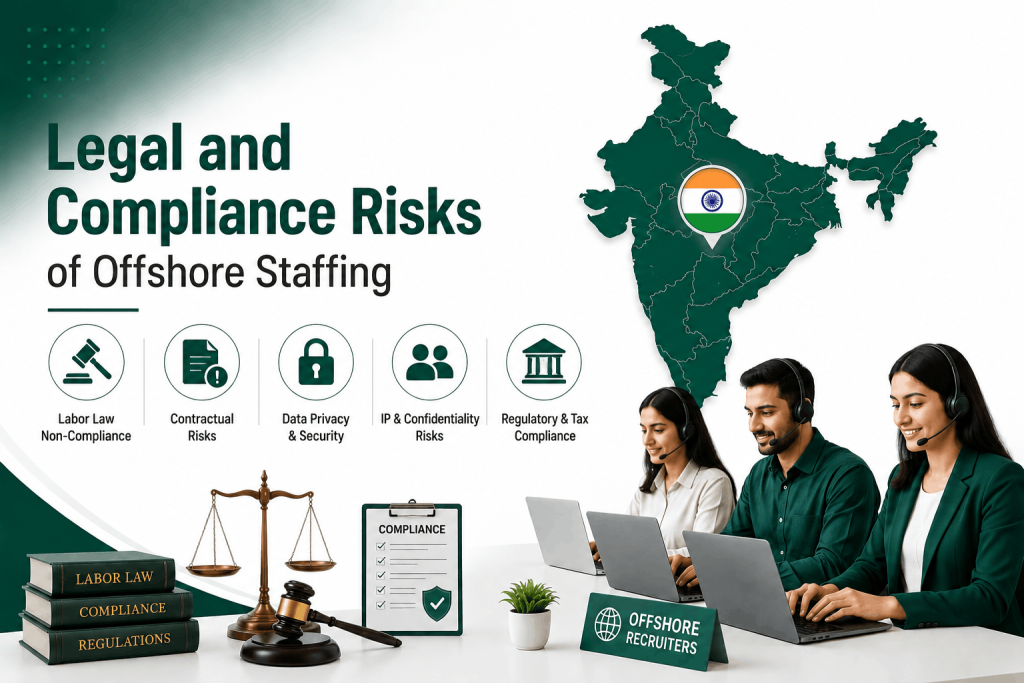
Legal risks of offshore staffing refer to the regulatory, contractual, and jurisdictional liabilities businesses face when hiring workers in foreign countries. Offshore staffing compliance requires adherence to local labor laws, tax regulations, data privacy mandates like GDPR, and intellectual property protections. Failing to manage these risks can result in fines, lawsuits, and reputational damage that undermine the cost savings offshore hiring promises.
Key Takeaways / Quick Facts
- Offshore staffing compliance spans labor law, tax obligations, data privacy regulations, and intellectual property protections across every jurisdiction where workers are located.
- Worker misclassification of offshore employees as independent contractors can trigger penalties ranging from back taxes to six-figure fines under local employment laws.
- Offshore staffing data privacy GDPR violations can result in fines of up to 4% of a company’s annual global revenue under the EU General Data Protection Regulation.
- Intellectual property protection for offshore employees requires explicit contractual clauses, as default IP ownership rules differ significantly between countries like the U.S., India, and the Philippines.
- According to Deloitte (2023), 57% of organizations cited regulatory compliance as a top challenge in managing global workforce operations.
- According to Statista (2024), the global legal process outsourcing market reached $15.9 billion, reflecting increased demand for compliance support in offshore operations.
Why Legal Risks of Offshore Staffing Are Increasing in 2025
Legal risks of offshore staffing are growing because governments worldwide are tightening labor regulations, data privacy laws, and tax enforcement for cross-border employment. Businesses that once relied on informal offshore arrangements now face audits, penalties, and lawsuits when compliance gaps surface. Understanding these risks is the first step toward building a legally sound global workforce.
What Drives Regulatory Scrutiny of Offshore Staffing?
Three primary forces drive regulatory scrutiny of offshore staffing in 2025:
- Expansion of data privacy laws: More than 140 countries now enforce some form of data protection legislation, up from 80 in 2015.
- Crackdowns on worker misclassification: Tax authorities in the U.S., UK, Australia, and the EU are actively auditing companies that classify offshore workers as contractors to avoid employment obligations.
- Cross-border tax enforcement: Initiatives like the OECD’s Base Erosion and Profit Shifting (BEPS) framework have increased transparency and reporting requirements for multinational staffing arrangements.
According to Robert Half (2024), 68% of senior managers reported concerns about compliance risks when hiring remote or offshore talent.
How Do Local Labor Laws Vary Across Offshore Destinations?
Local labor laws in popular offshore destinations like India, the Philippines, Poland, and Mexico differ significantly in areas such as mandatory benefits, termination protections, and working hour restrictions. For example:
| Requirement | India | Philippines | Poland (EU) |
|---|---|---|---|
| Mandatory severance | Yes, after 5 years | Yes, after 1 year | Yes, varies by tenure |
| Maximum work hours/week | 48 | 48 | 40 |
| Mandatory health insurance | Employer-provided (ESI) | Employer-provided (PhilHealth) | State system, employer contributes |
| Paid leave minimum | 15 days | 5 days + holidays | 20 days |
Businesses that apply U.S. employment norms to offshore staff without adapting to local requirements risk termination disputes, benefit claims, and regulatory penalties.
Offshore Staffing Compliance: Data Privacy and GDPR Obligations
Offshore staffing compliance with data privacy laws is defined as the set of legal obligations a business must fulfill when personal data crosses international borders through offshore employment. GDPR, the California Consumer Privacy Act (CCPA), and similar frameworks require explicit data handling agreements, breach notification protocols, and restrictions on where employee and customer data is stored and processed.
What Are the GDPR Requirements for Offshore Staffing?
GDPR requirements for offshore staffing include the following obligations when EU resident data is accessed by offshore teams:
- Data Processing Agreements (DPAs): Written contracts must define the scope, purpose, and security measures for any data processing by offshore workers.
- Standard Contractual Clauses (SCCs): Transfers of personal data outside the European Economic Area require legally approved SCCs or equivalent safeguards.
- Data Protection Impact Assessments (DPIAs): High-risk processing activities involving offshore teams must be evaluated before implementation.
- Breach notification: Organizations must report data breaches to supervisory authorities within 72 hours, regardless of where the breach originates.
According to DLA Piper (2024), GDPR enforcement actions resulted in over 4.5 billion euros in cumulative fines since the regulation took effect, with cross-border data transfer violations representing a growing share.
How Can Businesses Protect Customer Data with Offshore Teams?
Here are the top 5 ways to protect customer data when working with offshore teams:
- Implement role-based access controls so offshore workers only access the data necessary for their tasks.
- Use end-to-end encryption for all data transfers between onshore and offshore systems.
- Conduct regular security audits of offshore partner facilities and networks.
- Require all offshore staff to complete data privacy training specific to GDPR, CCPA, or the applicable regulation.
- Maintain a centralized data inventory that tracks where personal data resides and who can access it.
Intellectual Property Protection for Offshore Employees
Intellectual property protection for offshore employees is the legal framework of contracts, agreements, and jurisdictional safeguards that ensure a company retains ownership of work products, trade secrets, and proprietary information created by workers in foreign countries. Without explicit IP assignment clauses, businesses risk losing ownership of code, designs, content, and innovations developed offshore.
Why Do Default IP Laws Differ Across Countries?
Default IP ownership rules vary because each country’s legal system treats the employer-employee relationship differently. In the United States, the “work for hire” doctrine generally assigns IP ownership to the employer. In India, Section 17 of the Copyright Act grants the employer ownership of works created during employment, but only when a formal employment contract exists. In the Philippines, IP rights often default to the creator unless a written assignment is executed.
Mini Case Study: In 2022, a mid-sized U.S. SaaS company discovered that a software module built by its offshore development team in Eastern Europe could not be exclusively claimed because the developers were classified as independent contractors under local law, and no IP assignment agreement had been signed. The company spent over $200,000 in legal fees to negotiate retroactive licensing rights. This situation illustrates why intellectual property protection for offshore employees must be established contractually before work begins.
What Clauses Should an Offshore IP Agreement Include?
An effective offshore IP protection agreement should include these core clauses:
- IP assignment clause: All work products created during and related to employment are assigned to the hiring company.
- Confidentiality and non-disclosure provisions: Offshore workers must agree not to share proprietary information with third parties.
- Non-compete and non-solicitation terms: Where enforceable under local law, these prevent offshore staff from working with competitors or poaching clients.
- Moral rights waiver: In jurisdictions where creators retain moral rights, a waiver ensures the company can modify or rebrand work products.
- Governing law provision: Specifies which country’s laws apply in the event of a dispute.
Worker Misclassification Offshore: A Growing Compliance Threat
Worker misclassification offshore occurs when a company incorrectly classifies an offshore worker as an independent contractor rather than an employee, resulting in failure to provide legally mandated benefits, tax withholdings, and labor protections. This is one of the most common and costly legal risks of offshore staffing, with penalties ranging from back-pay obligations to criminal charges in some jurisdictions.
How Does Worker Misclassification Happen in Offshore Staffing?
Misclassification typically occurs when companies engage offshore workers through staffing intermediaries or freelance platforms without evaluating the worker’s status under local law. Key risk indicators include:
- The worker uses company-provided tools, email, and systems exclusively.
- The company controls the worker’s schedule, tasks, and reporting structure.
- The engagement lasts longer than 12 months with no defined project scope.
- The worker performs the same functions as onshore employees.
According to the National Employment Law Project (2023), misclassification costs U.S. federal and state governments an estimated $15.3 billion annually in lost tax revenue, and enforcement agencies are increasingly extending scrutiny to offshore arrangements.
What Are the Penalties for Offshore Worker Misclassification?
Penalties for offshore worker misclassification vary by jurisdiction:
| Jurisdiction | Potential Penalties |
|---|---|
| United States (IRS/DOL) | Back taxes, benefits, penalties up to $50 per misclassified worker per form, plus interest |
| United Kingdom (HMRC/IR35) | Unpaid National Insurance, income tax, and penalties up to 100% of tax owed |
| European Union | Varies by member state; can include fines, back-pay for benefits, and criminal liability |
| India | Back-pay for provident fund, ESI contributions, and potential debarment from government contracts |
Conclusion
Legal risks of offshore staffing span three critical areas: data privacy compliance (including GDPR), intellectual property protection, and worker misclassification. Each of these risks carries financial penalties, operational disruptions, and reputational consequences that can erode the cost advantages of global hiring. Businesses must invest in compliant contracts, local legal counsel, and robust data security frameworks before expanding offshore.
Ready to build a compliant global workforce? Contact Neuhire today for expert offshore staffing solutions that prioritize legal compliance and risk mitigation, or download our Global Staffing Compliance Guide to get started.
Help Center
Frequently asked questions
Offshore staffing agreements can specify U.S. governing law, but enforceability depends on the offshore country's courts. Many jurisdictions override foreign governing law provisions in favor of local employment protections, making dual-jurisdiction legal review essential.

Marketing professional with a passion for people, creativity, and growth. I love turning ideas into campaigns that connect and inspire. Currently part of the Neuhire team, helping businesses find the right talent fast.

Marketing professional with a passion for people, creativity, and growth. I love turning ideas into campaigns that connect and inspire. Currently part of the Neuhire team, helping businesses find the right talent fast.