

Offshore Staffing vs Freelancers: Which Works Better for Growth?
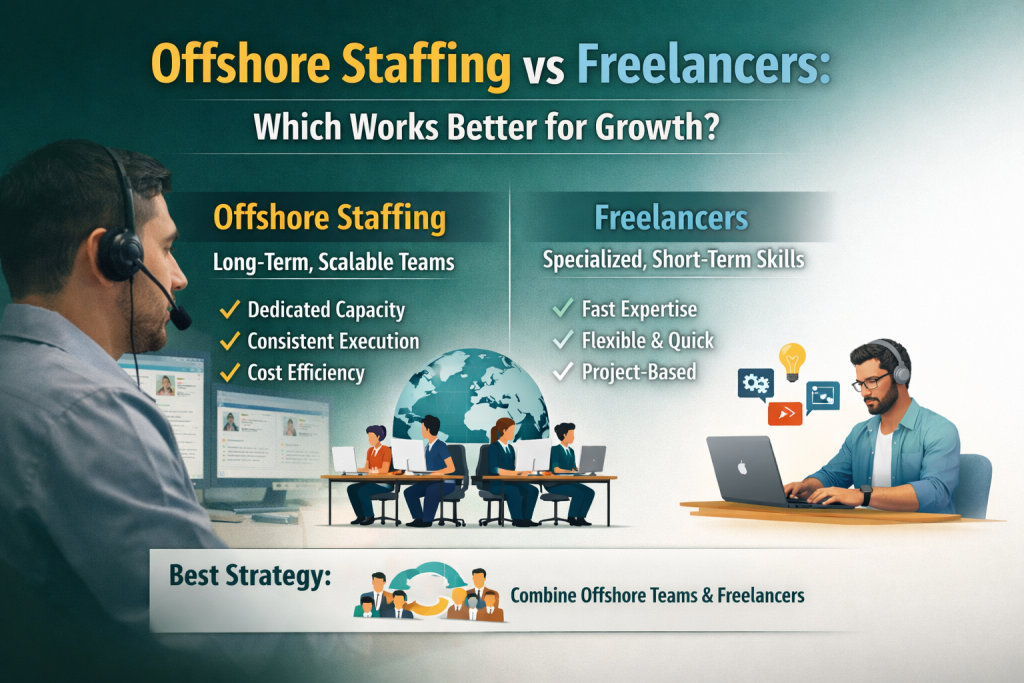
If your goal is fast, scalable growth, offshore staffing usually delivers better long-term results than freelancers because it provides dedicated capacity, consistent execution, and team continuity. Freelancers are a strong choice when you need specialized skills quickly or short-term project support. The best strategy for many companies is a hybrid model: offshore staffing for core operations and freelancers for bursts of expertise.
Quick Facts: Offshore Staffing vs Freelancers
- Offshore staffing = hiring remote professionals through an offshore team model for ongoing roles and scalable delivery.
- Freelancers = hiring independent contractors for short-term, flexible, project-based work.
- Remote staffing = umbrella term that includes both offshore staffing and freelancers, depending on structure and engagement type.
- Best for growth: Offshore staffing for repeatable execution, freelancers for specialized, short-term needs.
Recent Statistics (2023–2025) on Remote Work, Freelancers, and Outsourcing
Here are recent, credible data points you can cite in strategy decisions:
- Freelancers are now a major part of the U.S. workforce. According to Upwork Research Institute (Dec 2023), 38% of the U.S. workforce (64 million Americans) performed freelance work in 2023.
- Freelancing is also a major economic force. According to Upwork Research Institute (Dec 2023), freelancers contributed $1.27 trillion in annual earnings to the U.S. economy.
- Many companies expect outsourcing investment to grow, not shrink. According to Deloitte Global Outsourcing Survey 2024 (2024), 80% of executives plan to maintain or increase investment in third-party outsourcing.
- Companies are evolving outsourcing models due to talent and agility needs. According to Deloitte Global Outsourcing Survey 2024 (2024), 70% of executives have selectively insourced scope previously delivered by third parties over the last 5 years, reflecting shifting strategies rather than abandoning global delivery.
- Remote work remains a major part of employment. According to Investopedia (Jul 2024) reporting on U.S. federal survey data, 35% of full-time employees worked remotely at least part of the time in 2023, up from 34% in 2022.
What Is Offshore Staffing?
Offshore staffing is a remote staffing model where a company hires full-time or dedicated remote professionals in another country to support ongoing business operations. It is designed to reduce labor costs, expand access to talent, and scale output consistently without the overhead of building an entirely local team.
Offshore staffing is often structured as:
- Dedicated offshore teams
- Offshore developers or IT support
- Offshore recruiters or HR teams
- Offshore back-office operations
What Are Freelancers?
Freelancers are independent professionals hired on a contract or project basis to complete defined work without long-term employment commitment. This model provides flexibility and speed, especially for specialized tasks like design, copywriting, development, analytics, or short-term marketing execution.
Freelancers typically work:
- Hourly or per-project
- Across multiple clients at once
- With limited long-term operational ownership
Offshore Staffing vs Freelancers: What’s the Real Difference?
Offshore staffing is about building capacity. Freelancers are about accessing skills.
Here’s the simplest way to frame it:
- Offshore staffing = long-term growth engine (repeatable execution)
- Freelancers = speed and specialization (tactical output)
Comparison Table: Offshore Staffing vs Freelancers
| Factor | Offshore Staffing | Freelancers |
|---|---|---|
| Best For | Scaling operations, long-term growth | Fast projects, niche expertise |
| Commitment | Ongoing, dedicated | Short-term, flexible |
| Team Integration | High, works like an internal team | Medium to low |
| Cost Predictability | Higher | Variable |
| Knowledge Retention | Strong | Limited |
| Availability | Reserved capacity | Depends on their schedule |
| Quality Consistency | High with proper management | Varies widely |
Which Works Better for Growth?
For most growing companies, offshore staffing works better for growth because it builds a consistent team that can execute week after week, maintain process documentation, and improve over time. Freelancers are best for growth only when your needs are short-term or highly specialized, and you can manage frequent transitions between different contractors.
Best Use Cases for Offshore Staffing (Remote Staffing That Scales)
Offshore staffing performs best when your business needs:
1) Repeatable execution across functions
If your work is consistent and recurring, offshore teams can drive compounding results, such as:
- Customer support and ticket handling
- Sales development and lead qualification
- Back-office finance and reporting
- Recruiting coordination and sourcing
- QA testing and application support
2) Dedicated output without hiring locally
When local hiring is too expensive, slow, or competitive, offshore staffing allows you to keep growing without stalling your roadmap.
This is especially useful in:
- IT support and engineering
- Healthcare administration and billing support
- Engineering design workflows
- Government contracting support roles
3) Cross-time-zone productivity
A well-managed offshore staffing strategy can create near 24-hour momentum:
- U.S. team hands off tasks end-of-day
- Offshore team completes builds, updates, documentation, or QA
- Work is ready the next morning
Best Use Cases for Freelancers (Short-Term Speed and Specialized Skills)
Freelancers are often the better solution when you need:
1) Specialized expertise fast
This might include:
- UX/UI design for a product redesign
- Motion graphics for a product launch
- Paid media setup for a campaign sprint
- A one-time CRM automation build
2) One-time projects with clear deliverables
Freelancers thrive when scope is crystal clear, such as:
- “Design a landing page”
- “Build a pitch deck”
- “Write 10 SEO blogs”
- “Audit our analytics setup”
3) Quick tests before committing
Freelancers can reduce risk when exploring:
- A new marketing channel
- A new product category
- A new geographic market
Offshore Staffing vs Freelancers: Cost, Risk, and Management Tradeoffs
Offshore staffing advantage: predictable cost and capacity
With offshore staffing, you can typically plan:
- Monthly cost per role
- Expected weekly output
- Stable working hours and delivery ownership
This is one reason global delivery remains a strategic lever for leaders. For example, Deloitte’s Global Outsourcing Survey 2024 notes that 80% of executives plan to maintain or increase investment in third-party outsourcing, reinforcing continued reliance on scalable staffing models.
Freelancer advantage: flexibility and speed
Freelancers often work best when:
- You have short timelines
- Your internal team is overloaded
- The work is expert-level and narrow in scope
That flexibility is part of why freelancing continues to expand. According to Upwork Research Institute (Dec 2023), 64 million Americans freelanced in 2023, showing how large and accessible this talent pool has become.
Growth Scenarios: Who Wins and Why?
Scenario A: You need to double output in 90 days
Winner: Offshore staffing
Why? You need reliable throughput. Hiring 2–5 offshore team members can quickly increase delivery without constantly re-onboarding new freelancers.
Scenario B: You need a new brand identity and website design
Winner: Freelancers
Why? A senior freelance designer and front-end developer can deliver expert work faster than ramping a full offshore function.
Scenario C: You need ongoing lead generation + appointment setting
Winner: Offshore staffing
Why? Outreach requires consistency, iteration, and process improvement over time.
Scenario D: You need a one-time HubSpot automation fix
Winner: Freelancers
Why? It’s targeted, time-bound, and doesn’t require long-term retention.
Case Study Examples (Real-World Patterns)
Case Study 1: SaaS company scaling customer support
A B2B SaaS company starts with freelancers answering tickets on evenings and weekends. Quality is inconsistent and SLA misses increase.
They move to offshore staffing:
- Dedicated agents
- Standard operating procedures (SOPs)
- Coverage across time zones
Result: faster response times, fewer escalations, better retention.
Case Study 2: Startup launching a new paid media channel
A startup wants to test paid search and paid social quickly, but cannot hire a full-time growth marketer.
They hire freelancers:
- Campaign setup
- Landing page copy
- Tracking configuration
Result: fast experiment, clear metrics, and a decision to scale in-house or offshore later.
Risks to Watch: Offshore Staffing vs Freelancers
Offshore staffing risks
- Poor onboarding leads to slow ramp time
- Communication gaps without clear documentation
- Vendor inconsistency if leadership changes
How to reduce risk
- Use documented workflows and KPIs
- Schedule daily standups (15 minutes)
- Assign a clear owner for performance tracking
Freelancer risks
- Availability changes unexpectedly
- Context is lost when a freelancer leaves
- Inconsistent quality across contractors
How to reduce risk
- Use detailed scopes and timelines
- Require handoff documentation
- Use milestone-based payments
Key Takeaways: Offshore Staffing vs Freelancers for Growth
- Offshore staffing is best when you need consistent output, stable teams, and long-term scale.
- Freelancers are best when you need speed, flexibility, or specialized expertise.
- Remote staffing works best when you match the hiring model to the work type.
- For growth, offshore staffing typically delivers better continuity, cost control, and operational maturity.
Final Verdict: Which Works Better for Growth?
If you are scaling revenue, operations, or delivery capacity, offshore staffing is usually the better long-term growth strategy. It gives you the structure of a team, the predictability of a system, and the ability to build repeatable performance.
Freelancers still play a valuable role in growth, especially when you need specialized expertise quickly or want short-term agility.
Conclusion
Offshore staffing and freelancers are both powerful remote staffing options, but they solve different problems. Use freelancers for short, high-impact tasks. Use offshore staffing to build durable capacity and scale performance across departments.
If you want to grow faster with a dedicated offshore or remote staffing team, contact Neuhire to explore flexible offshore staffing solutions tailored to your goals.

Marketing professional with a passion for people, creativity, and growth. I love turning ideas into campaigns that connect and inspire. Currently part of the Neuhire team, helping businesses find the right talent fast.

Marketing professional with a passion for people, creativity, and growth. I love turning ideas into campaigns that connect and inspire. Currently part of the Neuhire team, helping businesses find the right talent fast.