

The 3.5 Million Unfilled Cybersecurity Jobs and How Offshore Staffing Is Quietly Closing the Gap
The breach you didn’t see coming had a hiring problem behind it
In 2024, the average cost of a data breach hit $4.88 million, the highest on record, according to IBM’s annual Cost of a Data Breach Report. Buried inside that figure is a detail most post-mortems skip: organizations with understaffed security teams faced breach costs 2 to 3 times higher than those with adequate coverage.
The talent problem isn’t coming. It’s already here.
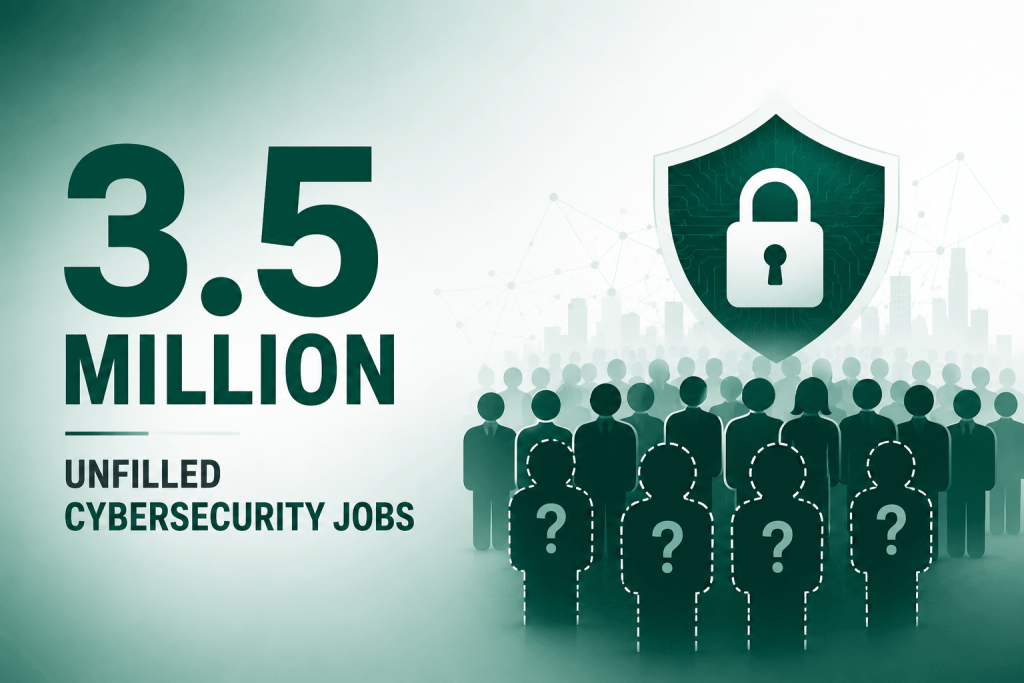
There are currently 3.5 million unfilled cybersecurity positions worldwide, according to the ISC² 2024 Cybersecurity Workforce Study. That’s more people than the entire population of Chicago, a ghost workforce of analysts, engineers, and incident responders that organizations desperately need but cannot find. Meanwhile, the average time-to-hire for a senior security analyst in the US or UK stretches to 6 to 9 months. Threats don’t wait that long.
So whose fault is it? And more importantly, what can organizations do about it right now, not a decade from now when the next generation of security graduates finally enters the workforce?
Increasingly, the answer is offshore staffing. Not as a corner-cutting measure, but as a strategic, compliance-ready approach to building security teams that are faster to assemble, more cost-effective to sustain, and, done correctly, just as rigorous as their domestic counterparts.
Who’s actually responsible for 3.5 million empty seats?
Before exploring solutions, it’s worth being honest about the problem, because it doesn’t have a single villain.
- Universities are producing cybersecurity graduates, but not nearly fast enough, and curricula often lag behind real-world threat landscapes by two to three years. A student learning about the threat models of 2022 is graduating into the threat environment of 2025.
- Employers bear significant responsibility too. Job descriptions routinely demand five or more years of experience for roles labeled “entry-level,” effectively locking out career-changers, bootcamp graduates, and international candidates who could otherwise contribute meaningfully. The industry has collectively written itself into a catch-22: organizations want experienced professionals, but nobody wants to create the experience.
- Governments have under-invested in public cyber education pipelines. While initiatives like the US National Cybersecurity Workforce Framework and the UK’s Cyber Security Council are steps in the right direction, funding and implementation remain patchy, particularly for community colleges and vocational programs that could serve as the most scalable talent feeder.
- The industry itself is eroding its own talent base through burnout. Alert fatigue is real. Security operations center (SOC) analysts routinely manage hundreds of alerts per shift, many of them false positives, with insufficient tooling and inadequate staffing ratios. The result: experienced professionals are leaving the field faster than entry-level hires can replace them.
The gap, in other words, is structural. No single stakeholder created it, and no single stakeholder can fix it alone.
Why domestic hiring alone can’t solve it, at least not fast enough
Even if every university, employer, and government acted perfectly starting today, the pipeline would take a decade or more to deliver meaningful results at scale. The math simply doesn’t work in the short term.
Consider the economics. The median cybersecurity salary in the United States sits between $120,000 and $160,000 for mid-level roles, according to the US Bureau of Labor Statistics Occupational Outlook for Information Security Analysts. For small and medium-sized businesses, which represent the majority of organizations and the majority of breach targets, this is simply unaffordable. Many SMBs have no dedicated security team at all. They are running on hope and a firewall.
Geography compounds the problem. Cybersecurity talent in the US clusters heavily in metropolitan areas: Washington DC (driven by government contracting), New York, San Francisco, and a handful of other major cities. A manufacturing firm in rural Ohio, a hospital network in the Midwest, or a logistics company in the Southeast faces a talent desert that no amount of competitive salary can fully overcome when candidates simply don’t want to relocate.
The conclusion is uncomfortable but unavoidable: for most organizations, waiting for the domestic talent pipeline to catch up is not a strategy. It is a risk.
Enter offshore staffing: what it actually looks like
“Offshore staffing” in cybersecurity still carries outdated connotations for some, images of low-skill, high-volume outsourcing from a different era of IT. The reality in 2025 looks very different.
Today, the Philippines hosts a mature and growing ecosystem of certified SOC analysts operating across multiple time zones. India produces more CISSP holders per year than almost any other country outside the US, a fact reflected in ISC²’s global member data. Eastern Europe, particularly Poland, Romania, and Ukraine, has built a dense cluster of elite penetration testers and red team operators, many of whom hold OSCP and CEH certifications and compete at the highest levels in international capture-the-flag competitions. Latin America, particularly Colombia, Brazil, and Argentina, is emerging as a hub for application security engineers who work embedded within US and European product development teams.
These are not backup analysts. They are primary contributors.
In practice, offshore security staffing might look like:
- A team of three SOC Level 1 and Level 2 analysts in Manila monitoring a US retailer’s SIEM alerts from midnight to 8am Eastern, hours when domestic staff are either asleep, on call and exhausted, or prohibitively expensive to employ.
- A penetration tester based in Warsaw conducting quarterly red team engagements for a German fintech startup, holding the same certifications as any London-based counterpart, at roughly 55% of the cost.
- An application security engineer in Bogotá embedded in a US SaaS company’s engineering Slack, reviewing pull requests for security issues and running DAST scans as part of the standard CI/CD pipeline.
None of these scenarios require sending sensitive data overseas. None of them require compromising on rigor. What they require is a thoughtful model and the right provider.
The real benefits: beyond the cost savings headline
Cost is real, and worth stating plainly: offshore cybersecurity staffing typically delivers 40 to 60% savings compared to equivalent domestic hires. For an organization trying to build a security team for the first time, this difference is the difference between having a team and not having one.
But cost is only the beginning of the business case.
- Speed to hire is transformative. Where a domestic senior analyst search stretches to 6 to 9 months, including sourcing, interviewing, background checks, and notice periods, a well-run offshore engagement can place a qualified analyst in four to six weeks. In a threat environment where the mean time to identify a breach is already 194 days according to IBM, shortening team-building timelines is a security improvement, not just an HR convenience.
- 24/7 coverage becomes achievable without burning out your existing staff. The follow-the-sun model, where security operations are handed off between teams in different time zones, means threats detected at 2am are caught by someone who is wide awake and on their primary shift, not a domestic analyst dragged out of sleep and working at degraded capacity. The security outcome is measurably better.
- Specialization becomes accessible. Certain security disciplines, including operational technology (OT) security, cloud forensics, and firmware analysis, are so niche that finding qualified domestic practitioners can take years. Offshore talent pools in Eastern Europe and Southeast Asia have developed genuine depth in some of these areas, allowing organizations to access skills that would otherwise require a retained search firm and a very long wait.
- Burnout reduction on the domestic team is one of the most underrated benefits. When alert volume is distributed across a global team and overnight monitoring is handled by offshore staff on their primary shift, domestic analysts can focus on higher-order work, including threat hunting, architecture review, and incident response, with sustainable workloads. Retention improves. Institutional knowledge stays.
Addressing the real objections: trust, data, and compliance
These concerns are legitimate, and any honest discussion of offshore staffing has to take them seriously.
- Data residency and sovereignty is the most common concern, and rightly so. The answer is architectural: well-designed offshore staffing models define clearly what data offshore analysts can access, through what channels, and under what conditions. In most SOC workflows, offshore analysts interact with log data and alert queues, normalized and pseudonymized telemetry, rather than raw sensitive records. Data never leaves the client’s environment; the analyst works through a controlled interface.
- Regulatory compliance is manageable with the right provider. Leading offshore cybersecurity firms maintain ISO 27001 certification as a baseline, and many hold SOC 2 Type II attestations that align with GDPR, HIPAA, and PCI-DSS requirements. The key is vetting providers on their compliance documentation, not just their pricing. Ask for audit reports, not assurances.
- Vetting and trust has matured significantly. Background screening at reputable offshore security providers now includes criminal records checks, employment history verification, and reference checks, the same baseline any domestic employer would apply. For organizations in regulated industries, providers can accommodate additional screening requirements.
- The zero-trust argument is perhaps the most technically compelling. In a properly implemented zero-trust architecture, geographic location of an analyst is largely irrelevant. Access is governed by identity, device health, and least-privilege policy, not by whether the analyst is sitting in Austin or Manila. If your security architecture still treats physical location as a meaningful trust boundary, that is an architectural problem to solve regardless of whether you hire offshore. The NIST Zero Trust Architecture guidelines provide a solid framework for getting this right.
Which roles to offshore and which to keep onshore
Not every security function is equally suited to a distributed model. The practical guidance is straightforward.
Strong candidates for offshore staffing:
- SOC Level 1 and Level 2 analysts (alert triage, initial investigation, escalation)
- Vulnerability management and patch prioritization
- Threat intelligence analysis and reporting
- Application security review and DAST/SAST operations
- Compliance monitoring and evidence collection
- Security awareness training content and delivery
Keep onshore:
- Chief Information Security Officer and direct reports with board or executive access
- Incident commanders during active breach response (proximity and accountability matter)
- Roles requiring government security clearances
- Functions with contractual or regulatory requirements for domestic staffing
- Any role with standing access to the most sensitive data classifications
The hybrid model, onshore leadership and strategic roles paired with offshore execution and coverage roles, is the architecture that works best in practice. It is not an either/or decision.
How to start: a practical three-step approach
The organizations that struggle with offshore security staffing are typically those that try to offshore too much, too fast, with insufficient governance. The ones that succeed start narrow, build trust, and scale deliberately.
Step 1: Audit your open roles. Identify every security position that has been unfilled for 90 days or more. For each role, ask honestly: does this require physical presence, a security clearance, or board-level access? If the answer is no, it belongs on the offshore candidate list.
Step 2: Vet providers on compliance, not price. Require ISO 27001 certification and SOC 2 Type II attestation as non-negotiables. Ask for client references in your industry. Review their background screening procedures and data handling policies in writing. The 10% cost difference between a compliant provider and a non-compliant one is not worth the regulatory exposure.
Step 3: Run a pilot before scaling. Place one or two offshore analysts on a 90-day contract focused on a specific, bounded scope, such as overnight SOC coverage or vulnerability management. Measure the quality of their output, their integration with your domestic team, and the friction in your operational handoffs. Use that data to make an informed decision about expanding the model.
Conclusion
The cybersecurity talent gap will not be solved quickly. It is a structural problem built over decades of under-investment, and it will take years of coordinated effort across education, government, and industry to close meaningfully. Organizations cannot afford to wait.
Offshore staffing is not a permanent substitute for building a domestic talent pipeline. But it is a practical, available, compliance-ready tool that organizations can use today, to cover their gaps, protect their systems, and give their existing teams the breathing room to do their best work.
The 3.5 million empty seats are not going to fill themselves. And the next breach is not going to wait for your next hire.
Looking to build a security team that scales? Neuhire can help with offshore staffing that gets you there faster than you think, without cutting corners on quality or compliance.

Marketing professional with a passion for people, creativity, and growth. I love turning ideas into campaigns that connect and inspire. Currently part of the Neuhire team, helping businesses find the right talent fast.

Marketing professional with a passion for people, creativity, and growth. I love turning ideas into campaigns that connect and inspire. Currently part of the Neuhire team, helping businesses find the right talent fast.