
ATS vs. Hiring Platform: What Is the Difference and Which Do You Need?
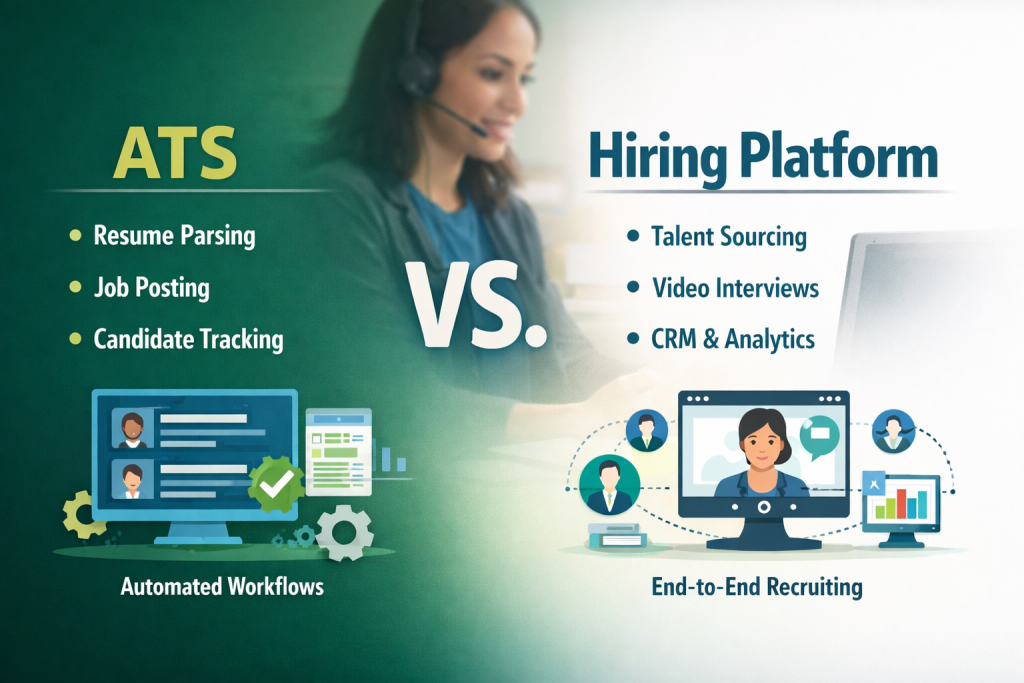
The primary difference between an ATS vs. hiring platform is that an Applicant Tracking System (ATS) focuses on managing the backend recruitment process, while a modern hiring platform is a comprehensive ecosystem that combines candidate sourcing, engagement, and advanced AI-driven automation. If you need to organize applications, use an ATS; if you want to proactively find and nurture top talent, a hiring platform is the superior choice.
Important Recruiting Statistics – 2025
Understanding the current landscape is essential for making an informed software decision. Here are the latest industry figures:
- Fortune 500 Dominance: According to Jobscan, 2025, 99% of Fortune 500 companies utilize an ATS to process resumes and manage high application volumes.
- Shift to Skills: According to SelectSoftware Reviews, 2025, 81% of companies have now transitioned to skills-based hiring, compared to only 56% in 2022, highlighting a need for software that evaluates talent beyond simple resume keywords.
- Impact of AI: According to TestGorilla’s State of Skills-Based Hiring, 2025, 65% of employers are now using AI in their hiring process, with 94% of them reporting it has improved their hiring outcomes.
- Candidate Experience: According to HiringThing, 2024, 63% of job seekers will reject a job offer specifically due to a bad candidate experience during the recruitment process.
What Is an Applicant Tracking System?
An applicant tracking system vs hiring software comparison often begins with the basics. An Applicant Tracking System (ATS) is a software application designed to provide a digital filing cabinet for your recruitment team. Its primary goal is to collect, store, and organize resumes in a central repository.
Defining the ATS
An ATS is a workflow tool that automates the administrative side of hiring. It tracks where a candidate is in the pipeline from “Applied” to “Interviewing” to “Hired.” By using keyword-based filters, it helps recruiters sort through hundreds of applications to find those that match specific job descriptions.
Core Features of an ATS
- Resume Parsing: Automatically extracting data from resumes to create candidate profiles.
- Job Posting: Distributing job ads to various boards from one interface.
- Compliance Tracking: Storing data for EEO and GDPR audits.
- Interview Scheduling: Syncing with calendars to set up meetings.
What Is a Hiring Platform?
When looking at hiring platform vs ATS differences, the hiring platform is essentially the next generation of recruitment technology. It is a holistic solution that often includes an ATS but adds layers of proactive tools like Candidate Relationship Management (CRM), AI-driven sourcing, and employer branding features.
Defining the Hiring Platform
A hiring platform is a unified talent acquisition suite that manages the entire lifecycle of a candidate. Unlike a traditional ATS, which waits for people to apply, a hiring platform helps you go out and find talent. It uses AI to identify passive candidates and provides tools to keep them engaged with your brand long before a job opening even exists.
Core Features of a Hiring Platform
- AI Candidate Matching: Using machine learning to predict which candidates are the best fit based on skills and context, not just keywords.
- Nurture Campaigns: Automated email and text sequences to keep your talent pool warm.
- Advanced Analytics: Predictive insights that tell you which hiring sources provide the best long-term employees.
- Built-in Sourcing: Tools that allow you to search external databases and social media directly within the platform.
Key Differences: ATS vs. Hiring Platform
Understanding the applicant tracking system vs hiring software distinction is easier when you look at their focus areas. While they share some DNA, their goals are distinct.
| Feature | Applicant Tracking System (ATS) | Modern Hiring Platform |
|---|---|---|
| Primary Focus | Managing the process and compliance. | Finding, engaging, and hiring top talent. |
| Approach | Reactive (wait for applications). | Proactive (outreach and nurturing). |
| Candidate View | A record in a database. | A long-term relationship. |
| Technology | Keyword filters and manual workflows. | AI matching and automated engagement. |
| Best For | Organization and high-volume filtering. | Scaling teams and finding specialized talent. |
Why the Difference Matters for Your Business
Choosing the wrong tool can lead to a resume black hole where qualified candidates are ignored by rigid filters. A traditional ATS is excellent for maintaining order and ensuring legal compliance. However, in a competitive market, merely being organized is not enough.
A hiring platform allows you to treat recruitment like marketing. It provides a better candidate experience by using chatbots for instant communication and personalized portals. According to research from SelectSoftware Reviews, 2025, 39% of talent acquisition leaders say improving communication throughout the hiring process is a top priority to reduce candidate drop-off rates.
Case Study: Transitioning from ATS to a Unified Platform
Consider a mid-sized tech company that relied on a standard ATS. While they were organized, their time-to-hire for specialized engineers was over 50 days. They were losing talent to faster-moving competitors.
By switching to a comprehensive hiring platform, they integrated AI sourcing and automated nurture campaigns. Instead of waiting for applicants, the system rediscovered high-quality candidates already in their database from previous years. The result was a 35% reduction in time-to-hire and a significant decrease in cost-per-hire, as they no longer relied as heavily on expensive external agencies.
Key Takeaways: ATS vs. Hiring Platform
- ATS focuses on the “how”: It is designed to make the administrative tasks of hiring more efficient.
- Hiring platforms focus on the “who”: They are built to find the best possible people through intelligent data.
- Automation is the bridge: Both tools use automation, but platforms apply it to candidate engagement and sourcing, not just scheduling.
- Compliance is standard: Both systems typically handle necessary legal reporting (EEO/GDPR).
- The choice depends on volume and goals: Small teams with few openings may only need an ATS; growing companies looking to scale need a full hiring platform.
Which One Should You Choose?
The decision between an ATS vs. hiring platform ultimately depends on your specific recruiting goals and the complexity of your talent needs.
Choose an ATS if:
- You have a low volume of hires and a limited budget.
- Your main priority is moving away from spreadsheets and paper resumes.
- You primarily need to stay compliant with local labor laws.
- Most of your candidates come from organic job board applications.
Choose a Hiring Platform if:
- You are actively scaling and need to build a talent pipeline for the future.
- You struggle to find specialized talent and need proactive sourcing tools.
- You want to leverage AI to reduce bias and improve the quality of hire.
- You want to provide a world-class candidate experience that reflects your employer brand.
Conclusion
The evolution from the traditional applicant tracking system vs hiring software has changed the way businesses compete for talent. While an ATS provides the necessary foundation for organization, a hiring platform provides the competitive edge needed to secure top-tier professionals in 2025. By moving beyond simple tracking and embracing holistic talent engagement, your organization can turn recruitment from a hurdle into a strategic advantage.
Are you looking to scale your team with the best global talent? Neuhire provides expert offshore staffing and remote staffing solutions designed to help you find the right fit faster. Whether you need specialized technical skills or high-volume support, we help you navigate the complexities of modern hiring. Contact Neuhire today to start building your dream team.

Marketing professional with a passion for people, creativity, and growth. I love turning ideas into campaigns that connect and inspire. Currently part of the Neuhire team, helping businesses find the right talent fast.

Marketing professional with a passion for people, creativity, and growth. I love turning ideas into campaigns that connect and inspire. Currently part of the Neuhire team, helping businesses find the right talent fast.