
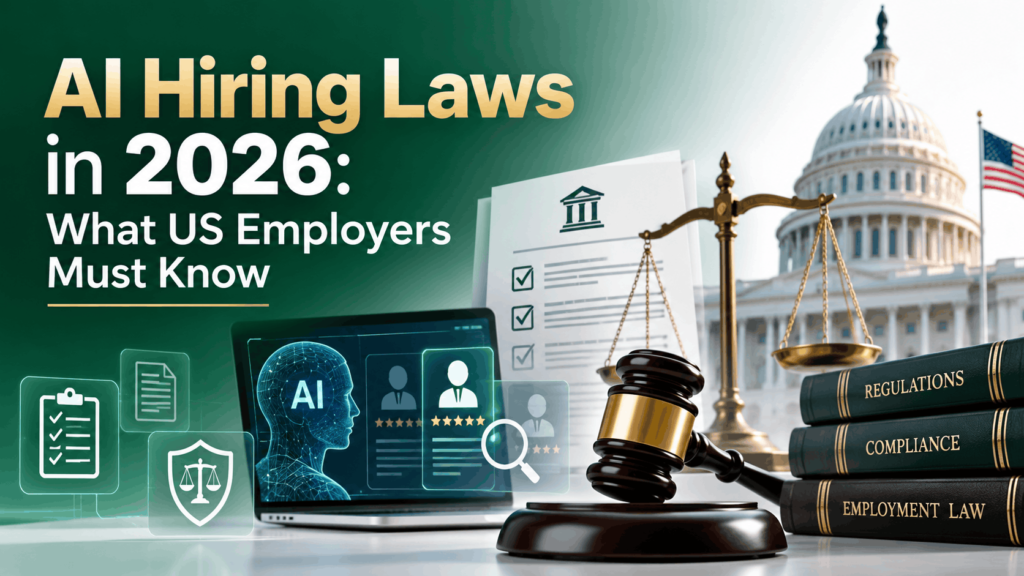
AI Hiring Laws in 2026: What US Employers Must Know
AI hiring laws 2026 are defined as the state and city rules that control how US employers use artificial intelligence to screen, rank, interview, and select job candidates. The core laws are NYC Local Law 144, Illinois HB 3773, California’s ADS regulations, and Colorado SB 26-189. Most require notice, bias controls, and human review.
Key Takeaways: AI Hiring Laws 2026 Quick Facts
- Illinois HB 3773 took effect on January 1, 2026, and requires employers to notify workers and applicants when AI is used in employment decisions.
- NYC Local Law 144 requires an independent bias audit within one year before an employer uses an automated employment decision tool.
- Colorado repealed its original AI Act in May 2026 and replaced it with SB 26-189, which takes effect on January 1, 2027.
- California’s Civil Rights Council regulations, effective October 1, 2025, require employers to keep automated-decision system data for four years.
- Using AI to screen resumes is legal in the US, but employers stay liable under Title VII, the ADEA, and the ADA for discriminatory outcomes.
Why AI Hiring Laws 2026 Matter for US Employers
AI hiring laws 2026 matter because AI now touches most applications at mid-size and large US employers. Resume screeners, chatbots, and ranking tools inside platforms like Workday and HireVue all count as automated decision tools. When those tools filter out protected groups, the employer carries the legal risk.
- According to Resume Builder (2024), 51% of companies used AI in hiring, and 82% of those used it to review resumes.
- According to Resume Builder (2024), 21% of companies using AI let it reject candidates at every stage without human review.
- According to Robert Half (2026), 67% of US HR leaders say reviewing AI-generated applications has slowed hiring.
- According to Statista (2026), more than 60% of US and UK jobseekers used AI in their applications over the previous 24 months.
State-by-State AI Hiring Laws 2026 Compared
The difference between the major AI hiring laws 2026 is what each one requires. NYC demands bias audits, Illinois demands notice and bans discriminatory AI, California expands record-keeping and agent liability, and Colorado demands notice plus human review starting in 2027. No single federal AI hiring statute exists today.
| Law | Effective date | Core employer duty | Enforcement |
|---|---|---|---|
| NYC Local Law 144 | July 5, 2023 | Annual independent bias audit, public summary, candidate notice | NYC DCWP, $500 to $1,500 per violation |
| Illinois HB 3773 | January 1, 2026 | Notice of AI use; no discriminatory AI; no zip code proxies | Illinois Department of Human Rights |
| California ADS regulations | October 1, 2025 | Four-year ADS data retention; vendors liable as agents | California Civil Rights Department |
| Colorado SB 26-189 | January 1, 2027 | Pre-use notice, adverse decision notice, human review | Colorado Attorney General, up to $20,000 per violation |
What does an NYC Local Law 144 bias audit require?
An NYC Local Law 144 bias audit is an independent review of selection rates and impact ratios by sex and race/ethnicity, completed within one year before a tool is used, per the NYC Department of Consumer and Worker Protection. According to the New York State Comptroller (2025), auditors found at least 17 potential violations among 32 companies, while the city agency found one.
What does the Illinois AI hiring law require?
The Illinois AI hiring law, HB 3773, makes discriminatory AI use in hiring, promotion, or discharge a civil rights violation. As Foley & Lardner explains, employers must give notice of AI use and cannot use zip codes as a proxy for protected classes.
What changed for Colorado AI Act employers in 2026?
Governor Jared Polis signed SB 26-189 on May 14, 2026, which repealed and replaced the original Colorado AI Act. Impact assessments and risk programs are gone. Colorado AI Act employers still face notice, a 30-day adverse decision notice, human review, and three-year records from January 1, 2027. A federal court also stayed enforcement on April 27, 2026, after xAI sued.
Is AI Resume Screening Legal Under AI Hiring Laws 2026?
Yes. AI resume screening is legal in every US state under AI hiring laws 2026, but it is regulated. Employers must follow local notice and audit rules and remain liable under Title VII, the ADEA, and the ADA if a tool produces disparate impact. Buying software from a vendor does not transfer that liability.
Do employers need to disclose AI in hiring?
Employers must disclose AI in hiring in New York City and Illinois, and in Colorado from 2027. Elsewhere, disclosure is a best practice. California’s ADS regulations do not mandate bias testing, but testing, or the lack of it, counts as evidence in discrimination claims.
Case study: Mobley v. Workday and AI resume screening legal risk
Derek Mobley alleges Workday’s screening tools rejected him from more than 100 jobs because of age, race, and disability. On May 16, 2025, a California federal court certified a nationwide age-discrimination collective and accepted that a vendor can act as the employer’s agent. Every employer using a shared tool could face similar claims.
How to Build AI in Recruitment Compliance for AI Hiring Laws 2026
Here are the top 5 ways to build AI in recruitment compliance for AI hiring laws 2026. These steps work across New York, Illinois, California, and Colorado. President Trump’s December 2025 executive order targets state AI laws, but Fisher Phillips notes those laws remain enforceable.
- Inventory every AI tool in your ATS, HRIS, chatbots, and assessments.
- Run annual bias audits by sex, race, and age, even outside NYC.
- Publish candidate notices on job postings and career pages.
- Require human review before any AI rejection.
- Keep records for four years and update vendor contracts.
How Neuhire helps with AI hiring compliance
Neuhire pairs technology with trained recruiters, so every screening decision gets documented human review. Its offshore and remote teams handle resume review and candidate communication without adding in-house headcount. Learn how Neuhire uses data to improve hiring decisions and why AI augmentation beats full automation.
Conclusion: Staying Ahead of AI Hiring Laws 2026
AI hiring laws 2026 come down to three points. First, AI resume screening is legal, but employers own the discrimination risk. Second, disclosure is mandatory in NYC and Illinois, and in Colorado from 2027. Third, bias audits, human review, and four-year records work in every state.
Need compliant, human-reviewed hiring support? Contact Neuhire today to build a fast, fair offshore or remote recruiting team.
Help Center
Frequently asked questions: AI hiring laws 2026

Marketing professional with a passion for people, creativity, and growth. I love turning ideas into campaigns that connect and inspire. Currently part of the Neuhire team, helping businesses find the right talent fast.

Marketing professional with a passion for people, creativity, and growth. I love turning ideas into campaigns that connect and inspire. Currently part of the Neuhire team, helping businesses find the right talent fast.