ATS vs HRIS: What’s the Difference and Do You Need Both?
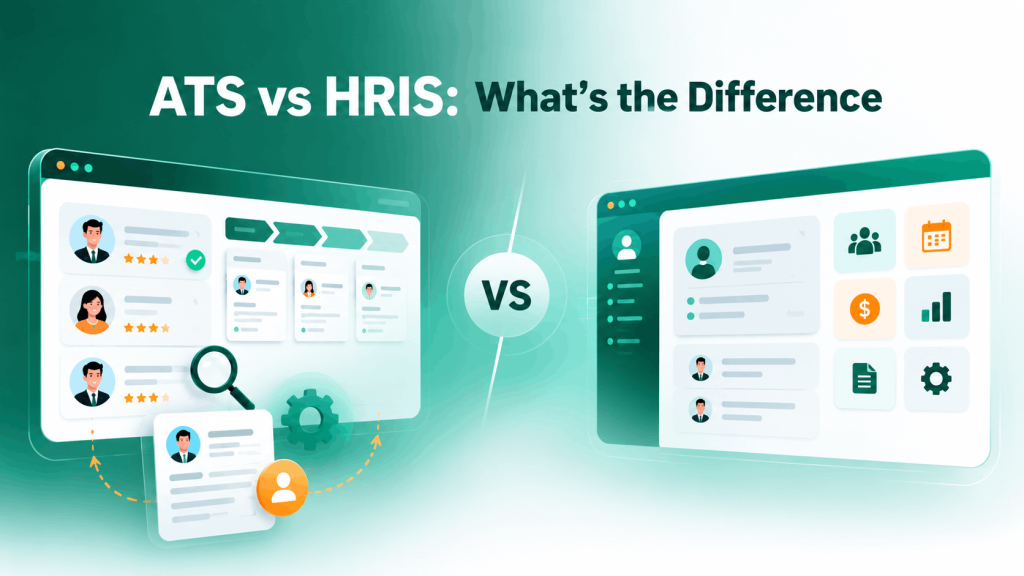
ATS vs HRIS is a comparison of two HR systems with different jobs. An applicant tracking system (ATS) is defined as software that manages candidates from job posting to signed offer. A human resources information system (HRIS) manages employees after hire, covering records, payroll, benefits, and compliance. Most growing companies need both, connected by an integration.
Key Takeaways: ATS vs HRIS Quick Facts
- An ATS manages candidates before hire; an HRIS manages employees after hire.
- The handoff point between an ATS and HRIS is the accepted offer, when candidate data becomes an employee record.
- Workday, SAP SuccessFactors, iCIMS, Greenhouse, and Lever are common ATS platforms; BambooHR, Rippling, Gusto, and Workday HCM are common HRIS platforms.
- Companies with fewer than 50 employees and fewer than 10 hires per year can usually manage with an HRIS that includes a basic hiring module.
- A sourcing tool finds passive candidates; an ATS organizes candidates who already applied or were added.
- Neuhire delivers pre-screened offshore talent from India that plugs into any existing ATS and HRIS workflow.
What Is the Difference Between ATS vs HRIS?
The difference between ATS vs HRIS is timing and purpose. An ATS supports recruiters and hiring managers during the hiring process, from requisition to offer. An HRIS supports HR, payroll, and finance teams across the employee lifecycle, from onboarding to exit. The ATS ends where the HRIS begins: the accepted offer.
What Is a Hiring ATS and What Does It Do?
A hiring ATS is defined as a recruiting platform that collects, filters, and tracks job applicants in one pipeline. Recruiters use it to post jobs to LinkedIn and Indeed, parse resumes, score candidates, schedule interviews, and send offers.
Core ATS features include:
- Job posting and career page management
- Resume parsing and keyword screening
- Interview scheduling and scorecards
- Offer letters and EEO reporting
According to Jobscan (2026), an ATS was detected at 97.4% of Fortune 500 companies, and Workday is used by more than 40% of the list.
What Is an HRIS and Who Uses It?
An HRIS is defined as a system of record for employee data. HR generalists, payroll managers, and CFOs use it to store personnel files, run payroll, administer benefits, track PTO, and file compliance reports such as I-9 and W-2 records.
According to Capterra (2025), 50% of HR software buyers rate HRIS as critical to their business, compared with 42% for recruiting and ATS software.
ATS vs HRIS Comparison Table
| Feature | ATS | HRIS |
|---|---|---|
| Primary user | Recruiters, hiring managers | HR, payroll, finance |
| Data subject | Candidates | Employees |
| Lifecycle stage | Job posting to offer | Onboarding to exit |
| Key tasks | Screening, interviews, offers | Payroll, benefits, compliance |
| Core metric | Time to hire, cost per hire | Turnover, headcount, labor cost |
| Example tools | Greenhouse, Lever, iCIMS | BambooHR, Rippling, Gusto |
ATS and HRIS: Do You Need Both?
Most companies need both an ATS and HRIS once they hire more than 10 people per year or pass 50 employees. Below that size, an HRIS with a light hiring module usually covers the basics. Above it, a dedicated ATS reduces time to hire while the HRIS keeps payroll and compliance accurate.
According to Robert Half (2025), 93% of U.S. hiring managers say the hiring process takes longer than it did two years ago.
When Is HRIS vs ATS the Better First Purchase?
The right first purchase in the HRIS vs ATS decision depends on whether hiring or employee administration is the bigger bottleneck. Choose an HRIS first if payroll and compliance cause the most pain. Choose an ATS first if open roles and applicant volume are the problem.
Here are the top 4 signs you need both systems:
- You post more than 5 open roles at the same time.
- Recruiters re-enter new hire data into payroll by hand.
- Hiring managers cannot see candidate status without email.
- You hire across multiple states or countries.
How Do You Integrate an ATS and HRIS?
Integrating an ATS and HRIS means sending new hire data automatically when a candidate accepts an offer. Most vendors offer native connectors or APIs through tools such as Merge or Workato.
Follow these steps:
- Map shared fields such as name, title, start date, and salary.
- Set the trigger to “offer accepted” in the ATS.
- Test with one sample hire before going live.
- Audit the sync monthly for duplicates or missing fields.
According to Capterra (2025), organizations use an average of four HR tools, which makes integration a top priority.
ATS vs Sourcing Software: Where Each Fits Next to an HRIS
The difference between ATS vs sourcing software is direction. Sourcing software, such as LinkedIn Recruiter, SeekOut, or hireEZ, finds passive candidates who have not applied. An ATS organizes candidates once they enter your pipeline. An HRIS takes over after the hire. Together, the three tools cover the full talent lifecycle.
| Tool | Main job | Stage |
|---|---|---|
| Sourcing software | Find and contact passive talent | Before application |
| ATS | Screen, interview, and hire | Application to offer |
| HRIS | Pay, manage, and retain | After hire |
In practice, a recruiter at a 300-person SaaS company might source a DevOps engineer in SeekOut, move the profile into Greenhouse for interviews, and push the signed offer into Rippling for payroll. Each tool owns one stage, and no single tool replaces the others.
Software alone does not create candidates. According to Robert Half (2026), 67% of U.S. HR leaders say reviewing AI-generated applications has slowed the hiring process.
Real-World Example of ATS and HRIS Working Together
The clearest real-world example of ATS and HRIS working together is the Fortune 500 pattern of buying recruiting and core HR from one vendor. Workday Recruiting feeds Workday HCM, and SAP SuccessFactors Recruiting feeds SuccessFactors Employee Central, so offer data becomes an employee record without manual entry.
Jobscan’s 2026 study found that Workday and SuccessFactors together serve 52.4% of Fortune 500 companies. The lesson for a 200-person company is the same: pick an ATS and HRIS that share data natively, or budget for an integration layer.
The demand for clean HR data is growing. According to the U.S. Bureau of Labor Statistics (2025), employment of human resources specialists is projected to grow 6% from 2025 to 2035, faster than the average for all occupations.
How Neuhire Supports Your ATS and HRIS Stack
Neuhire supports any ATS and HRIS stack by supplying the one thing software cannot: qualified people. Neuhire sources, screens, and presents pre-vetted remote talent from India, so your ATS receives fewer, stronger candidates and your HRIS onboards hires who stay.
This matters because the ATS vs HRIS question is only half of the hiring equation. The other half is candidate supply, which is where most U.S. teams lose weeks.
Neuhire capabilities include:
- 2-week talent delivery for most roles
- Up to 80% savings compared with U.S. hiring costs
- A 3-month replacement guarantee on every hire
- Remote engineers in AI, cloud, DevOps, and cybersecurity, plus SEO, social media, support, and sales talent
For a deeper look at recruiting tools, read ATS vs. Hiring Platform and How to Reduce Time to Hire.
Conclusion: Choosing Between ATS vs HRIS
The ATS vs HRIS decision comes down to three points. An ATS manages candidates until the offer is accepted. An HRIS manages employees from day one onward. Most growing companies need both, connected through an integration that removes manual data entry. Software organizes hiring, but people fill roles.
Ready to fill your pipeline? Contact Neuhire for offshore staffing solutions and remote staffing solutions that deliver pre-screened talent into your ATS in as little as two weeks.
Help Center
Frequently asked questions: ATS vs HRIS FAQ
Small businesses with fewer than 50 employees usually need an HRIS first because payroll and compliance are legal requirements. A separate ATS becomes worth the cost once a business has more than 5 open roles at once or receives over 100 applications per role, which slows manual review.

Marketing professional with a passion for people, creativity, and growth. I love turning ideas into campaigns that connect and inspire. Currently part of the Neuhire team, helping businesses find the right talent fast.

Marketing professional with a passion for people, creativity, and growth. I love turning ideas into campaigns that connect and inspire. Currently part of the Neuhire team, helping businesses find the right talent fast.