

Leveraging the 10.5-Hour Time Difference to Achieve a 24-Hour Development Cycle
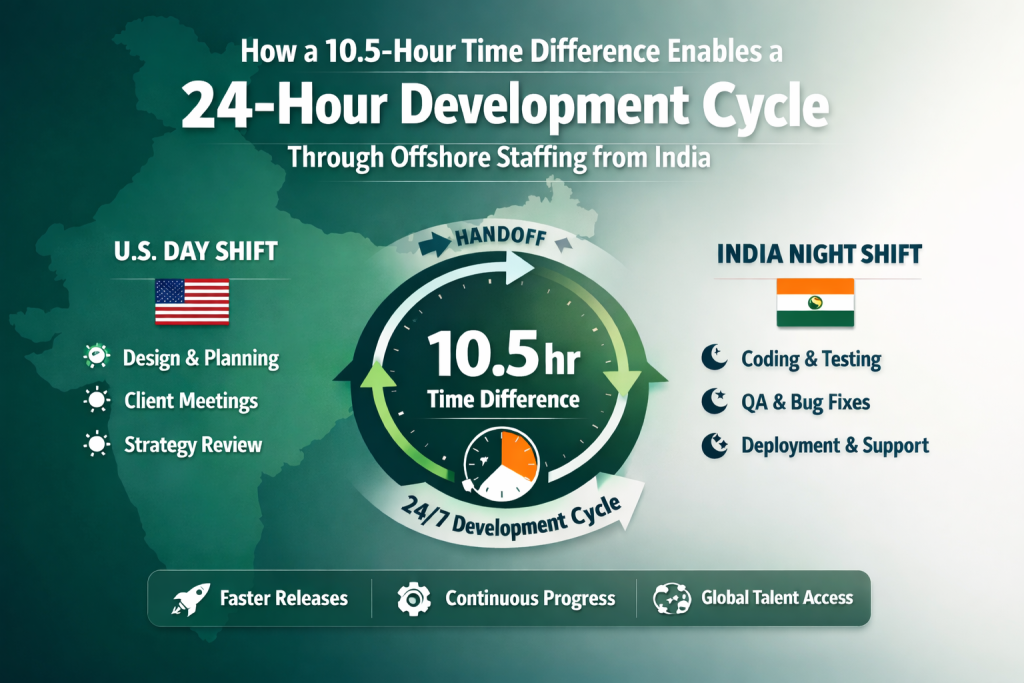
A 10.5-hour time difference between onshore and offshore teams can power a true 24-hour development cycle by enabling round-the-clock progress, faster releases, and continuous support. When managed effectively through offshore staffing and remote staffing models, this time advantage accelerates delivery, reduces downtime, and increases productivity without increasing local headcount.
What Is a 24-Hour Development Cycle?
A 24-hour development cycle is a workflow model where distributed teams in different time zones collaborate in shifts so that work continues around the clock.
In this model, one team hands off completed tasks at the end of its workday to another team in a different time zone. The second team continues development, testing, or support, ensuring uninterrupted progress across software projects, product builds, or IT operations.
Why the 10.5-Hour Time Advantage Matters in Offshore Staffing
A 10.5-hour gap, such as between the United States and India, creates near-perfect overlap for handoffs while still allowing separate full workdays. This balance makes it ideal for remote staffing strategies that aim to maximize output without exhausting teams.
Instead of waiting overnight for responses or delaying tasks by a full business day, organizations can:
- Complete design during US hours
- Execute development during offshore hours
- Perform QA before the US team starts again
This model compresses timelines and improves responsiveness.
The Business Case for Offshore and Remote Staffing in 2024 and 2025
Recent data highlights why companies are increasingly adopting offshore staffing and remote staffing strategies.
1. Remote Work Is Now Standard Practice
According to Owl Labs, State of Remote Work Report 2023, 66 percent of US workers work remotely at least part-time, and 39 percent work fully remote.
This shift normalizes distributed collaboration and strengthens the case for leveraging global talent pools.
2. Outsourcing Continues to Grow
Deloitte’s Global Outsourcing Survey 2024 reports that 76 percent of executives outsource IT functions to reduce costs and improve operational efficiency.
Offshore staffing is no longer just cost-driven. It is now performance and speed driven.
3. Demand for Contract Professionals Is Rising
According to Peoplematters report 2025, 80 percent of managers report difficulty finding skilled professionals locally, increasing reliance on contract and remote talent.
Remote staffing expands the available talent pool significantly.
4. Hybrid and Distributed Teams Improve Productivity
Zoom’s Future of Work Report 2023 found that 64 percent of leaders believe hybrid work improves productivity compared to fully in-office environments.
A well-managed offshore team can enhance output rather than disrupt it.
5. Global IT Outsourcing Market Growth
Devico reports that the global IT outsourcing market revenue is projected to exceed 460 billion dollars in 2025.
This growth reflects long-term structural adoption, not a temporary trend.
How to Achieve a 24-Hour Development Cycle Using Offshore Staffing
Step 1: Establish Structured Handoff Protocols
A 24-hour cycle depends on disciplined communication.
Effective handoffs should include:
- Clear documentation of completed work
- Updated project management boards
- Defined next steps and blockers
- Version-controlled code repositories
Teams should follow standardized templates to avoid ambiguity.
Step 2: Overlap Strategic Hours
Even with a 10.5-hour time difference, schedule 1 to 2 hours of daily overlap for:
- Sprint alignment
- Clarifying requirements
- Resolving blockers
- Quick retrospectives
This overlap maintains cohesion while preserving time zone benefits.
Step 3: Divide Responsibilities by Time Zone
To optimize the time advantage, assign tasks strategically.
| US Team (Day Shift) | Offshore Team (Night Shift US) |
|---|---|
| Product strategy | Feature development |
| Client meetings | Code implementation |
| Architecture review | QA testing |
| Sprint planning | Bug fixes and optimization |
This structured division ensures continuity.
What Are the Benefits of a 24-Hour Development Model?
A 24-hour development cycle accelerates product delivery, reduces time-to-market, and increases operational efficiency. By leveraging offshore staffing and remote staffing strategies, companies transform time zone differences into productivity gains rather than communication barriers.
1. Faster Time to Market
Products move from concept to release in fewer calendar days. If development continues while local teams sleep, release cycles shorten significantly.
2. Continuous Problem Solving
Issues discovered in one time zone are resolved in another before the original team returns online. This reduces idle time.
3. Increased Productivity Without Burnout
Instead of extending local work hours, companies distribute workload across global teams.
4. Cost Optimization
Offshore staffing often reduces operational expenses while maintaining quality, especially in IT, engineering, and software development.
Common Challenges and How to Overcome Them
How Do You Prevent Communication Gaps?
Clear documentation, standardized workflows, and defined escalation channels prevent misalignment. Companies that rely on structured project management tools experience fewer delays in remote staffing environments.
How Do You Maintain Quality Control?
Implement layered QA processes. For example:
- Offshore team performs primary QA
- Onshore team reviews critical features
- Automated testing tools run continuously
This creates redundancy without slowing development.
How Do You Preserve Team Culture?
Build cross-cultural training programs and regular video meetings. Encourage virtual team-building sessions and shared documentation standards.
Real-World Example of Time Advantage in Action
A US-based SaaS company adopted offshore staffing with a 10.5-hour difference between its US and India teams.
Before offshore integration:
- Sprint cycles averaged 14 days
- Bug resolution time was 48 hours
After implementing a 24-hour development cycle:
- Sprint cycles reduced to 10 days
- Bug resolution time dropped to under 24 hours
- Release frequency increased by 30 percent
The key was structured handoffs and overlapping leadership syncs.
Quick Facts About Leveraging Time Zones in Remote Staffing
- A 10.5-hour difference allows near-zero downtime in development workflows
- IT outsourcing adoption remains above 70 percent among global enterprises
- Hybrid and distributed models improve perceived productivity
- 24-hour cycles reduce backlog accumulation
- Offshore staffing expands access to specialized global talent
Best Practices for Implementing Offshore and Remote Staffing
1. Start with a Pilot Team
Test the 24-hour model with one product line or sprint team before scaling.
2. Invest in Collaboration Tools
Use platforms such as:
- Jira or Asana for task tracking
- Slack or Microsoft Teams for communication
- GitHub or GitLab for version control
3. Define Clear KPIs
Track metrics such as:
- Sprint velocity
- Defect rate
- Time-to-resolution
- Release frequency
Measure improvement after introducing offshore staffing.
4. Choose the Right Offshore Partner
Select partners with proven experience in remote staffing, compliance, and workforce scalability.
Offshore Staffing vs Traditional Outsourcing
| Feature | Offshore Staffing | Traditional Outsourcing |
|---|---|---|
| Control | High client control | Vendor controlled |
| Integration | Embedded teams | Separate entity |
| Collaboration | Daily interaction | Periodic updates |
| Scalability | Flexible scaling | Contract-bound |
| Time Advantage | Optimized for 24-hour cycle | Often task-based |
Offshore staffing allows deeper integration and stronger time zone optimization compared to transactional outsourcing models.
Long-Term Strategic Advantages of the Time Advantage
Competitive Differentiation
Companies operating on a 24-hour development cycle outpace competitors that rely on single-location teams.
Global Talent Access
Remote staffing unlocks specialized skills in AI, cloud engineering, cybersecurity, and product development.
Business Continuity
Distributed teams reduce risks associated with regional disruptions, weather events, or localized infrastructure failures.
Key Takeaways
- A 10.5-hour time difference enables continuous development cycles
- Offshore staffing transforms time zones into productivity assets
- Structured handoffs are essential for success
- Remote staffing increases access to skilled global talent
- A 24-hour development cycle reduces time-to-market significantly
Conclusion: Turn Time Differences Into Competitive Advantage
A 10.5-hour time difference is not a barrier. It is a strategic asset. When supported by structured offshore staffing and remote staffing models, it enables continuous development, faster releases, and scalable growth.
Organizations that leverage this time advantage achieve shorter product cycles, improved efficiency, and stronger global competitiveness.
If your company is ready to implement a 24-hour development cycle through offshore and remote staffing, contact Neuhire today to explore scalable, high-performance staffing solutions designed for modern global teams.

Marketing professional with a passion for people, creativity, and growth. I love turning ideas into campaigns that connect and inspire. Currently part of the Neuhire team, helping businesses find the right talent fast.

Marketing professional with a passion for people, creativity, and growth. I love turning ideas into campaigns that connect and inspire. Currently part of the Neuhire team, helping businesses find the right talent fast.