

What Is Offshore Staffing? A Complete Guide for U.S. Companies
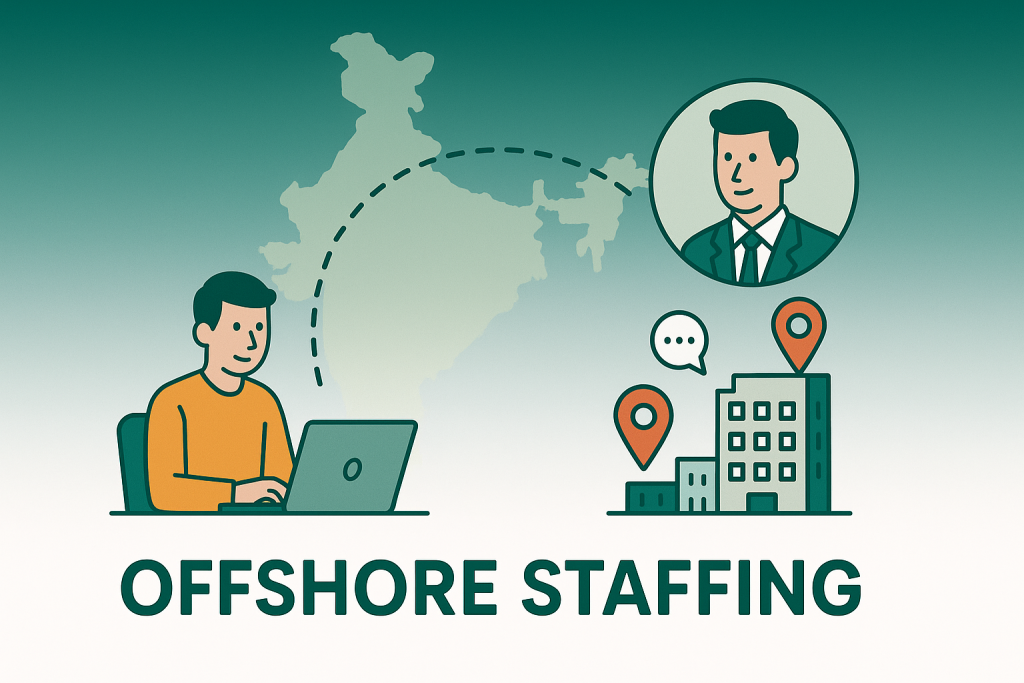
Offshore staffing, also known as remote or global staffing, allows U.S. companies to hire skilled professionals located outside the country to work remotely or in offshore centers. This approach helps reduce costs, expand talent access, and scale operations more quickly.
Introduction
Offshore staffing enables U.S. companies to access global talent pools, lower labor and overhead costs, and scale operations efficiently by hiring professionals abroad or remotely. It is a strategic method to achieve workforce flexibility and business growth.
What Is Offshore Staffing and Remote Staffing?
Offshore staffing means contracting personnel who are employed or managed outside the United States instead of hiring locally.
Remote staffing refers to workers who operate virtually, often outside the country, but are integrated into a company’s team, processes, and culture.
In simple terms:
- Offshore staffing focuses on the location of the talent, which is outside the U.S.
- Remote staffing focuses on the mode of work, which is virtual or distributed, and can include both domestic and international workers.
For U.S. companies, combining both terms means hiring global remote workers, often in lower-cost regions, to support essential or non-core business functions.
Why U.S. Companies Use Offshore and Remote Staffing
U.S. companies use offshore and remote staffing to lower labor costs, access specialized global talent, enable 24/7 operations, and scale quickly while maintaining control over quality and culture.
Key drivers:
- Cost savings: Offshore wages and benefits are typically lower, reducing overall employment costs.
- Access to specialized talent: Global hiring provides access to niche skills in IT, engineering, design, and other fields.
- Scalability and flexibility: Offshore staffing makes it easier to expand or downsize teams quickly.
- Time zone advantage: Offshore teams can offer round-the-clock service coverage.
- Focus on core business: Remote or offshore workers can handle repetitive or administrative tasks, allowing U.S. teams to focus on strategy and growth.
- Support for remote work trends: The normalization of virtual work has made integrating global teams much easier.
Offshore and Remote Staffing Growth Statistics
- According to Forbes (April 26, 2024), 66% of U.S. businesses outsourced at least one department in 2023.
- According to Gitnux, the remote staffing sector grew by 28% in 2023.
- 70% of staffing firms reported increased demand for remote services in 2023.
What Functions Can Be Offshored or Remotely Staffed?
Any role that does not require a physical presence in a U.S. office can be offshored or staffed remotely, including IT, customer service, back-office administration, HR, and marketing functions.
Common functions:
- IT support and software development
- Customer service and call center operations
- Finance and accounting (bookkeeping, payroll)
- Human resources and recruitment
- Marketing, design, and content creation
- Research and development support
Tips for selecting roles:
- Choose roles that are process-driven and measurable.
- Avoid roles requiring extensive in-person collaboration or local compliance.
- Consider hybrid models with a domestic core team and offshore remote support.
Offshore Staffing vs. In-House Hiring vs. Traditional Outsourcing
Offshore staffing combines the control of in-house hiring with the cost and talent benefits of global remote work. Traditional outsourcing transfers full control to external vendors, while in-house hiring involves higher costs and longer recruitment cycles.
Comparison table:
| Model | Talent Location and Control | Cost Implication | Management Complexity |
|---|---|---|---|
| In-House Hiring | U.S.-based employees, full control | High wages and overhead | Medium to high |
| Traditional Outsourcing | External vendor, limited control | Lower cost, less flexibility | Low to medium |
| Offshore or Remote Staffing | Global remote team, internal control | Reduced cost and overhead | Medium, requires coordination |
Key takeaway: Offshore staffing offers cost advantages and global reach while allowing companies to retain control over quality, culture, and performance.
How to Set Up Offshore Staffing for Your U.S. Company
Setting up offshore staffing requires selecting the right roles, choosing a reliable partner, establishing communication systems, ensuring compliance, and integrating remote teams into company culture.
Step-by-step process:
- Identify suitable roles: Choose tasks that are well-documented and measurable.
- Select the right partner model: Hire directly or through an offshore staffing agency.
- Define structure: Set up reporting lines and schedules that overlap time zones.
- Onboard and integrate: Train offshore teams in company systems and values.
- Ensure compliance and data security: Follow U.S. and local labor and privacy laws.
- Monitor performance: Track KPIs like time-to-fill, cost per hire, and productivity.
- Scale strategically: Expand teams as performance metrics validate success.
Pro tip: Begin with a small pilot team, refine workflows, and then scale.
Common Challenges and How to Overcome Them
Common offshore staffing challenges include communication barriers, cultural differences, time zone mismatches, and compliance risks. Strong processes, training, and technology can help overcome these issues.
Challenges and solutions:
- Communication gaps: Schedule consistent check-ins and use project management tools.
- Cultural differences: Provide cross-cultural awareness training.
- Time zone overlap: Choose locations with overlapping business hours.
- Compliance and security: Partner with firms experienced in global employment law.
- Employee engagement: Offer remote recognition and professional development opportunities.
Case Study: How a U.S. Company Benefited from Offshore Staffing
Scenario:
A Fortune 500 U.S. company faced challenges hiring IT support professionals domestically due to high costs and long hiring cycles. They partnered with an offshore staffing provider to build a support team in the Philippines that worked U.S.-aligned hours.
Results:
- Time-to-fill reduced from 60 days to 25 days.
- Cost per hire dropped by 40%.
- 24/7 coverage improved customer response times by 20%.
- U.S. engineers could focus on product innovation instead of technical support.
Lesson: Offshore staffing can drive productivity and cost efficiency when managed effectively.
Key Takeaways
- Offshore staffing gives U.S. companies access to global talent, cost savings, and scalability.
- Common offshore roles include IT, customer service, finance, HR, and marketing.
- 66% of U.S. businesses outsourced at least one department in 2023.
- Remote staffing grew 28% in 2023, showing strong demand for flexible work.
- Success depends on good communication, legal compliance, and cultural integration.
- Pilot programs are ideal for testing and scaling offshore teams efficiently.
Conclusion
Offshore and remote staffing have become strategic tools for U.S. companies looking for flexibility, cost efficiency, and access to global talent. By identifying suitable roles, choosing the right partners, and investing in communication and culture, businesses can create high-performing international teams that drive long-term success.
If your company is ready to build a reliable offshore workforce, contact Neuhire for tailored offshore staffing solutions designed for Fortune 500 and enterprise-level companies. Let’s help you find the right global talent to grow your business.

Marketing professional with a passion for people, creativity, and growth. I love turning ideas into campaigns that connect and inspire. Currently part of the Neuhire team, helping businesses find the right talent fast.

Marketing professional with a passion for people, creativity, and growth. I love turning ideas into campaigns that connect and inspire. Currently part of the Neuhire team, helping businesses find the right talent fast.