

A Step-by-Step Guide to Building an Offshore Team for Your Company
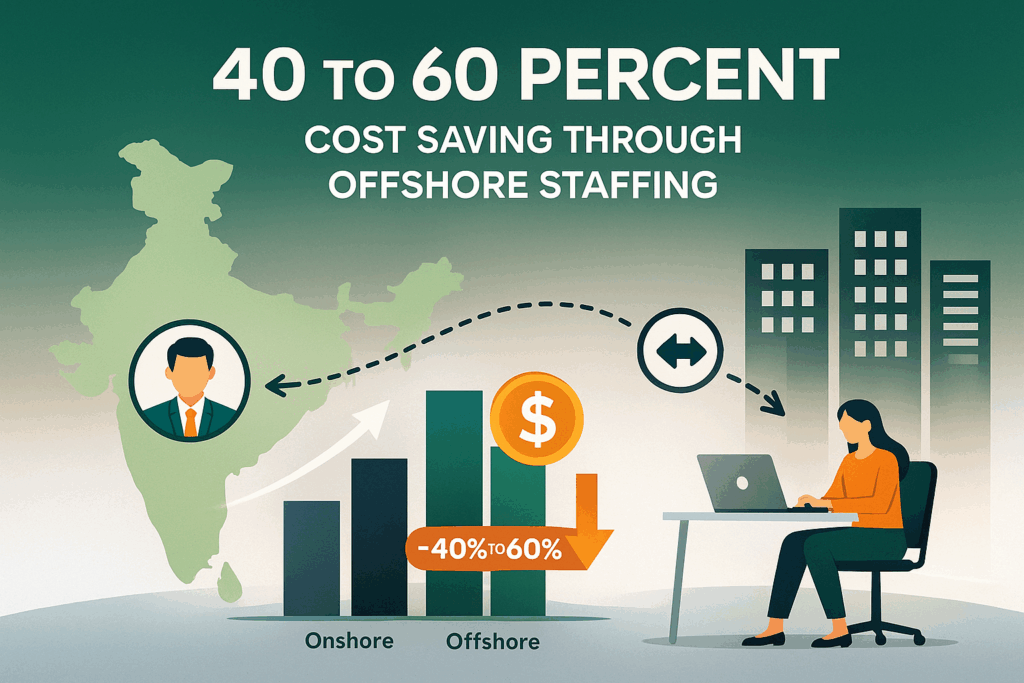
Companies use offshore staffing and remote staffing to cut IT project costs by a significant margin. The primary benefit is the ability to access skilled global talent at a fraction of local hiring costs. Most organizations save between 40 and 60 percent on IT initiatives by shifting development, support, and engineering work to offshore teams.
What Is Offshore and Remote Staffing
Offshore staffing refers to hiring professionals located in another country who work remotely as part of your organization. Remote staffing is a broader model that includes both domestic and international remote talent. Offshore remote staffing is especially effective for IT projects because it offers access to specialized skills with major cost advantages.
Why it matters: Offshore staffing enables cost reduction, flexible scaling, access to hard-to-find skills, and faster project delivery.
How Offshore Staffing Cuts IT Project Costs
Offshore staffing reduces IT project budgets by lowering hourly labor rates, eliminating office and equipment costs, enabling round-the-clock productivity, and allowing teams to scale up or down without long-term commitments. These factors combined produce consistent savings in the 40 to 60 percent range for most modern IT organizations.
Primary Cost Advantages
- Lower labor rates: Software engineers in Asia and Eastern Europe cost significantly less than equivalent talent in the United States or Western Europe.
- Reduced overhead: Offshore remote teams eliminate the cost of office space, utilities, equipment, and local employee benefits.
- Flexible scaling: Offshore providers allow rapid expansion or contraction of teams based on project needs.
- Time zone advantages: Work progresses continuously when teams operate across multiple time zones.
Key Statistics You Should Know
The following recent statistics demonstrate the savings and efficiency of offshore and remote staffing.
- According to Full Scale (2024), organizations typically achieve 40 to 60 percent cost reduction through IT outsourcing compared with in-house development.
- A 2024 analysis by Kimon Services found that offshore staffing reduces labor expenses by 30 to 70 percent, depending on role complexity and region.
- ITTStar reported in a 2023 case study that a U.S. organization achieved 60 percent savings in personnel cost and a 40 percent reduction in sourcing time with an offshore data engineering team.
- World Business Outlook (2025) reported that some companies achieve up to 70 percent reduction in labor cost when shifting software development offshore.
These statistics verify that significant savings are not hypothetical but are consistently achieved across industries.
Offshore Staffing vs Traditional Onsite and Nearshore Models
Comparison Table
| Model | Cost Structure | Control and Integration | Scalability and Speed |
|---|---|---|---|
| Onsite or In-house | Highest labor and infrastructure cost | Strong control and cultural alignment | Slower scaling due to local hiring limits |
| Nearshore (similar time zone) | Moderate savings and lower travel burden | Good integration and communication | Faster than onsite but savings are limited |
| Offshore Remote Staffing | Largest savings across all cost categories | Requires structured communication | Very fast scalability with global talent |
Why Savings of 40 to 60 Percent Are Realistic
Savings come from four core drivers.
1. Salary and Benefit Differentials
A senior developer in the United States may cost 100 to 150 dollars per hour. Equivalent offshore developers may cost 25 to 50 dollars per hour.
2. Lower Infrastructure and Overhead
Offshore remote staffing removes office leases, local taxes, equipment purchasing, utilities, and other on-site expenses.
3. Faster Time to Market
Offshore teams can work in parallel with local teams. This reduces delays, shortens development cycles, and decreases the cost of prolonged sprints or extended timelines.
4. Scalable Staffing Models
Companies can hire talent only for the duration of a specific project. This eliminates ongoing payroll commitments, which improves ROI..
When combined, these savings reliably add up to the 40 to 60 percent range for most IT projects.
Case Studies and Real Examples
- A U.S. financial services company used an offshore data engineering team and reduced personnel cost by 60 percent while also reducing sourcing time by 40 percent.
- A 2024 review of offshore staffing models found that organizations commonly achieve 30 to 70 percent reduction in labor expense, depending on the location and hiring strategy.
- A 2024 study on offshore development usage reported that 66 percent of U.S. companies now rely on offshore software engineers, with hourly rates starting at 22 dollars in several regions.
These examples illustrate the real-world financial impact and widespread adoption of offshore staffing.
Best Practices for Success With Offshore and Remote Staffing
To fully realize cost savings while preserving quality, use the following guidelines.
1. Define Clear Roles and Responsibilities
Integrate offshore staff into your standard processes. Provide clarity around deliverables, expectations, tools, and workflows.
2. Choose an Experienced Offshore Partner
Select a provider with a proven history of quality control, communication, governance, and compliance.
3. Use Strong Communication Frameworks
Create overlapping working hours, set daily standups, use shared collaboration tools, and maintain clear documentation.
4. Measure Productivity and Output
Track relevant metrics such as team velocity, defect rate, adherence to timelines, and sprint outcomes.
5. Implement Rigorous Onboarding
Provide structured training on internal systems, coding standards, security expectations, and communication norms.
6. Ensure Security and Compliance
Protect IP and sensitive data with secure access, NDAs, compliance protocols, and controlled permissions.
7. Prioritize Scalability and Flexibility
Use offshore staffing as a dynamic resource to expand or contract teams according to project demand.
Following these best practices strengthens performance and ensures that cost savings do not come at the expense of quality.
Key Takeaways
- Offshore staffing and remote staffing are powerful models for reducing IT project cost.
- The typical savings range for offshore IT staffing is 40 to 60 percent.
- The largest cost cuts come from lower labor rates, reduced overhead, faster project cycles, and flexible team scaling.
- Many organizations also use offshore talent to boost speed to market and gain access to specialized skill sets.
- Industry data from 2023 to 2025 shows that cost reductions of 30 to 70 percent are common.
- Success requires clear governance, strong partner selection, and well-defined communication channels.
Conclusion
Offshore staffing and remote staffing offer one of the most effective ways to reduce IT project spending. Companies consistently save between 40 and 60 percent while gaining access to global talent and accelerating delivery speed. If your organization is ready to build cost-efficient, high-performing offshore teams, contact Neuhire to explore tailored offshore staffing solutions. Neuhire can help you scale faster, improve hiring ROI, operate more efficiently, and achieve measurable results on every IT project.

Marketing professional with a passion for people, creativity, and growth. I love turning ideas into campaigns that connect and inspire. Currently part of the Neuhire team, helping businesses find the right talent fast.

Marketing professional with a passion for people, creativity, and growth. I love turning ideas into campaigns that connect and inspire. Currently part of the Neuhire team, helping businesses find the right talent fast.