
Skip to content
Neuhire Logo
  • Solutions
  • Hiring ROI
  • Company
    • Why Choose Us
    • Insights
  • Get Started
Get Started

Insights

  • Home
  • Insights
  • Page 3
offshore-staffing-india
Insights

Offshore Staffing in India: Accessing the World’s Largest Talent Pool

October 2, 2025 Rajkumar R Comments Off on Offshore Staffing in India: Accessing the World’s Largest Talent Pool

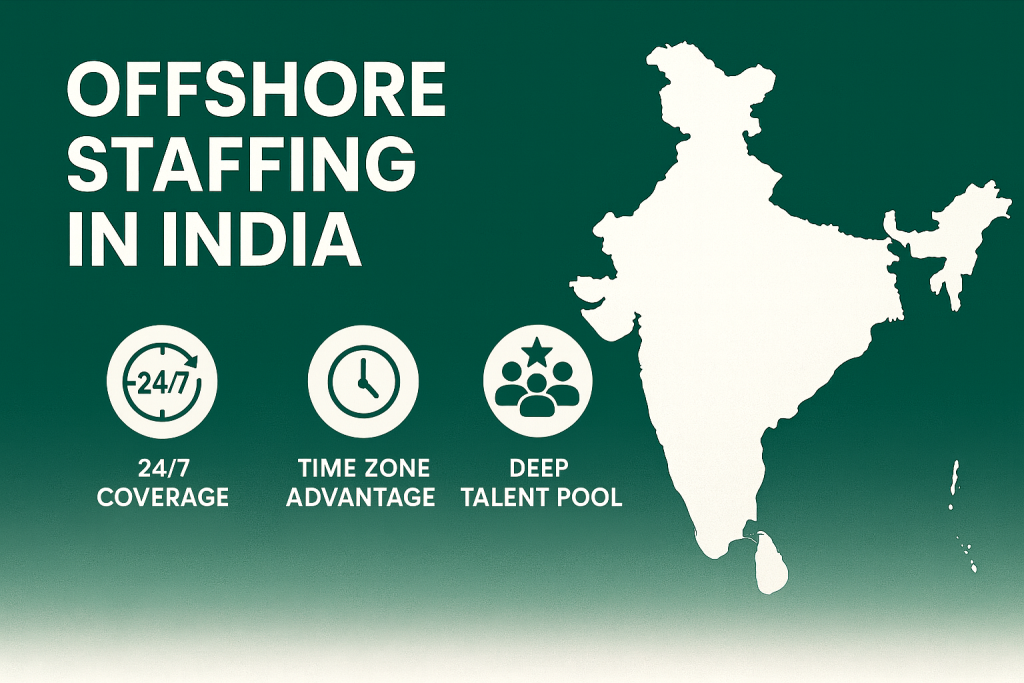
India is now a leading destination for offshore staffing, offering global enterprises unparalleled access to highly skilled, cost-effective talent across technology, operations, healthcare, finance, and more. With its vast workforce, strong English proficiency, and mature outsourcing ecosystem, India enables companies to scale quickly without compromising quality. In this article, we explore how offshore staffing in India works, the benefits, challenges, and how Neuhire helps you tap into this talent reservoir.  The Offshore Staffing Landscape: Why India Leads  India’s Dominant Market Position  According to offshoring industry data, India accounts for approximately 55% of the global offshoring market in many IT and business process sectors.  Offshore staffing in India can reduce labor costs by 30–70% compared to U.S. or European equivalents.  The India staffing and recruitment market was valued at US$ 18.06 billion in 2022, and is projected to grow to US$ 48.53 billion by 2030 (CAGR ~13.2%).  These numbers reflect not just cost savings, but sustained growth and structural strength in India’s workforce sector.  Benefits of Offshore Staffing in India  Here are the key advantages organizations gain:  1. Cost Efficiency and Scalability Lower wage structures, reduced overheads, and favorable operating costs allow companies to manage large offshore teams economically. Jensei reports that a software engineer in India may cost US $18,000–$30,000 annually, compared to US $90,000–$120,000 in the U.S.  2. Deep Talent Pool and Specialist Skills India produces a huge number of engineers, IT professionals, data scientists, and domain experts every year. This enables niche hiring and rapid scaling. Offshore staffing accounts for nearly 72% of global outsourcing contracts in IT services.  3. English Proficiency and Cultural Fit Many Indian professionals are educated in English, enabling seamless communication with clients in the U.S., U.K., Australia, and other markets. This reduces language barriers in remote collaboration.  4. 24/7 Coverage and Time Zone Leverage Indian teams can operate during U.S. off-hours or European late-hours, providing continuous progress on projects and quicker turnaround.  Offshore Staffing Services and Models  When companies offshore to India, they typically adopt one or more of these models:  Model Description Pros Considerations Staff Augmentation / Remote Staff Hire Indian professionals who function as part of your team High control, seamless collaboration Requires strong remote management Project-Based Teams Outsource full projects or modules Turnkey delivery, less overhead Less control over internal processes Managed Services / Offshore Vendor A third-party vendor provides full service Minimal client burden, vendor handles admin Dependent on vendor’s capabilities Global Capability Center (GCC) / Captive Unit Company sets up its own hub in India Maximum control, scalable, aligned with internal culture Greater setup cost, governance required Neuhire can work in any of these models, tailoring based on your business needs, risk tolerance, investment, and control preferences.  Common Use Cases and Industries  Offshore staffing in India supports a wide variety of sectors and functions:  Information Technology and Software Development: Full-stack development, backend systems, QA, cloud, DevOps, AI/ML, mobile apps  Business Process Outsourcing (BPO): Customer support, call centers, transcription, data entry  Finance and Accounting: Bookkeeping, tax, audit support, financial analysis  Healthcare and Life Sciences: Medical coding, telehealth support, clinical data management  Engineering and Manufacturing: CAD, design, simulation, testing  Administrative and Back Office: HR, scheduling, operations support  Challenges and Mitigation Strategies  No offshore model is without challenges. Here is how they appear and how Neuhire helps address them:  1. Time Zone and Communication Gaps Issue: Lack of real-time overlap can delay decisions and cause bottlenecks. Mitigation: Build overlap windows, implement “follow the baton” cycles, encourage asynchronous collaboration, and use tools like Slack, MS Teams, or Jira.  2. Managing Quality and Productivity Issue: Remote monitoring and accountability become difficult. Mitigation: Define clear SLAs, use milestone reviews, adopt OKRs and performance metrics, and schedule periodic audits.  3. Data Security and IP Protection Issue: Risks of leaks or compliance breaches exist. Mitigation: Apply NDAs, legal safeguards, restricted access, encryption, data localization, and work only with vetted providers.  4. Cultural Differences and Alignment Issue: Different work norms or communication styles can cause friction. Mitigation: Offer cross-cultural training, hold regular syncs, and create shared workflows.  5. Talent Attrition and Retention Issue: Market competition can increase turnover. Mitigation: Neuhire emphasizes career development, engagement programs, and competitive benefits.  How Neuhire Makes Offshore Staffing in India Work  1. Pre-Vetted Candidates Neuhire maintains a robust pipeline of vetted professionals across domains such as software, data, finance, healthcare, and engineering.  2. Flexible Deployment Models Whether you need a single remote developer or a full managed service, Neuhire adapts to your requirements.  3. Compliance and HR Support Neuhire manages payroll, contracts, benefits, and local labor laws so that you stay compliant.  4. Integration and Collaboration We set up collaboration stacks and ensure seamless workflow integration with your existing systems.  5. Continuous Oversight Dedicated delivery leads ensure performance reviews, alignment sessions, and consistent quality.  6. Retention and Engagement We implement recognition programs, mentorship, and career growth opportunities to reduce attrition.  Case Study Example  Client: U.S.-based SaaS scale-up Challenge: Needed to expand backend and DevOps teams rapidly but faced high U.S. costs. Solution: Partnered with Neuhire to staff 7 engineers in India, integrated into sprints and daily workflows. Results:  Reduced cost per engineer by about 60%  Delivered two feature releases on time  Improved retention and team cohesion  India vs Other Offshore Destinations  Country Strengths Challenges India Large talent pool, English proficiency, mature ecosystem, cost savings Time zone gaps with Europe, city-level wage pressure Philippines Strong BPO and customer service, cultural fit Smaller STEM talent base Eastern Europe Deep tech expertise, cultural alignment with Europe Higher costs, smaller labor market, geopolitical risks Trends in Offshore Staffing  AI and Automation: Indian teams increasingly use AI to streamline workflows.  High-Value Work: Beyond BPO, offshored teams deliver analytics and R&D.  Hybrid Models: Companies retain core strategy locally and offshore execution.  Remote-First Culture: Post-pandemic, global teams are more comfortable with remote integration.  Vendor Accountability: Clients expect strong SLAs and transparent reporting.  Getting Started with Neuhire  Define goals and scope of work  Assess governance and remote management capability  Partner with Neuhire for domain expertise and compliance support  Start with a pilot team, then scale  Measure performance with metrics and feedback  Build retention and engagement practices  Key Takeaways  India holds more than half of the global offshoring market in IT and business processes.  Offshore staffing in India can cut costs by 30–70% while delivering quality.  The
main-drivers-offshore-staffing
Insights

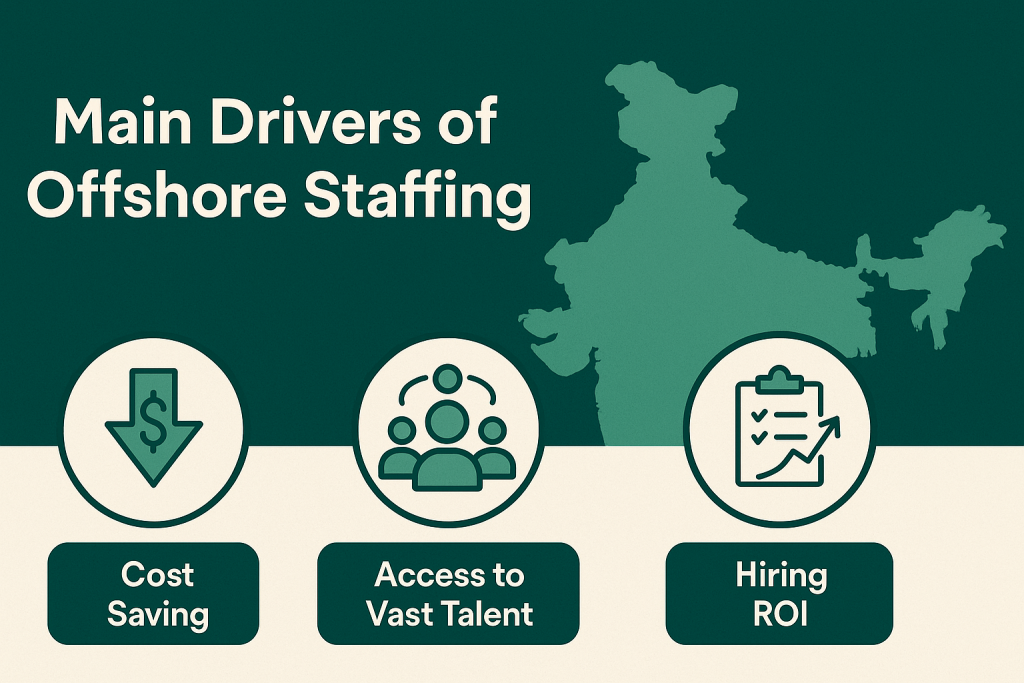
Exploring the Main Drivers of Offshore Staffing and How Neuhire Empowers Growth

October 2, 2025 Rajkumar R Comments Off on Exploring the Main Drivers of Offshore Staffing and How Neuhire Empowers Growth

Companies are increasingly adopting offshore staffing models to reduce costs, access untapped talent pools, speed up hiring, and improve return on investment (ROI). Neuhire offers a compelling case: remote staffing from India not only cuts expenses, but also improves hiring ROI by delivering measurable business value and faster time to productivity.  In this article, we explore the main drivers behind this shift, explain how hiring ROI should be calculated, and show how Neuhire’s approach aligns with high ROI strategies.  Main Drivers Motivating the Shift to Offshore Staffing  1. Significant Cost Optimization One of the principal attractions is the ability to lower labor and operating costs by 30–70 percent relative to in-country staffing, depending on role and location. By offloading administrative overhead, facilities, benefits, and compliance burdens, companies can reallocate capital to core innovation and growth.  2. Access to a Vast, Skilled Talent Pool Many developed markets suffer from shortages in specialized domains such as AI, data science, cybersecurity, and full-stack development. Offshore staffing opens up access to large, high-quality talent pools in India, enabling access to niche skills at scale.  3. Speed and Flexibility in Scaling Teams Offshore vendors often maintain candidate pipelines and scalable processes, allowing businesses to spin up teams quickly for new projects or expansions. This flexibility is especially useful in tech, startups, and product development cycles.  4. Focus on Strategic Functions By moving operational, support, or mid-level technical tasks offshore, in-house teams can concentrate on differentiation, leadership, customer experience, and growth initiatives.  5. Business Continuity and 24/7 Capability Due to time zone offsets, offshore teams can continue working while onshore teams sleep. This enables follow the sun workflows, continuous progress, and faster turnaround in global operations.  6. Mitigating Talent Scarcity in Local Markets In many regions (especially the United States, the United Kingdom, and parts of Europe), competition for tech and domain specialists is intense, and salaries are rising steeply. Offshore staffing bypasses that scarcity and cost inflation.  7. Compliance, Infrastructure and Technology Access Established offshore providers often bring infrastructure, security, collaboration tools, and compliance capabilities such as data protection, IP safeguards, and labor law expertise. This reduces the burden on the client organization to build these capabilities in-house.  8. Post-Pandemic Remote Work Acceptance Since remote and hybrid work models became normalized, offshore staffing is viewed less as outsourcing and more as an extension of distributed teams. Collaboration tools, asynchronous workflows, and remote management practices have matured.  What Is Hiring ROI (Return on Investment) and Why It Matters  Hiring ROI measures how effectively an organization’s investment in hiring contributes to actual business value. It goes beyond cost per hire or time to fill by evaluating how much return (in productivity, revenue, cost savings, or strategic impact) is generated by new hires.  How to Calculate Hiring ROI (Common Frameworks)  A common formula:  Hiring ROI (%) = (Value Delivered by New Hire – Total Cost of Hiring) ÷ Total Cost of Hiring × 100  Total Cost of Hiring includes recruitment marketing, sourcing, interviews, assessments, onboarding, training, benefits, and infrastructure.  Value Delivered can be measured in productivity gains, revenue generation, cost savings, or strategic contributions over a period.  Key Metrics That Influence Hiring ROI  Time to Productivity: How quickly a new hire becomes fully productive.  Quality of Hire: Measured via performance reviews, retention, and cultural fit.  Turnover or First Year Attrition: Early resignations severely erode ROI.  Offer Acceptance Rate: Low acceptance wastes recruiting investment.  Application Completion and Drop off Rates: High drop off means lost investment in candidate acquisition.  Improving these metrics directly boosts hiring ROI.  How Neuhire Positions Around Hiring ROI  Although the full data from Neuhire’s “Hiring ROI” page was inaccessible, the public summary indicates that Neuhire emphasizes ROI-driven staffing solutions from India.  Here is how Neuhire’s model aligns with maximizing hiring ROI:  Lower Input Costs: By leveraging India’s cost advantages, Neuhire helps reduce the “Total Cost of Hiring” denominator, making ROI more favorable.  Faster Ramp Up: Neuhire speeds up hiring and scaling, which improves time to productivity and increases the numerator (value delivered) more swiftly.  Scalable Remote Teams: Their model allows scaling teams for short or long durations, matching supply to demand and reducing overstaffing.  Domain Expertise and Pre Vetted Talent: Pre screened professionals reduce the risk of mismatch, improving quality of hire and lowering turnover risk.  Illustrative Example: How Hiring ROI Can Work in Practice  Let’s run a hypothetical scenario for a software engineer:  Total cost of hiring (recruitment, onboarding, salary, benefits for first year): USD 30,000  Value delivered in first year (revenue, cost savings, productivity): USD 60,000  Then:  Hiring ROI = (60,000 – 30,000) ÷ 30,000 × 100 = 100 percent  So for every dollar invested in that hire, the company gained another dollar in net value. By reducing cost of hiring through Neuhire’s offshore model or by accelerating productivity, ROI improves further.  Combining Offshore Staffing Drivers with Hiring ROI  The reasons companies switch to offshore staffing (cost, speed, talent access, continuity) are not isolated from ROI. They directly influence ROI improvements when implemented well.  Lower cost base reduces the denominator  Faster ramp and higher performance increase the numerator  Pre vetting and retention initiatives minimize losses from turnover  Flexible scaling reduces over investment or idle capacity  In essence, offshore staffing improves ROI across both sides of the equation.  Best Practices to Maximize Hiring ROI in Offshore Models  Define measurable goals up front (revenue targets, process improvements).  Use milestones and performance metrics early (30/60/90 day goals).  Track real productivity rather than just time employed.  Invest in onboarding and alignment so remote staff integrate quickly.  Monitor retention closely, since early exits can undermine ROI.  Use data and feedback loops to adjust hiring models.  Link hires to business outcomes such as feature delivery or cost savings.  Key Takeaways  Companies shift to offshore staffing to reduce costs, gain global talent access, increase speed, and maintain 24/7 operations.  Hiring ROI connects hiring investment to business returns.  Neuhire’s remote staffing model from India delivers ROI by lowering costs and accelerating productivity.  Key levers include time to productivity, quality of hire, turnover rates, and alignment with strategic goals.  Conclusion  Switching to offshore staffing models is not just about lowering costs. It is about creating sustainable, high return talent strategies. Offshore staffing becomes a multiplier for hiring ROI when structured intentionally.  If you want to explore how Neuhire can deliver measurable

offshore-staffing-services
Insights

Why U.S. and European Companies Are Shifting to Offshore Staffing Services

September 8, 2025 Rajkumar R Comments Off on Why U.S. and European Companies Are Shifting to Offshore Staffing Services

According to Forbes (2024), 66% of U.S. companies now outsource at least one department, with approximately 300,000 jobs being offshored each year. Offshore staffing agencies enable organizations to tap into regions with a surplus of specialized skills while reducing payroll costs and administrative burdens.  Key Offshore Staffing Statistics  Forbes (2024): 66% of U.S. firms outsourced at least one department, resulting in about 300,000 jobs moved overseas annually.  Statista (2023): The global staffing industry reached $650 billion in revenue in 2022, reflecting both domestic and offshore staffing growth.  Deloitte (2024): Asset management firms adopting flexible, hybrid, and remote work models (including offshore talent pools) see 74% less employee stress and 50% higher productivity.  Statista (2023): Global IT outsourcing spend hit $132 billion, with 37% of IT operations managed by external (often offshore) agencies.  What Is Offshore Staffing?  Offshore staffing refers to hiring qualified employees from foreign countries, usually via specialized offshore staffing agencies, to fill roles traditionally held in domestic offices. These staff can be dedicated remote employees or managed teams deployed for functions such as IT, customer service, payroll, or marketing.  Top Reasons Why Businesses Choose Offshore Staffing Services  1. Lower Labor Costs and Operational Savings  Offshore staffing helps companies reduce wage expenses, overhead, and taxes. Labor costs in popular offshore markets like India and the Philippines can be 60–70% lower than in the U.S. or Europe.  2. Access to Global Talent and Specialized Skills  Offshore agencies provide direct access to a pool of highly trained professionals such as software engineers, data analysts, and financial experts that may be in short supply domestically.  3. Scalability and Flexibility  Offshore staffing allows rapid scaling without increasing office space, infrastructure, or in-house HR teams. Companies can ramp up or down quickly according to project demands or seasonal requirements.  4. Enhanced Process Efficiency  Outsourcing repetitive or administrative tasks streamlines workflows, allowing domestic teams to focus on strategy and innovation.  How Offshore Staffing Agencies Work  Agencies source, screen, and manage overseas talent for client companies.  They provide payroll, compliance, and HR support, reducing legal complexity for the client.  Offshore teams can be fully remote or operate from dedicated agency offices.  Case Study: Offshore Staffing Drives Business Growth  A mid-sized U.S. marketing firm struggling with local talent shortages partnered with an offshore staffing agency for campaign management.   Results included:  40% reduction in payroll costs.  Improved campaign turnaround times.  Access to creative talent not available locally.  Increased profit margins and business scalability.  Pros and Cons of Offshore Staffing Services  Pros:  Substantial cost savings.  Greater access to skilled talent.  Improved business agility.  Cons:  Potential cultural and time zone challenges.  Data security concerns.  Less direct oversight of staff.  What’s Driving the Offshore Staffing Trend?  1. Remote Work Adoption  Deloitte (2024) found that investment management firms with flexible, hybrid, and remote work arrangements (often leveraging offshore talent) reported higher employee engagement and lower attrition than those mandating full-time office presence.  2. Digital Transformation and Tech Skills Gaps  With IT roles comprising 37% of all outsourced functions in 2023, digitalization has made offshore staffing a necessity for many organizations facing local skills shortages.  3. Economic Uncertainty and Cost Pressure  Firms are prioritizing efficiency amid inflation and global uncertainty, seeking offshoring solutions to boost productivity and preserve margins.  Key Takeaways / Quick Facts  66% of U.S. companies outsource at least one department (Forbes, Oct 2024).  The global staffing industry earned $650 billion in 2022 (Statista, Dec 2023).  Offshore staffing can reduce employee costs by up to 70%.  Remote or hybrid models using offshore teams lower stress and raise productivity by 50% (Deloitte, June 2024).  IT outsourcing now accounts for 37% of IT budgets worldwide (Statista, 2024).  Comparison Table: Offshore vs. Onshore Staffing Factor Onshore Staffing Offshore Staffing Labor Cost High Low Talent Availability Regional limits Global access Scalability Slower Faster Compliance Handling Local only Managed by the agency Communication Real-time Time zone gaps Offshore Staffing Services: Best Practices  How to Succeed With Offshore Staffing Agencies  Select experienced, reputable agencies with strong compliance records.  Define clear expectations, KPIs, and communication protocols.  Invest in cross-cultural training and collaboration tools.  Protect data and intellectual property with robust contracts.  Continuously review performance and address challenges proactively.  What Is an Offshore Staffing Agency?  An offshore staffing agency is a third-party provider that recruits, manages, and supports remote employees in foreign countries for businesses seeking cost-effective, scalable staffing solutions. Such agencies handle payroll, HR, compliance, and administrative tasks, allowing companies to focus on core business activities.  Real-World Examples of Offshore Staffing Success  Global brands like IBM, Microsoft, and Deloitte source specialized skills from major offshore talent pools including India, the Philippines, and Eastern Europe.  According to Forbes (Nov 2024), high-growth startups report quicker scaling and product launches by leveraging offshore marketing and IT teams.  Healthcare leaders optimize costs by offshoring non-clinical functions, as noted in Deloitte’s 2025 outlook.  How Offshore Staffing Supports Remote and Hybrid Work Models  Deloitte’s research indicates that self-selected work environments (including offshore and remote teams) improve employee happiness, energy levels, and productivity. Companies using offshore talent pools are more resilient and effective in transforming workplace culture.  Future Outlook for Offshore Staffing Services  Given ongoing economic challenges and rapid digitalization, the offshore staffing market is predicted to expand even further. Statista forecasts the global IT outsourcing market will grow by $812.7 billion by 2029. U.S. and European enterprises will increasingly integrate offshore staffing services for their critical growth strategies.  Key Takeaways  Offshore staffing adoption is accelerating across multiple sectors.  Agencies help companies save money, scale faster, and access hard-to-find talent.  Firms with flexible work models leveraging offshore employees show increased productivity and retention.  IT and business processes dominate offshored functions.  Conclusion  The shift to offshore staffing services empowers U.S. and European companies to remain competitive in a global market while reducing labor costs and gaining access to specialized talent. With the rise of offshore staffing agencies, businesses can build agile teams that drive innovation and growth.  For organizations seeking tailored offshore staffing solutions, contact Neuhire to discover how strategic talent partnerships can transform your business future Rajkumar RMarketing professional with a passion for people, creativity, and growth. I love turning ideas into campaigns that connect and inspire. Currently part of the Neuhire team, helping businesses find the right talent fast. neuhire.co/

building-a-global-team
Insights

How to Build a Global Team Aligned in Culture and Productivity

August 21, 2025 Rajkumar R Comments Off on How to Build a Global Team Aligned in Culture and Productivity

Building a globally distributed team that maintains cultural alignment and high productivity is one of the most significant challenges modern organizations face. With remote work now accounting for 22.8% of the US workforce and 16% of companies operating as fully remote globally, creating cohesive international teams has become a business imperative rather than a luxury.  A culturally aligned global team delivers measurable results: companies with strong cultural alignment see 21% higher profitability and 682% revenue growth over 11 years compared to just 166% growth for companies without thriving cultures. The key lies in implementing strategic frameworks that bridge geographical boundaries while fostering shared values and accountability.  Understanding the Global Team Alignment Challenge  1. The Scale of Modern Remote Work  The transformation to global remote work has been unprecedented. According to Owl Labs’ 2024 State of Hybrid Work report, managers report that their remote and hybrid teams are 62% more productive than in-office counterparts, yet team misalignment challenges have risen from 37% in 2023 to 44% in 2024.  Deloitte’s 2024 Global Human Capital Trends research shows only 3% of organizations are extremely effective at capturing the value created by workers.  2. The Cost of Misalignment  Team misalignment costs businesses significantly. Research indicates that 86% of executives cite lack of collaboration and communication as the main reason for workplace failures, with some businesses losing $1.5 million annually from broken team alignment.  Strategic Framework for Cultural Alignment  1. Establish Clear Cultural Values and Communication Standards  Cultural alignment begins with explicitly defined values that transcend geographical boundaries. According to Harvard Business Review research, organizations that prioritize positive culture experience a 32% increase in employee productivity.  Essential steps for cultural foundation:  Define non-negotiable core values that apply globally regardless of local customs  Create cultural ambassadors in each region to bridge local practices with global standards  Implement consistent communication protocols across all time zones  Establish decision-making frameworks that respect cultural differences while maintaining organizational coherence  2. Leverage Technology for Seamless Collaboration  The global remote team communication tools market, valued at $17.67 billion in 2023 and projected to reach $58.38 billion by 2032, provides unprecedented opportunities for team alignment.  Technology implementation best practices:  Centralize communication platforms (Slack, Microsoft Teams, or similar) to reduce confusion  Implement asynchronous communication tools that accommodate different time zones effectively  Use visual collaboration tools: 76% of survey respondents say visuals are very or extremely important to achieving shared understanding  Deploy project management systems that provide real-time visibility into team progress and individual contributions  Building Productive Global Teams Across Time Zones  1. Master Asynchronous Work Methodologies  Successful global teams operate on asynchronous principles that prioritize clarity over immediate availability. According to Forbes research, async rituals keep distributed teams aligned by focusing on deliberate communication rather than constant connectivity.  Asynchronous productivity strategies:  Documentation-first approach: Create comprehensive written records of decisions, processes, and project status  Rotating meeting schedules: Ensure no single team member consistently bears the burden of inconvenient meeting times  24-hour feedback cycles: Establish clear expectations for response times that respect work-life boundaries  Structured handoff processes: Create seamless project transitions between team members in different time zones  2. Implement Performance Management Systems  Remote work productivity statistics show that 77% of workers believe their productivity is higher when working from home, yet 85% of leaders struggle to have confidence in remote worker productivity.  Performance management solutions:  Outcome-based metrics rather than time-tracking systems  Regular check-ins focused on project progress and obstacle removal  Clear goal-setting frameworks using OKRs (Objectives and Key Results) methodology  Recognition systems that celebrate achievements across all regions equally  Fostering Cross-Cultural Communication Excellence  1. Address Language and Cultural Barriers  Managing international teams requires addressing inherent language and cultural barriers that can impede productivity. Research from the Global Management Admissions Council shows that 57% of global employers identify communication as the most desirable skill in potential recruits.  Communication enhancement strategies:  Provide language support tools and training for non-native speakers  Cultural sensitivity training for all team members, not just managers  Clear documentation standards that minimize misinterpretation  Regular cultural exchange sessions to build understanding and empathy  2. Build Trust Through Transparency  Trust becomes exponentially more important in distributed teams. According to Harvard Professional Development research, trust unleashes people to do their best work by creating psychological safety.  Trust-building mechanisms:  Radical transparency in decision-making processes  Regular feedback loops that include both positive recognition and constructive guidance  Consistent leadership presence across all geographical regions  Inclusive meeting practices that ensure all voices are heard regardless of time zone  Measuring and Maintaining Team Alignment  1. Key Performance Indicators for Global Teams  Tracking the right metrics ensures sustainable cultural alignment and productivity. Companies with aligned teams see a 24% decrease in employee turnover and 21% higher profitability.  Essential alignment metrics:  Employee engagement scores across different regions  Project completion rates and quality measures  Cross-cultural collaboration frequency and effectiveness  Knowledge sharing and documentation quality  Retention rates by geographical location  2. Continuous Improvement Processes  According to Gallup’s 2024 State of the Global Workplace, global employee engagement declined to 21%, making continuous improvement essential for maintaining team cohesion.  Improvement strategies:  Quarterly alignment assessments using anonymous feedback tools  Regular culture pulse surveys to identify emerging issues  Cross-regional mentorship programs to share best practices  Iterative policy adjustments based on team feedback and performance data  Conclusion  Building a global team aligned in culture and productivity requires intentional strategy, robust communication systems, and continuous refinement. The data clearly shows that organizations investing in cultural alignment and global team management see significant returns in productivity, profitability, and employee retention.  Success depends on establishing clear cultural foundations, leveraging appropriate technology, implementing asynchronous work methodologies, and maintaining transparent communication across all geographical boundaries. Companies that master these elements create competitive advantages that drive sustainable growth in an increasingly global marketplace.  Ready to Transform Your Global Team?  Building culturally aligned, productive global teams requires specialized expertise and strategic implementation. Contact Neuhire today to discover how our comprehensive staffing solutions can help you create high-performing international teams that drive measurable business results. Our proven methodologies have helped organizations achieve up to 40% improvements in team

women-in-remote-work
Insights

Women in Remote Work: Opportunities and Challenges in India’s Distributed Teams

August 18, 2025 Rajkumar R Comments Off on Women in Remote Work: Opportunities and Challenges in India’s Distributed Teams

India’s remote work revolution in the past five years has reshaped professional opportunities, especially for women. As companies across sectors adopt flexible, location-agnostic models, the potential to bridge gender gaps and decentralize talent has never been more promising. This comprehensive blog explores how remote work is empowering Indian women – and the unique obstacles they face.  The Remote Work Boom in India  Remote and hybrid work have grown from pandemic necessity to mainstream practice. According to Forbes, by 2025 60 to 90 million Indians are expected to be working remotely, making up 10.12% to 15.17% of the workforce.  Industry surveys indicate that over 70% of Indian companies now have formal remote or hybrid policies – a number that’s only rising in tech, finance, and education. Large IT firms, including TCS, Infosys, and Zoho, have pioneered flexible models like TCS’s “25/25” strategy (only 25% of staff on-premise at any time), rural office hubs, and metaverse onboarding experiments.  This transformation has been supported by improvements in:  Internet connectivity across cities and rural areas.  Proliferation of digital tools (cloud platforms, collaboration apps).  Inclusion of remote work in recruitment, onboarding, and performance evaluation.  For Indian women, these shifts have opened doors that were previously closed due to family priorities, mobility constraints, or bias in traditional workplaces.  Opportunities for Women: Why Remote Work Matters  Remote work is proving to be a catalyst for women’s economic empowerment:  Broader Job Access: Flexible work-from-home options allow women from Tier-2, Tier-3 cities, and rural areas to enter professional roles more easily.  Work-Life Balance: The ability to manage home and career is a game-changer, especially in a society where women still bear the brunt of caregiving and domestic responsibilities.  Career Continuity: Qualified women who leave the workforce after marriage or childbirth can now return through remote roles that accommodate variable schedules.  Reduced Commuting: Less time and stress from commuting is a key reason women pursue remote jobs, according to Uplers, which reports that over 34% of rural and 28% of urban Indian women are open to work-from-home opportunities.  Global Exposure: Remote work opens up high-value assignments with international companies, broadening skills and income.  Hiring platforms like Apna.co report a 132% annual increase in women seeking remote jobs, and demand has doubled year-over-year. Academic studies show that when offered local, part-time remote jobs, more than half of married women accept, compared to only a quarter for traditional office roles.  The Ratio of Women in India’s IT Industry  The IT sector is at the forefront of this change – women now hold 32% of technology jobs in India in 2025, up from 29% in 2024. In contractual roles, female participation surged from 9.51% in 2020 to nearly 28% in 2024, with global capability centers (GCCs) reporting even higher numbers.  IT and Computers: In white-collar roles, 34% of women employed in 2025 are in IT/software jobs, followed by BFSI (banking and finance) and recruitment sectors.  Emerging Technologies: Around 26% of women are now working in modern roles like AI, cybersecurity, cloud computing, and data science – reflecting a surge in digital skills and specialized talent.  Geographic Diversity: 41% of women’s jobs are now located in Tier-2 and Tier-3 cities, expanding hiring beyond traditional corporate hubs.  This progress is tangible, but disparities persist – particularly in leadership representation and pay parity at senior levels.  Major Challenges: The Hidden Load  Despite significant gains, Indian women in remote roles face ongoing hurdles:  Persistent Household Expectations: Even with remote flexibility, women shoulder disproportionate family and domestic work, resulting in double workloads and increased stress.  Digital Divide: Not all regions have reliable internet or adequate workspaces, limiting access for many women – especially in less urbanized areas.  Visibility & Advancement: “Out of sight, out of mind” bias persists. Remote employees, particularly women, may miss out on mentorship, networking, and promotions, exacerbated by cultural norms that undervalue women’s work.  Skill Gaps: Women sometimes lag in exposure to new tech tools and platforms, stemming from education barriers or less workplace experience.  Isolation: Remote work can limit professional camaraderie and peer support – essential for confidence and growth.  Cybersecurity and Safety: Online harassment and privacy threats affect women more acutely, making digital safety crucial.  Useful Strategies & Staff Solutions  Forward-looking Indian companies are rolling out practices that help women thrive remotely:  Supportive HR policies: Flexible leave, family-friendly benefits, mental health resources, and mentorship programs.  Tech stipends and home-office support: Internet and hardware reimbursements to overcome infrastructure gaps.  Digital training and upskilling: Company partnerships with ed-tech platforms, bootcamps, and online courses targeting women (notably, 42% of Indian online learners were women in 2022 – an increase from 38% in 2019).  Transparent performance metrics: Outcome-based evaluations rather than physical presence or hours, promoting equity.  Virtual communities and networking: Online chat groups, digital conferences, and virtual mentorship to replace physical networking.  The Transformative Impact – And the Path Forward  Remote work is more than a logistical shift; it’s a social and economic lever for change. In India, it is rewriting the rules for women’s workforce participation, helping them bypass traditional barriers and join high-growth digital sectors, from urban tech giants to startups in small towns.  But true empowerment demands ongoing effort – policy updates, tech investments, upskilling, family engagement, and company leadership.  Key Takeaways  Remote work is enabling millions of Indian women to join or re-enter the workforce, with tech sectors leading the way.  Women now constitute 32% of the tech industry workforce in India (2025) – a significant jump reflecting successful inclusion initiatives.  Around 10-15% of the entire Indian workforce is working remotely in 2025, representing 60-90 million people.  Challenges remain: double workloads, digital divides, career advancement hurdles, and safety concerns.  Progressive policies – flexible HR, tech reimbursements, digital upskilling, and transparent promotions – can be game-changers.  The future is flexible, digital, and inclusive: but it requires commitment from employers, policymakers, and society.  Conclusion The rise of remote work in India has unlocked unprecedented opportunities for women, enabling them to overcome geographical, cultural, and logistical barriers. Yet, the journey is far from

6-common-mistakes
Insights

6 Mistakes to Avoid When Scaling a Remote Workforce

August 18, 2025 Rajkumar R Comments Off on 6 Mistakes to Avoid When Scaling a Remote Workforce

Scaling a remote workforce offers flexibility, access to global talent, and cost savings. However, it also presents unique challenges that can hinder growth and productivity if not managed well. In 2025, with remote work becoming a standard practice worldwide, companies need to navigate these complexities deliberately. This blog highlights the six key mistakes companies often make when scaling remote teams and offers actionable strategies to avoid them—ensuring a sustainable, engaging, and high-performing remote work culture. 1. Unclear Communication and Expectations Clear, consistent communication is the cornerstone of remote team success. When scaling, vague instructions or sporadic check-ins create confusion, duplicated efforts, missed deadlines, and employee disengagement.  What to avoid:  Ambiguous goal-setting and inconsistent updates  Relying heavily on unstructured chats or emails without defined processes  How to fix it:  Set clear roles, responsibilities, and deadlines  Use standardized communication tools like Slack, Microsoft Teams, or Zoom  Document processes and meeting outcomes centrally accessible to all team members  Establish regular check-ins that balance frequency with respect for individual focus time  2. Ignoring Time Zone Differences and Scheduling Conflicts Scaling often means hiring across multiple time zones. Ignoring these differences causes burnout, missed collaboration opportunities, and fragmented workflows.  Common pitfalls:  Expecting synchronous availability without considering time zone overlaps  Scheduling redundant or unnecessary meetings outside core hours  Best practices:  Define core overlapping work hours for real-time collaboration, supported by asynchronous communication for other tasks  Use scheduling tools like World Time Buddy or Google Calendar that adjust for time zones  Record meetings and share notes to keep remote workers informed asynchronously  Futuramo’s 2023 survey found that 65% of employees prefer full-time remote work but emphasized flexibility around time zones as crucial for productivity.  3. Micromanaging Instead of Building Trust Micromanagement takes away freedom, lowers team spirit, and can make people quit. This is even worse in remote teams where building trust is already more difficult. Common mistakes:  Monitoring every action or requiring constant status updates  Focusing on hours logged rather than outcomes achieved  How to lead effectively:  Set clear expectations and outcomes, then empower employees to manage their workflows  Schedule regular but non-intrusive one-on-ones focused on support and development  Foster a culture where employees feel trusted and accountable  Forbes highlights that building trust over micromanaging drives better engagement and retention in remote teams.  4. Overloading Employees with Meetings and Ineffective Tool Use Too many meetings cause fatigue and reduce time for focused work, while poorly chosen or inconsistently used tools create friction.  What to avoid:  Scheduling excessive video calls or meetings without clear agendas  Using multiple overlapping tools without training or standardization  Strategies to implement:  Limit meetings to necessary topics with clear goals and time limits  Emphasize asynchronous collaboration through platforms like Asana, Trello, or Microsoft Planner  Standardize tool usage company-wide and provide training to maximize efficiency  Buffer’s State of Remote Work report found that 44% of remote workers suffer from burnout partly due to excessive meetings and poor tool use.  5. Neglecting Work-Life Balance and Burnout Prevention Remote work can blur boundaries between professional and personal life, leading to overwork, stress, and disengagement.  Risk factors:  Employees feeling pressure to work beyond scheduled hours to prove productivity  Lack of defined workspaces and routines making it hard to disconnect  How to support balance:  Encourage setting clear work hours and respecting off-hours communication boundaries  Promote mental health initiatives and regular breaks  Provide guidance on creating dedicated home workspaces  6. Underinvesting in Remote-First Technology Relying on outdated tools hampers communication, collaboration, and engagement across locations.  Key Statistics  75% of employees believe their current remote-work tools need improvement.   83% say good technology is essential to do their job well.   Recommendations  Equip teams with secure, reliable communication tools (e.g. Slack, Teams), video platforms (e.g. Zoom), and project management software (e.g. Asana, Jira) to ensure seamless collaboration regardless of location.  Ensure VPNs, cloud storage, and hardware meet performance and security standards to minimize downtime, protect sensitive data, and maintain operational efficiency.  Regularly survey teams to identify pain points, assess tool effectiveness, and gather suggestions for improvements. Use this feedback to upgrade or customize tools, provide targeted training, and ensure that every team member can work efficiently without unnecessary friction or technical barriers.  Conclusion  Successfully scaling a remote workforce requires a proactive approach to overcoming the unique challenges of distributed work. By focusing on clear communication, respecting time zones, building trust instead of micromanaging, optimizing meetings and tool usage, prioritizing work-life balance, and investing in remote-first technology, companies can create a resilient, high-performing, and engaged remote culture.  In 2025 and beyond, organizations that embrace modern tools, flexible practices, and empathetic leadership will be best positioned to attract top global talent, maintain productivity, and foster long-term employee satisfaction.  Neuhire is a modern talent solutions platform committed to helping businesses connect with skilled professionals across India’s distributed workforce. We specialize in flexible hiring models, leveraging technology to match top talent with the right opportunities – from IT and emerging tech to creative and operational roles. With a focus on inclusivity, Neuhire actively supports women in remote and hybrid careers, helping employers build diverse, future-ready teams.  Ready to scale your distributed team without the common mistakes? Contact Neuhire for expert staffing solutions tailored to your remote workforce needs or download our free guide on building high-performance remote teams.  Rajkumar RMarketing professional with a passion for people, creativity, and growth. I love turning ideas into campaigns that connect and inspire. Currently part of the Neuhire team, helping businesses find the right talent fast. neuhire.co/

reduce-hiring-cost
Insights

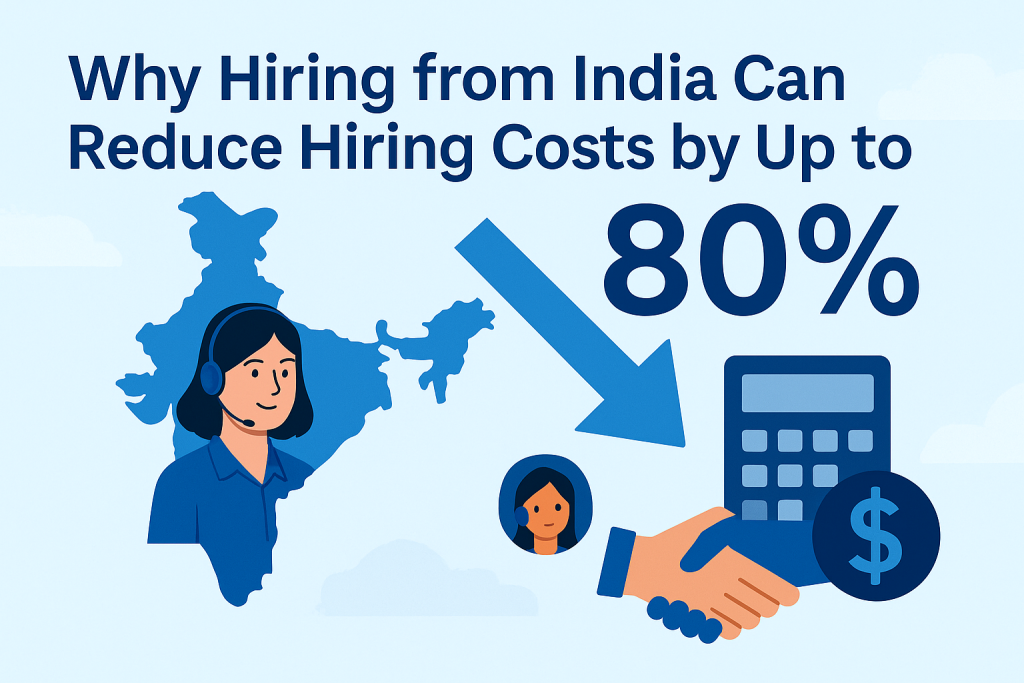
Why Hiring from India Can Slash Your Hiring Costs by Up to 80%

August 13, 2025 Rajkumar R Comments Off on Why Hiring from India Can Slash Your Hiring Costs by Up to 80%

The global talent landscape has fundamentally changed with the rapid adoption of remote staffing and hybrid work models. Companies aiming to optimize costs and tap into high-quality expertise are increasingly turning to India — the world’s leading destination for affordable skilled labor.  This post explores why hiring remote staff from India can cut your hiring costs by up to 80%, supported by recent statistics and actionable insights to strengthen your IT staffing strategies.  The India Advantage: How Much Can You Really Save? Compelling Statistics  Cost savings: Businesses save 60–80% on payroll and associated employment costs by hiring remote staff from India compared to equivalents in the U.S., U.K., or Australia.  Salary comparison: Indian employees in technical roles typically earn 20–25% of the salaries offered in developed Western economies.  Lower recruitment costs: In India, agency fees are usually 8–15% of annual salary, significantly less than in the U.S., and job advertising, screening, and onboarding are also far more cost-efficient.  Why Is It So Affordable to hire from India? 1. Lower Cost of Living Major Indian cities have a significantly lower cost of living compared to Western hubs, reducing salary expectations while still offering competitive local pay.  2. Favorable Exchange Rates Currency values allow USD or EUR-paying employers to stretch budgets further.  3. Elimination of Overheads Remote staffing cuts expenses related to office space, utilities, equipment, and in-office perks.  Remote Staffing & Hybrid Work: The Modern Staffing Strategy Remote and Hybrid Work – The New Normal  Mainstream adoption: As of 2025, 22% of the U.S. workforce is fully remote, and 83% of global employees prefer hybrid work arrangements.  Flexible staffing: Modern IT staffing strategies blend core teams with project-based remote staff for greater scalability and agility.  India’s sweet spot: With over 808 million working-age individuals under 35 and one of the world’s largest digitally skilled populations, India is a global leader in remote-ready talent. How Remote Staffing from India Benefits Your Business 1. Access to a Vast, Diverse Talent Pool India produces millions of engineers and IT professionals annually, ensuring availability across niche skills like AI, cybersecurity, and cloud architecture.  2. Time Zone Advantages Indian teams can overlap with both European mornings and U.S. mornings or evenings, enabling 24/7 productivity and faster turnaround.  3. Scalability and Flexibility Easily scale teams up or down based on project demands, paying only for the resources you need.  Deep Payroll Savings Through Indian Staffing Payroll Costs Compared  Role U.S. Salary (avg) India Salary (avg) Savings (%) Software Engineer $110,000 $15,000–$22,000 80% QA Analyst $75,000 $10,000–$15,000 80% IT Project Manager $115,000 $18,000–$25,000 78% Other Hidden Savings  No local payroll taxes or social security (when using an EOR or offshore contractor model).  Lower benefit costs: Statutory benefits in India are typically 12–20% of salary, compared to 30%+ in the U.S. or EU.  No physical benefits: Remote setups avoid costs for office space, utilities, and transportation subsidies.  Real-World Statista Data  IT staffing market value: India’s IT staffing industry is valued at $4+ billion in 2025, growing at 8–10% annually.  Employee cost efficiency: Employee costs for India’s IT sector average 55.41% of company revenue, reflecting its ability to maintain strong workforce density at competitive rates.  How to Hire Remotely from India: Proven Strategies 1. Leverage IT Staffing Agencies Partner with full-service or niche agencies that handle recruitment, vetting, compliance, and onboarding.  2. Adopt Employer of Record (EOR) Solutions Use EOR platforms to manage payroll, benefits, and tax compliance seamlessly.  3. Blend with Hybrid Models Combine India-based remote hires with local or on-site staff for optimal collaboration.  4. Use Collaboration Technology Invest in tools like Jira, Slack, and Zoom to integrate global teams into unified workflows.  In Closing: The Smart Choice for Modern Businesses In today’s competitive global market, remote staffing from India is not just a way to save money, it is a strategic move that boosts agility, scalability, and innovation. By tapping into India’s deep talent pool, companies can reduce hiring costs by up to 80%, scale quickly, and remain competitive in the digital economy.  Neuhire is a staffing platform that connects global businesses with top professionals from India, helping companies save up to 80% on payroll costs. With over two decades of experience and a team of more than 500 professionals, Neuhire offers a “Perfect Hire” guarantee for high-quality permanent staffing. Streamline your hiring process and access top talent in India today,  get started with Neuhire.  Rajkumar RMarketing professional with a passion for people, creativity, and growth. I love turning ideas into campaigns that connect and inspire. Currently part of the Neuhire team, helping businesses find the right talent fast. neuhire.co/

Remote hiring benefits
Insights

How Remote Hiring Benefits Every Sector in the US

January 8, 2025 Kirubanandan S Comments Off on How Remote Hiring Benefits Every Sector in the US

A well-defined statement helps participants focus their creativity and ensures everyone is on the same page.

Recruitment Challenges
Insights

Top Recruitment Challenges and How Neuhire Solves Them

December 12, 2024 Kirubanandan S Comments Off on Top Recruitment Challenges and How Neuhire Solves Them

Recruitment can be overwhelming—rising costs, limited access to qualified candidates, and inefficient processes can slow down business growth. Neuhire tackles these pain points with innovative solutions that make hiring seamless, cost-effective, and high-quality. Here’s a closer look at the top hiring challenges and how Neuhire solves them. High Recruitment Costs The Challenge: Businesses often face inflated payroll costs, recruitment fees, and administrative expenses, which can hinder scalability. How Neuhire Solves It: Neuhire connects you with India’s top talent, enabling you to save up to 80% on payroll. With transparent, one-time fees and no recurring costs, you can focus on scaling your team without worrying about your budget. Limited Access to Skilled Talent The Challenge: Finding highly skilled professionals with the right cultural alignment and expertise can be challenging, especially in global markets. How Neuhire Solves It: With over 20 years of experience, Neuhire leverages India’s diverse and highly skilled talent pool. Whether you need engineers, customer support specialists, or marketing experts, we ensure candidates meet your specific requirements. Lengthy Hiring Timelines The Challenge: Delays in hiring can lead to missed deadlines, stalled projects, and increased operational costs. How Neuhire Solves It: Neuhire’s streamlined hiring process ensures quick turnarounds. Entry-level roles are filled within 2 weeks, while senior positions are finalized in 1-2 months, keeping your business on track. Poor Candidate Quality The Challenge: Many businesses struggle to find candidates who are both technically skilled and culturally aligned with their teams. How Neuhire Solves It: Our expert screening process ensures only pre-vetted, high-quality professionals are presented to you. Plus, our 3-Month Perfect Hire Guarantee offers peace of mind—if a hire doesn’t meet your expectations, we’ll replace them at no extra cost. Hidden Fees and Lack of Transparency The Challenge: Hidden recruitment fees and unclear pricing structures can make hiring stressful and unpredictable. How Neuhire Solves It: At Neuhire, transparency is key. Our pricing is upfront, with no hidden fees or recurring costs. You pay a one-time fee and enjoy seamless, hassle-free hiring. Why Choose Neuhire? Cost Savings: Save up to 80% on payroll costs. Access to Talent: Tap into a pool of highly skilled professionals across industries. Quick Turnaround: Fill roles faster, from 2 weeks for entry-level to 2 months for senior positions. Expert Screening: Receive pre-screened, culturally aligned candidates. 3-Month Guarantee: Replace hires at no cost if they don’t meet expectations. Beat Recruitment Challenges with Neuhire Neuhire simplifies the recruitment process, addressing common pain points and offering tailored solutions for your business. With 20+ years of experience and a track record of 10,000+ successful placements, we’re the trusted choice for businesses looking to hire top-tier talent. Ready to solve your recruitment challenges? Contact Neuhire today and start hiring smarter! Help Center Frequently asked questions 1. How does Neuhire ensure candidate quality? Our candidates undergo a thorough screening process to ensure they meet technical and cultural requirements. Plus, we offer a 3-month Perfect Hire Guarantee for added peace of mind. 2. How much can businesses save with Neuhire? Businesses save up to 80% on payroll costs by hiring skilled professionals from India. 3. What industries does Neuhire serve? Neuhire provides hiring solutions across industries, including IT, e-commerce, real estate, and marketing. 4. How long does it take to hire a candidate through Neuhire? Entry-level roles can be filled within 2 weeks, while senior positions are typically finalized in 1-2 months. 5. Are there any hidden fees with Neuhire? No, Neuhire offers transparent pricing with no hidden fees or recurring costs. Kirubanandan S

Neuhire Best Place to Hire Indian Talent
Insights

Why Neuhire is The Best Place to Hire Indian Talent

November 11, 2024 Kirubanandan S Comments Off on Why Neuhire is The Best Place to Hire Indian Talent

Neuhire is the go-to solution for businesses seeking top-tier Indian talent. With over 20 years of experience, cost-efficient hiring, and an unparalleled talent pool, Neuhire connects businesses with skilled professionals who align with their unique requirements.

Posts pagination

Previous 1 2 3

Recent posts

  • 10-practices-for-high-performance-remote-teams
    10 Best Practices to Maintain Quality Control in Offshore Staffing
  • how-offshore-staffing-reduces-long-hiring-cycles
    Struggling with Long Hiring Cycles? Offshore May Be the Answer
  • 24-hour-development-cycle
    Leveraging the 10.5-Hour Time Difference to Achieve a 24-Hour Development Cycle
Neuhire Logo
Quick Links
  • Solutions
  • Hiring ROI
  • Why Choose Neuhire
  • Insights
  • Get Started
Other Links
  • VIVA USA Inc
  • STARS Supplier Management
  • Savvysoft Technologies
Follow us on

2025 © Copyright, VIVA USA Inc. All Rights Reserved.

  • Terms & Conditions
  • Privacy Policy