

How Fortune 500 Companies Use Offshore Staffing to Stay Competitive
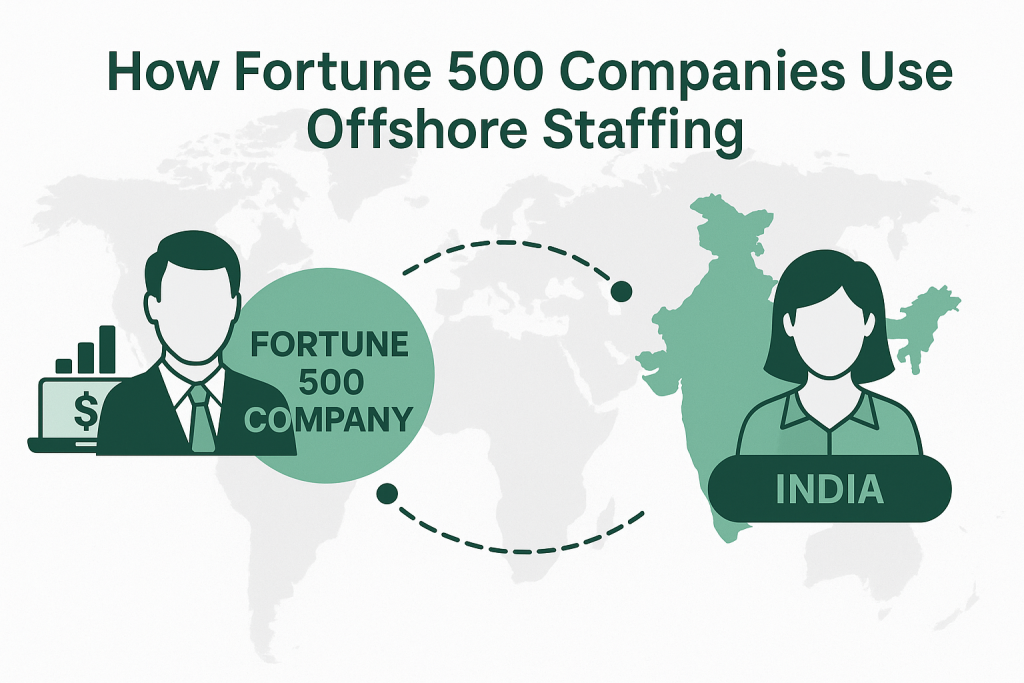
Offshore staffing, often called remote staffing, is a strategic approach that top U.S. companies use to access global talent, reduce labor costs, and accelerate innovation. This guide explains how Fortune 500 firms use offshore staffing, why it matters, and how other businesses can follow their lead.
Introduction
Fortune 500 companies use offshore staffing to access global skills, lower costs, and gain agility in competitive markets. This strategy helps them scale faster, provide 24/7 service, and free domestic teams to focus on innovation and growth.
What Is Offshore Staffing for Fortune 500 Companies?
Offshore staffing involves hiring full-time or contract professionals located outside the United States who work remotely or through an offshore delivery center. Remote staffing focuses on the virtual mode of work across different geographies.
In large enterprises, offshore staff are often integrated into core teams, using the same systems, goals, and workflows as domestic employees.
Why it matters for large organizations
- Access to global talent that may be hard to find domestically
- Cost savings from hiring in regions with lower labor expenses
- 24/7 operations made possible through multiple time zones
- Flexibility to scale teams up or down as needed
- Support for international expansion without opening new offices
Why Fortune 500 Companies Invest in Offshore and Remote Staffing
Fortune 500 companies invest in offshore and remote staffing to reduce costs, gain access to specialized global talent, maintain round-the-clock operations, and improve scalability while retaining control over performance and company culture.
Key reasons:
- Cost efficiency: Lower wage rates and reduced overhead lead to significant savings.
- Talent access: Offshore markets offer engineers, analysts, designers, and customer-service agents who may be scarce in the U.S.
- 24/7 coverage: Teams in multiple time zones provide continuous service and faster response times.
- Innovation focus: Offshore teams handle routine processes, allowing U.S. staff to focus on strategy and development.
- Scalability: Companies can quickly expand support functions without lengthy domestic hiring cycles.
Recent statistics:
- According to World Metrics (2023), more than 60% of Fortune 500 companies have offshored at least one business function.
- The 2023 Deloitte Global Shared Services and Outsourcing Survey found that 60% of organizations expanded their shared services or outsourcing operations in recent years.
- In the 2024 Deloitte Global Outsourcing Survey, 83% of executives reported using AI within their outsourced and offshore services.
These insights show that offshore staffing is now a mainstream strategy for competitive advantage.
What Functions Do Fortune 500 Companies Offshore?
Fortune 500 companies offshore roles such as IT, finance, HR, marketing, analytics, and customer service to improve efficiency, reduce costs, and enhance innovation while keeping strategic control.
Commonly offshored functions:
- Information technology and software development
- Customer service and support operations
- Finance and accounting (bookkeeping, payroll, data processing)
- Human resources and recruitment support
- Digital marketing, design, and content production
- Data analytics and research services
How Fortune 500 Companies Build Successful Offshore Teams
Leading companies use offshore staffing strategically by selecting suitable roles, building strong governance, aligning offshore teams with company culture, and investing in technology for seamless collaboration.
Steps Fortune 500 companies follow
- Identify suitable roles: Choose process-driven tasks that do not require in-person work.
- Establish governance: Use the same KPIs, management systems, and workflows for offshore teams as domestic teams.
- Leverage collaboration tools: Cloud platforms, video conferencing, and project management systems keep teams connected.
- Plan for time zones: Offshore staff often work overlapping or complementary hours for continuous operations.
- Invest in training: Ongoing learning and development ensure offshore workers stay aligned with business goals.
- Ensure compliance: Protect data, intellectual property, and labor rights through strict governance policies.
Real-world example
A U.S. technology company faced long domestic hiring cycles for software engineers. By building an offshore team in India, it:
- Cut hiring time from 60 to 25 days
- Reduced average cost per hire by 40%
- Enabled 24/7 product development cycles
- Increased productivity and reduced burnout among U.S. staff
Offshore Staffing vs. Outsourcing vs. Remote Domestic Hiring
Offshore staffing allows companies to employ international talent directly while retaining control, traditional outsourcing hands operations to external vendors, and remote domestic hiring relies on local talent within the U.S. .
| Model | Talent Location and Control | Cost Level | Integration and Culture Alignment |
|---|---|---|---|
| Remote Domestic Hiring | U.S.-based staff, full internal control | Highest | High integration |
| Traditional Outsourcing | External vendor manages processes | Lower, less control | Moderate integration |
| Offshore Staffing | Directly managed global employees | Lower with high control | Strong alignment through internal governance |
Offshore staffing provides the balance between cost savings and operational control that Fortune 500 companies prefer.
Key Metrics and Trends in Offshore Staffing
Fortune 500 companies measure offshore success using data-driven metrics:
- Time-to-fill: Offshore hiring pipelines reduce recruitment cycles significantly.
- Cost per hire: Offshore roles often cost 30–50% less than domestic equivalents.
- Productivity improvements: 24/7 operations accelerate delivery timelines.
- Employee retention: Offshore staff integrated into company culture stay longer.
- Speed to market: Offshore teams enable continuous progress, even outside U.S. hours.
Recent statistics:
- World Metrics (2023): 60% of Fortune 500 companies offshore at least one department.
- Deloitte (2023): 60% of enterprises expanded outsourcing or shared services operations.
Challenges and How Fortune 500 Companies Overcome Them
Large organizations face cultural, communication, and compliance challenges with offshore staffing, but overcome them through structured management, secure systems, and cross-cultural engagement.
Common challenges and solutions:
- Time zone overlap: Companies plan overlapping hours or implement follow-the-sun schedules.
- Cultural gaps: Cross-cultural training and standardized processes improve collaboration.
- Data and compliance: Strong security and local legal oversight minimize risks.
- Employee integration: Offshore teams participate in training, recognition, and reviews just like U.S. teams.
- Retention: Career development and fair compensation keep offshore employees engaged.
Best Practices Used by Fortune 500 Companies
- Define clear goals and KPIs for each offshore function.
- Create unified governance and performance management systems.
- Use reliable communication and collaboration tools.
- Include offshore employees in company culture and decision-making.
- Comply with international labor laws and data protection regulations.
- Start small, measure performance, then scale gradually.
- Track metrics like hiring speed, cost per hire, and productivity improvements.
Key Takeaways
- Over 60% of Fortune 500 companies offshore at least one function.
- Offshore staffing delivers 30–50% cost savings for U.S. businesses.
- Deloitte reports 60% of firms expanded global sourcing in 2023.
- Offshore teams enhance 24/7 operations and reduce time-to-market.
- Success requires integration, governance, and culture alignment.
Conclusion
Offshore staffing helps Fortune 500 companies remain competitive by combining cost efficiency with access to world-class global talent. With proper governance, technology, and training, offshore teams function as true extensions of the organization.
If your company wants to achieve similar results through offshore staffing or remote staffing, contact Neuhire for tailored workforce solutions that help you scale globally, reduce costs, and stay competitive in today’s fast-moving economy.

Marketing professional with a passion for people, creativity, and growth. I love turning ideas into campaigns that connect and inspire. Currently part of the Neuhire team, helping businesses find the right talent fast.

Marketing professional with a passion for people, creativity, and growth. I love turning ideas into campaigns that connect and inspire. Currently part of the Neuhire team, helping businesses find the right talent fast.