

Exploring the Main Drivers of Offshore Staffing and How Neuhire Empowers Growth
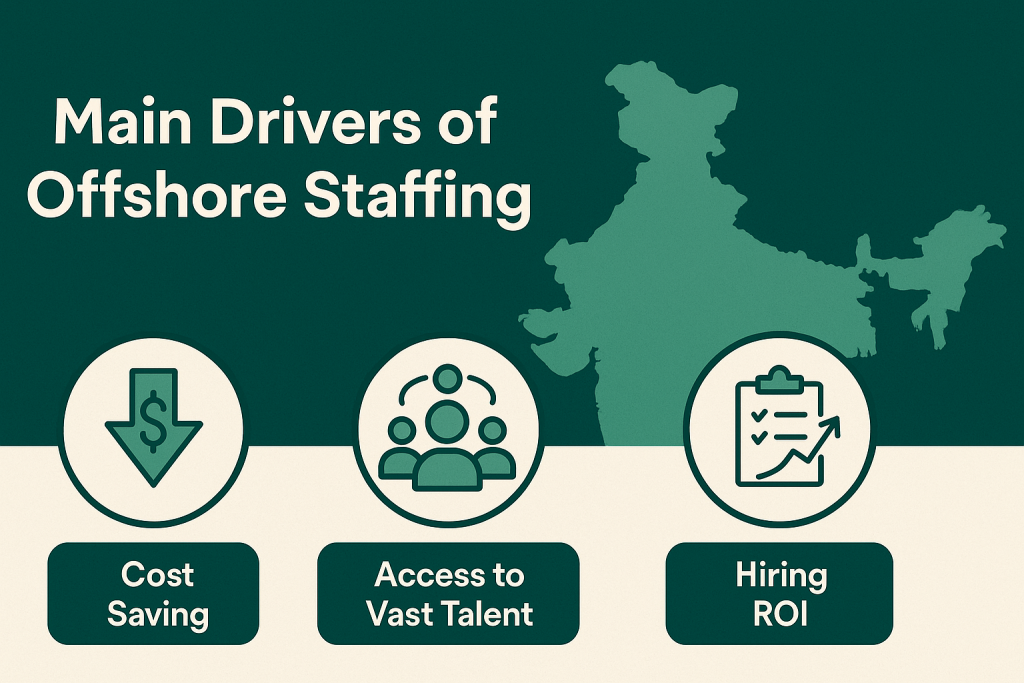
Companies are increasingly adopting offshore staffing models to reduce costs, access untapped talent pools, speed up hiring, and improve return on investment (ROI). Neuhire offers a compelling case: remote staffing from India not only cuts expenses, but also improves hiring ROI by delivering measurable business value and faster time to productivity.
In this article, we explore the main drivers behind this shift, explain how hiring ROI should be calculated, and show how Neuhire’s approach aligns with high ROI strategies.
Main Drivers Motivating the Shift to Offshore Staffing
1. Significant Cost Optimization
One of the principal attractions is the ability to lower labor and operating costs by 30–70 percent relative to in-country staffing, depending on role and location.
By offloading administrative overhead, facilities, benefits, and compliance burdens, companies can reallocate capital to core innovation and growth.
2. Access to a Vast, Skilled Talent Pool
Many developed markets suffer from shortages in specialized domains such as AI, data science, cybersecurity, and full-stack development. Offshore staffing opens up access to large, high-quality talent pools in India, enabling access to niche skills at scale.
3. Speed and Flexibility in Scaling Teams
Offshore vendors often maintain candidate pipelines and scalable processes, allowing businesses to spin up teams quickly for new projects or expansions. This flexibility is especially useful in tech, startups, and product development cycles.
4. Focus on Strategic Functions
By moving operational, support, or mid-level technical tasks offshore, in-house teams can concentrate on differentiation, leadership, customer experience, and growth initiatives.
5. Business Continuity and 24/7 Capability
Due to time zone offsets, offshore teams can continue working while onshore teams sleep. This enables follow the sun workflows, continuous progress, and faster turnaround in global operations.
6. Mitigating Talent Scarcity in Local Markets
In many regions (especially the United States, the United Kingdom, and parts of Europe), competition for tech and domain specialists is intense, and salaries are rising steeply. Offshore staffing bypasses that scarcity and cost inflation.
7. Compliance, Infrastructure and Technology Access
Established offshore providers often bring infrastructure, security, collaboration tools, and compliance capabilities such as data protection, IP safeguards, and labor law expertise. This reduces the burden on the client organization to build these capabilities in-house.
8. Post-Pandemic Remote Work Acceptance
Since remote and hybrid work models became normalized, offshore staffing is viewed less as outsourcing and more as an extension of distributed teams. Collaboration tools, asynchronous workflows, and remote management practices have matured.
What Is Hiring ROI (Return on Investment) and Why It Matters
Hiring ROI measures how effectively an organization’s investment in hiring contributes to actual business value. It goes beyond cost per hire or time to fill by evaluating how much return (in productivity, revenue, cost savings, or strategic impact) is generated by new hires.
How to Calculate Hiring ROI (Common Frameworks)
A common formula:
Hiring ROI (%) = (Value Delivered by New Hire – Total Cost of Hiring) ÷ Total Cost of Hiring × 100
- Total Cost of Hiring includes recruitment marketing, sourcing, interviews, assessments, onboarding, training, benefits, and infrastructure.
- Value Delivered can be measured in productivity gains, revenue generation, cost savings, or strategic contributions over a period.
Key Metrics That Influence Hiring ROI
- Time to Productivity: How quickly a new hire becomes fully productive.
- Quality of Hire: Measured via performance reviews, retention, and cultural fit.
- Turnover or First Year Attrition: Early resignations severely erode ROI.
- Offer Acceptance Rate: Low acceptance wastes recruiting investment.
- Application Completion and Drop off Rates: High drop off means lost investment in candidate acquisition.
Improving these metrics directly boosts hiring ROI.
How Neuhire Positions Around Hiring ROI
Although the full data from Neuhire’s “Hiring ROI” page was inaccessible, the public summary indicates that Neuhire emphasizes ROI-driven staffing solutions from India.
Here is how Neuhire’s model aligns with maximizing hiring ROI:
- Lower Input Costs: By leveraging India’s cost advantages, Neuhire helps reduce the “Total Cost of Hiring” denominator, making ROI more favorable.
- Faster Ramp Up: Neuhire speeds up hiring and scaling, which improves time to productivity and increases the numerator (value delivered) more swiftly.
- Scalable Remote Teams: Their model allows scaling teams for short or long durations, matching supply to demand and reducing overstaffing.
- Domain Expertise and Pre Vetted Talent: Pre screened professionals reduce the risk of mismatch, improving quality of hire and lowering turnover risk.
Illustrative Example: How Hiring ROI Can Work in Practice
Let’s run a hypothetical scenario for a software engineer:
- Total cost of hiring (recruitment, onboarding, salary, benefits for first year): USD 30,000
- Value delivered in first year (revenue, cost savings, productivity): USD 60,000
Then:
Hiring ROI = (60,000 – 30,000) ÷ 30,000 × 100 = 100 percent
So for every dollar invested in that hire, the company gained another dollar in net value. By reducing cost of hiring through Neuhire’s offshore model or by accelerating productivity, ROI improves further.
Combining Offshore Staffing Drivers with Hiring ROI
The reasons companies switch to offshore staffing (cost, speed, talent access, continuity) are not isolated from ROI. They directly influence ROI improvements when implemented well.
- Lower cost base reduces the denominator
- Faster ramp and higher performance increase the numerator
- Pre vetting and retention initiatives minimize losses from turnover
- Flexible scaling reduces over investment or idle capacity
In essence, offshore staffing improves ROI across both sides of the equation.
Best Practices to Maximize Hiring ROI in Offshore Models
- Define measurable goals up front (revenue targets, process improvements).
- Use milestones and performance metrics early (30/60/90 day goals).
- Track real productivity rather than just time employed.
- Invest in onboarding and alignment so remote staff integrate quickly.
- Monitor retention closely, since early exits can undermine ROI.
- Use data and feedback loops to adjust hiring models.
- Link hires to business outcomes such as feature delivery or cost savings.
Key Takeaways
- Companies shift to offshore staffing to reduce costs, gain global talent access, increase speed, and maintain 24/7 operations.
- Hiring ROI connects hiring investment to business returns.
- Neuhire’s remote staffing model from India delivers ROI by lowering costs and accelerating productivity.
- Key levers include time to productivity, quality of hire, turnover rates, and alignment with strategic goals.
Conclusion
Switching to offshore staffing models is not just about lowering costs. It is about creating sustainable, high return talent strategies. Offshore staffing becomes a multiplier for hiring ROI when structured intentionally.
If you want to explore how Neuhire can deliver measurable hiring ROI for your business, contact Neuhire team today for a customized ROI forecast.

Marketing professional with a passion for people, creativity, and growth. I love turning ideas into campaigns that connect and inspire. Currently part of the Neuhire team, helping businesses find the right talent fast.
Marketing professional with a passion for people, creativity, and growth. I love turning ideas into campaigns that connect and inspire. Currently part of the Neuhire team, helping businesses find the right talent fast.

Marketing professional with a passion for people, creativity, and growth. I love turning ideas into campaigns that connect and inspire. Currently part of the Neuhire team, helping businesses find the right talent fast.