

Why U.S. and European Companies Are Shifting to Offshore Staffing Services
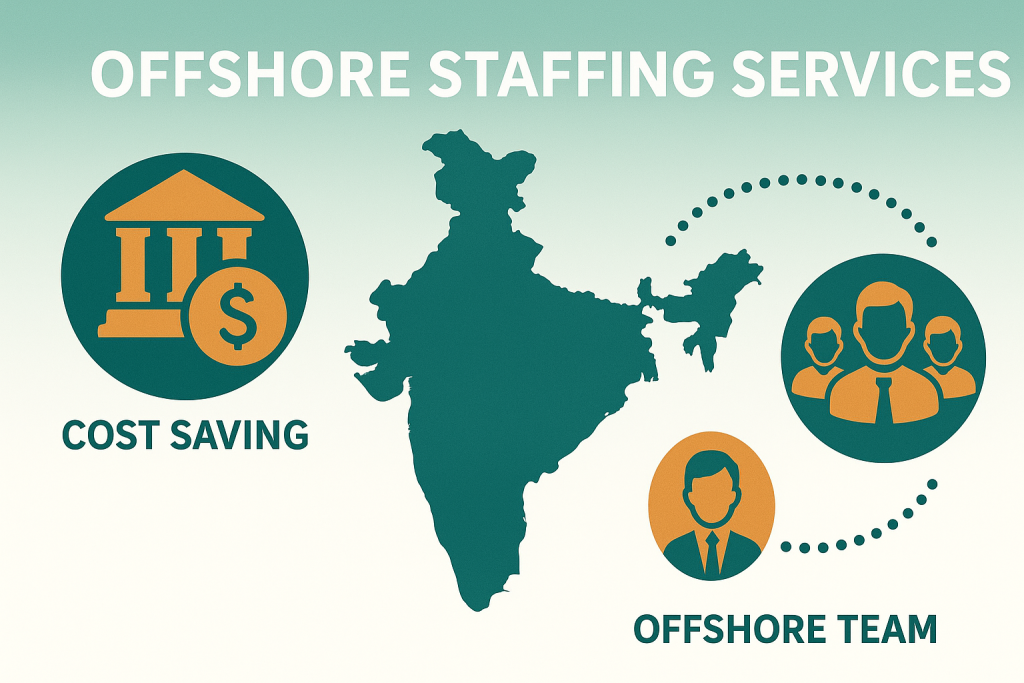
According to Forbes (2024), 66% of U.S. companies now outsource at least one department, with approximately 300,000 jobs being offshored each year. Offshore staffing agencies enable organizations to tap into regions with a surplus of specialized skills while reducing payroll costs and administrative burdens.
Key Offshore Staffing Statistics
- Forbes (2024): 66% of U.S. firms outsourced at least one department, resulting in about 300,000 jobs moved overseas annually.
- Statista (2023): The global staffing industry reached $650 billion in revenue in 2022, reflecting both domestic and offshore staffing growth.
- Deloitte (2024): Asset management firms adopting flexible, hybrid, and remote work models (including offshore talent pools) see 74% less employee stress and 50% higher productivity.
- Statista (2023): Global IT outsourcing spend hit $132 billion, with 37% of IT operations managed by external (often offshore) agencies.
What Is Offshore Staffing?
Offshore staffing refers to hiring qualified employees from foreign countries, usually via specialized offshore staffing agencies, to fill roles traditionally held in domestic offices. These staff can be dedicated remote employees or managed teams deployed for functions such as IT, customer service, payroll, or marketing.
Top Reasons Why Businesses Choose Offshore Staffing Services
1. Lower Labor Costs and Operational Savings
Offshore staffing helps companies reduce wage expenses, overhead, and taxes. Labor costs in popular offshore markets like India and the Philippines can be 60–70% lower than in the U.S. or Europe.
2. Access to Global Talent and Specialized Skills
Offshore agencies provide direct access to a pool of highly trained professionals such as software engineers, data analysts, and financial experts that may be in short supply domestically.
3. Scalability and Flexibility
Offshore staffing allows rapid scaling without increasing office space, infrastructure, or in-house HR teams. Companies can ramp up or down quickly according to project demands or seasonal requirements.
4. Enhanced Process Efficiency
Outsourcing repetitive or administrative tasks streamlines workflows, allowing domestic teams to focus on strategy and innovation.
How Offshore Staffing Agencies Work
- Agencies source, screen, and manage overseas talent for client companies.
- They provide payroll, compliance, and HR support, reducing legal complexity for the client.
- Offshore teams can be fully remote or operate from dedicated agency offices.
Case Study: Offshore Staffing Drives Business Growth
A mid-sized U.S. marketing firm struggling with local talent shortages partnered with an offshore staffing agency for campaign management.
Results included:
- 40% reduction in payroll costs.
- Improved campaign turnaround times.
- Access to creative talent not available locally.
- Increased profit margins and business scalability.
Pros and Cons of Offshore Staffing Services
Pros:
- Substantial cost savings.
- Greater access to skilled talent.
- Improved business agility.
Cons:
- Potential cultural and time zone challenges.
- Data security concerns.
- Less direct oversight of staff.
What’s Driving the Offshore Staffing Trend?
1. Remote Work Adoption
Deloitte (2024) found that investment management firms with flexible, hybrid, and remote work arrangements (often leveraging offshore talent) reported higher employee engagement and lower attrition than those mandating full-time office presence.
2. Digital Transformation and Tech Skills Gaps
With IT roles comprising 37% of all outsourced functions in 2023, digitalization has made offshore staffing a necessity for many organizations facing local skills shortages.
3. Economic Uncertainty and Cost Pressure
Firms are prioritizing efficiency amid inflation and global uncertainty, seeking offshoring solutions to boost productivity and preserve margins.
Key Takeaways / Quick Facts
- 66% of U.S. companies outsource at least one department (Forbes, Oct 2024).
- The global staffing industry earned $650 billion in 2022 (Statista, Dec 2023).
- Offshore staffing can reduce employee costs by up to 70%.
- Remote or hybrid models using offshore teams lower stress and raise productivity by 50% (Deloitte, June 2024).
- IT outsourcing now accounts for 37% of IT budgets worldwide (Statista, 2024).
Comparison Table: Offshore vs. Onshore Staffing
| Factor | Onshore Staffing | Offshore Staffing |
|---|---|---|
| Labor Cost | High | Low |
| Talent Availability | Regional limits | Global access |
| Scalability | Slower | Faster |
| Compliance Handling | Local only | Managed by the agency |
| Communication | Real-time | Time zone gaps |
Offshore Staffing Services: Best Practices
How to Succeed With Offshore Staffing Agencies
- Select experienced, reputable agencies with strong compliance records.
- Define clear expectations, KPIs, and communication protocols.
- Invest in cross-cultural training and collaboration tools.
- Protect data and intellectual property with robust contracts.
- Continuously review performance and address challenges proactively.
What Is an Offshore Staffing Agency?
An offshore staffing agency is a third-party provider that recruits, manages, and supports remote employees in foreign countries for businesses seeking cost-effective, scalable staffing solutions. Such agencies handle payroll, HR, compliance, and administrative tasks, allowing companies to focus on core business activities.
Real-World Examples of Offshore Staffing Success
- Global brands like IBM, Microsoft, and Deloitte source specialized skills from major offshore talent pools including India, the Philippines, and Eastern Europe.
- According to Forbes (Nov 2024), high-growth startups report quicker scaling and product launches by leveraging offshore marketing and IT teams.
- Healthcare leaders optimize costs by offshoring non-clinical functions, as noted in Deloitte’s 2025 outlook.
How Offshore Staffing Supports Remote and Hybrid Work Models
Deloitte’s research indicates that self-selected work environments (including offshore and remote teams) improve employee happiness, energy levels, and productivity. Companies using offshore talent pools are more resilient and effective in transforming workplace culture.
Future Outlook for Offshore Staffing Services
Given ongoing economic challenges and rapid digitalization, the offshore staffing market is predicted to expand even further. Statista forecasts the global IT outsourcing market will grow by $812.7 billion by 2029. U.S. and European enterprises will increasingly integrate offshore staffing services for their critical growth strategies.
Key Takeaways
- Offshore staffing adoption is accelerating across multiple sectors.
- Agencies help companies save money, scale faster, and access hard-to-find talent.
- Firms with flexible work models leveraging offshore employees show increased productivity and retention.
- IT and business processes dominate offshored functions.
Conclusion
The shift to offshore staffing services empowers U.S. and European companies to remain competitive in a global market while reducing labor costs and gaining access to specialized talent. With the rise of offshore staffing agencies, businesses can build agile teams that drive innovation and growth.
For organizations seeking tailored offshore staffing solutions, contact Neuhire to discover how strategic talent partnerships can transform your business future

Marketing professional with a passion for people, creativity, and growth. I love turning ideas into campaigns that connect and inspire. Currently part of the Neuhire team, helping businesses find the right talent fast.

Marketing professional with a passion for people, creativity, and growth. I love turning ideas into campaigns that connect and inspire. Currently part of the Neuhire team, helping businesses find the right talent fast.